
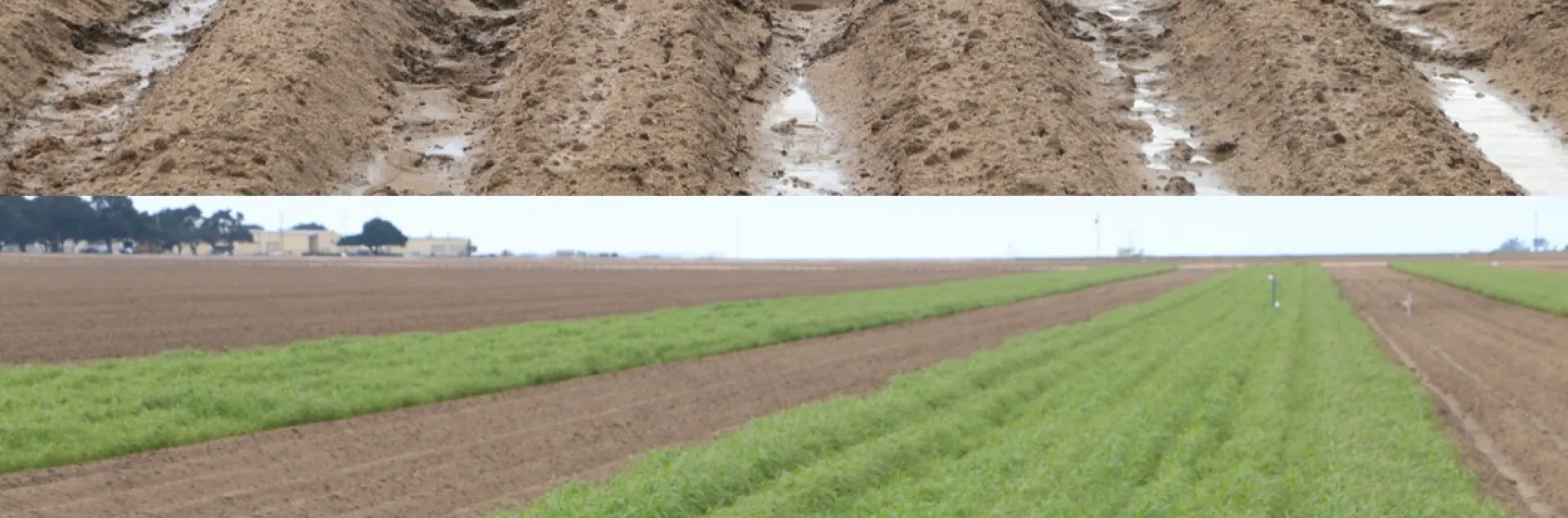
There has been much discussion in the media about a potentially high rainfall winter in California due to strong El Niño conditions in the eastern Pacific Ocean. El Niño is characterized by above normal sea surface temperatures, which can change weather patterns and translate into increased atmospheric river storms in the winter that cause intense rainfall rates on the West Coast. On some soil types such as found on the east side of the Salinas valley, high rainfall rates lead to significant runoff, soil erosion and flooding. However, greater than normal rainfall provides an opportunity to infiltrate and store more moisture in the soil profile, leach out salts, and increase aquifer recharge. Cover cropping is a critical management practice for maximizing infiltration of winter rainfall, reducing runoff and soil erosion.
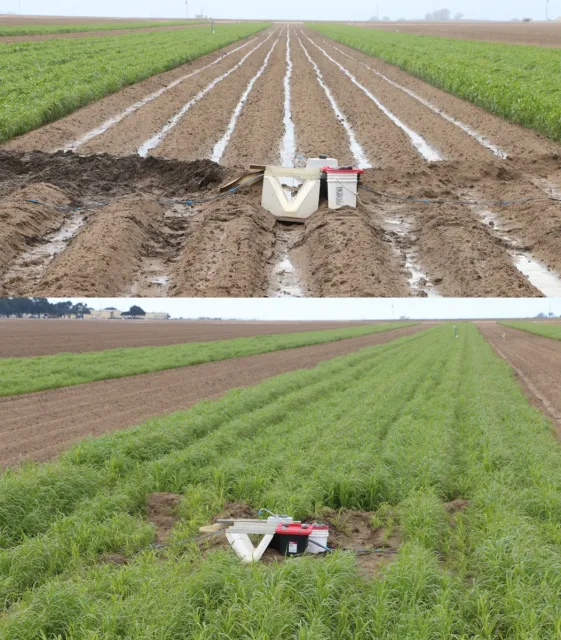
Last winter we conducted a cover crop trial in a vegetable field on the east side of the Salinas valley comparing runoff, rainfall infiltration, and erosion between bare fallow and cover crop planted plots. The field site was on a Gorgonio sandy loam soil with a 2% slope. Sudangrass (cv. Piper) was seeded on 40-inch-wide listed beds and in the furrows in late September. Sudangrass grows best in warm conditions, so growth slowed by late November as weather cooled, which limited the above ground biomass to 0.85 tons of dry matter per acre by mid-December. Plots measured 8 beds in width and were the length of the field (1650 ft), about 1 acre in area, and treatments were replicated 3 times. Flumes were positioned at the lower end of the plots to monitor runoff volume and collect water samples during runoff events using automated sampling equipment (Fig 1). A rain gauge was installed to monitor rainfall at 15-minute intervals during the fall and winter.
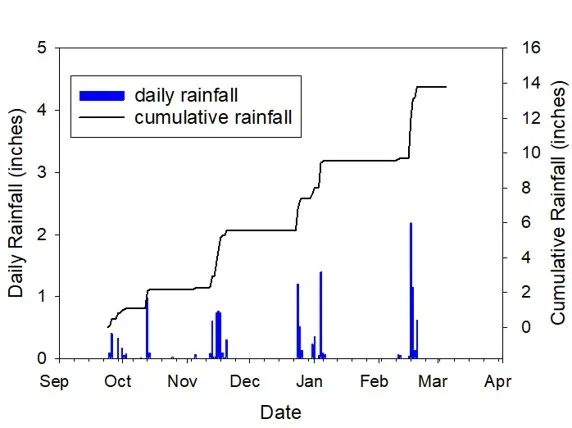
Total rainfall was 13.8 inches from the end of September 2025 to the beginning of March 2026 (Fig. 2), which was close to the long-term average for the region. Much of the precipitation occurred during three atmospheric river events in November, January, and February each contributing 2 to 4 inches to the cumulative rainfall. Runoff was monitored from November 12 – March 6 which corresponded to a total of 11.6 inches of rainfall.
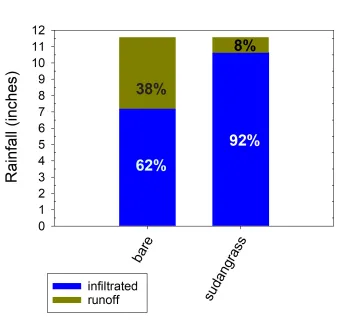
On average, the cover crop plots infiltrated 92% of the rainfall during the period of monitoring compared to 62% in the bare plots, and reduced runoff by 79% (Fig 3). The cover cropped plots infiltrated an average of 3.4 more inches or 48% more rainfall compared to the bare plots. Applying this cover crop strategy over 400 acres could have potentially contributed an additional 115 acre-feet of recharge to the aquifer compared with maintaining fields bare during the winter.
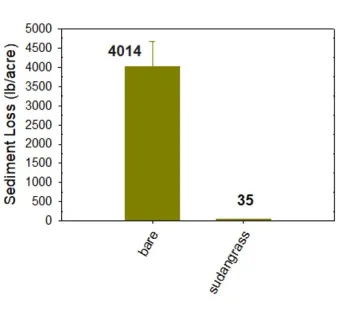
The cover cropped plots also greatly reduced suspended sediment concentration in the runoff (Fig.4). During the winter a total of 4014 lbs of sediment per acre was lost from the bare plots compared to 35 lbs per acre in the cover cropped plots (Fig 5). The combined effect of reduced volume of runoff and low suspended sediment concentration resulted in an average reduction in soil erosion of 99% in the cover crop plots compared to the bare plots.
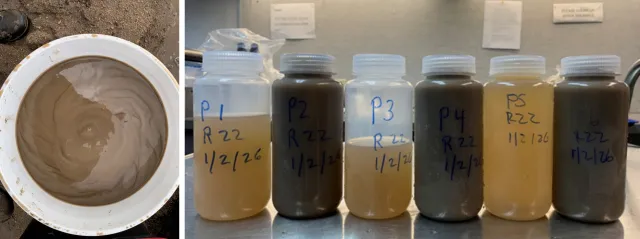
Although it is well known that cover crops can reduce runoff and soil erosion, less information is available about the extent to which this practice can help on soil types susceptible to crusting and runoff such as found on the east side of the Salinas Valley. Similar amounts of soil erosion were measured in bare plots in a winter cover crop trial that we conducted in a vegetable field on the west-side of the Salinas Valley in 2024. We observed that the suspended sediment concentration sampled in storm runoff consists mainly of clay and silt size particles that do not easily settle out and are likely permanently lost from the fields during large runoff events (Fig 4.) In other words, about 2 tons per acre of clay and silt size soil particles were likely lost from the field site last season. Analysis of sampled suspended sediment indicated that they contained 3% to 5% organic carbon. Calculated in units of organic matter (%C x 1.7) an average of about 200 lbs per acre of organic matter were lost in the bare plots compared to an average of 3 lbs per acre lost from the cover cropped plots (Fig 6). In addition to preventing the loss of soil organic matter, the cover crop also contributed more than 1000 lbs/acre of organic matter to the soil when it was incorporated into the beds in March 2026.
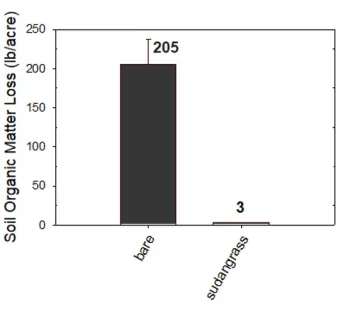
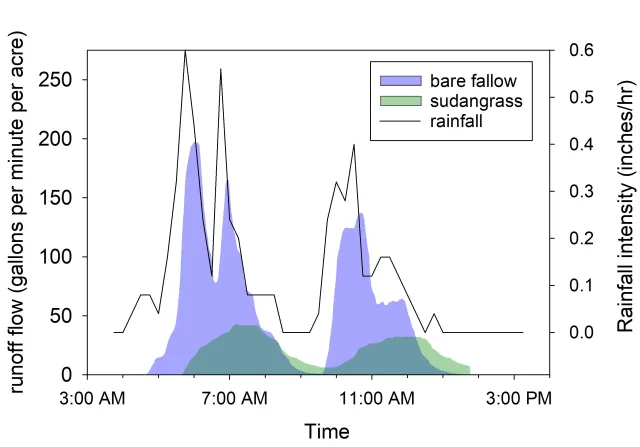
Figure 7 illustrates why the cover crops are so effective in reducing runoff and soil erosion. The line plot shows rainfall intensity during a storm event on January 4th, 2026. As the rain intensity reached more than 0.5 inches per hour at 6 am the runoff flow rate from the bare plot immediately spiked to almost 200 gallons per minute per acre. Meanwhile the onset of runoff lagged in the sudangrass plot which reached a peak flow of 40 gallons per minute per acre after 7 am. With a lower flow rate, less sediment became suspended in the runoff and because less volume of runoff occurred in the cover cropped plot much less soil eroded compared to the bare plot.
Incorporation of the Sudangrass cover crop into the beds was timed to allow more than a month for the residue to decompose before planting the subsequent lettuce crop. Some planning is required to ensure that the cover crop biomass can be incorporated without binding up in the tillage equipment. Sudangrass, being a warm season species, will normally die under frost conditions; however, the weather was warmer than normal in the fall and winter and the air temperature never dropped below 0 °C (freezing). Because of the warmer than expected conditions, the cover crop was flail mowed in mid-December to limit the aboveground biomass. In mid-January glyphosate was applied to kill the cover crop as well as any weeds that had been established. Finally, in March the cover crop residue was bed incorporated with two passes with a Lilliston cultivator. Before seeding the beds were shaped with a rototilling mulcher.
Conclusion
The results of this trial demonstrated the feasibility of managing low biomass cover crops on beds and potential efficacy of this practice for controlling runoff and erosion, and increasing aquifer recharge during wet winters, especially on soil types and slopes susceptible to runoff.
This trial was conducted in a bedded vegetable field rather than on flat ground. Except for late spring plantings, most vegetable ground in the Salinas Valley is listed into beds before winter. To achieve a much greater acreage of winter cover crops we need strategies to plant, grow and incorporate cover crops on listed beds in a manner that is relatively easy to manage and does not greatly add to production costs. Part 2 of this article discusses strategies for using cover crops on beds and what to consider to be successful.
Acknowledgements: This project was funded by the California Leafy Green Research Board