
In our previous article (part 1), we discussed how low biomass cover crops planted in bedded fields can greatly reduce runoff and soil erosion during winter storms and increase aquifer recharge. Though growing cover crops on flat ground is easier to manage than in bedded fields, fields suitable for this practice are limited in the Salinas Valley as most fields are listed into beds in the fall before storms arrive so that a vegetable crop can be planted in late winter and early spring. This article offers some tips and strategies for planting and growing low biomass cover crops on bedded fields.
Furrow, bed top, and furrow and bed planted cover crops
Planting a cover crop in furrows and on beds maximizes soil covered by vegetation and is probably the best approach to mitigate storm water runoff. However, other factors may influence whether to plant just the furrows or just the bed tops. First, the seeder or grain drill may be best suited for planting on bed tops or in furrows. Furrow planted cover crops may be preferred to avoid incorporating residue into the bed tops. Either strategy should help control runoff. Vegetation in furrows will slow the flow of runoff, which can increase infiltration, settle out suspended sediments, and result in cleaner and less runoff volume. Vegetation on bed tops protects soil from the impact of rain drops which minimizes sealing or crusting of the soil surface. Because a cover crop helps keep soil particles aggregated rain can infiltrate rather than run off into the furrows, reducing erosion and the volume of runoff.
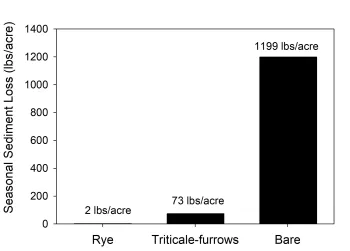
Previous research comparing a furrow-planted low biomass cover crop with a full bed and furrow cover crop showed better runoff control from the full cover crop strategy but both practices provided very large reductions in erosion compared to the bare (unplanted) treatment (Fig. 1). Planting just the ends of the furrows can slow runoff and may help drop out some of the suspended sediment but it may not be effective during intense storm events since much of the field is bare, which will result in a large volume of runoff carrying a high load of sediment. The short length of furrow planted with cover crop would only be able to drop out a small portion of the suspended sediment.
Species
The main species that have been evaluated for low biomass cover crops in the Salinas Valley have been winter cereal species (Cereal rye, Barley, Triticale), warm season species (Sudangrass, Sorghum Sudan hybrid), and Mustard species (Sinapis alba cv Ida Gold, Pacific Gold). The warm season species (Sudangrass and Sorghum Sudan hybrid) should be planted at least a month before the weather cools, ideally in late September until early October. The benefit of using these warm season species is that growth is limited by the cold weather in the winter, so they are less likely to accumulate too much biomass. Freezing temperatures will kill or severely set back these species. However, the need to plant early means that they will must be irrigated several times for germination and establishment and at least one selective herbicide application is usually needed to control emerging weeds. Winter cereal species can be planted later in the fall than the warm season species (late October – early December). Planting can be timed before upcoming rain events or soon after a rain event to avoid the need for irrigation. Unlike Sudangrass and Sorghum Sudangrass, cold weather will not stop the growth of winter cereals, and they must be terminated before they develop too much biomass. Also, they should be terminated before the stems become lignified or the biomass may be difficult to incorporate into the beds. Mustard species can be planted throughout the fall period. They also need to be terminated before they develop excessive biomass. They suppress weeds well and can be mechanically killed with a flail mower and are well suited for organic systems. In contrast to winter cereals, the stems of mustard cover crops are less lignified and decompose quickly once incorporated into the beds. There are additional species that we have not yet trialed as low biomass cover crops. For example, Phacelia was demonstrated to have potential as a low biomass cover crop planted on beds in the 1990’s. If you are unfamiliar with growing a species as a low biomass cover crop in a bedded field, it is best to start with a single strip in the field and develop an understanding of how it grows and the requirements for planting, termination, and incorporation of the biomass before planting a large area.
Seeding strategies
Planting cover crop seed at the optimal depth is important for fast germination and emergence which can help suppress weeds and reduce the need for high seeding rates. Ideally, Sudangrass and Sorghum Sudangrass hybrid seed are planted at a depth 1/2 to 3/4 inches. Ideally, winter cereals should be planted at 1 to 1.25 inch depth. Mustards, which are small seeded, should be planted at 1/2 inch depth.
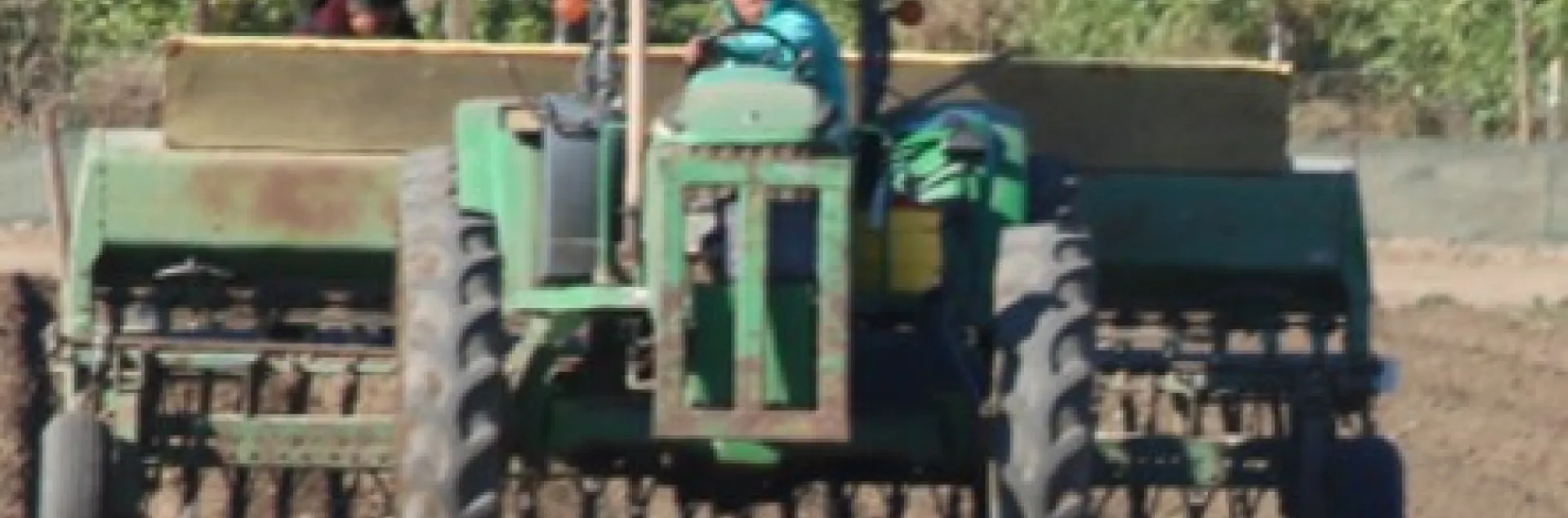
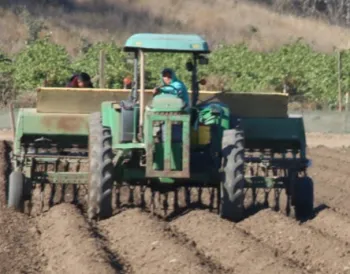
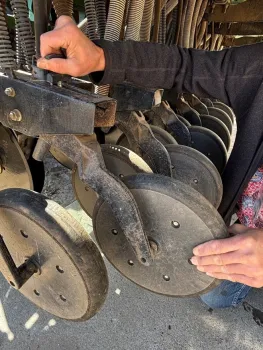
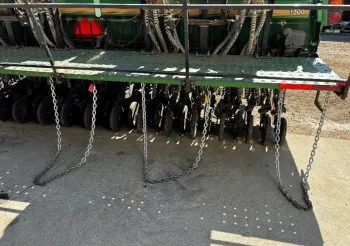
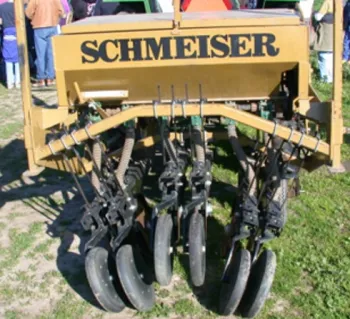
The most used implement to seed cover crops is a grain drill (Fig. 2). They work well on flat ground but on undulating surfaces, such as bedded fields, they may need to be modified so that the seed is planted at the correct depth. Planter shoes that can be individually adjusted allow the planting depth to be optimized for the height of the furrow, shoulder and top of the bed (Fig. 3). Even with this ability to adjust the depth of the shoes, some seed may be planted too shallow in the furrows and too deep on the top of the beds. Flattening peaked beds with a roller can help improve the control of seed depth. Also dragging chains behind the planter shoes located in the furrows ensures that seeds are buried (Fig. 4). The tool bar can also be modified so that the planting shoes are at varying heights which correspond better to the soil terrain (Fig. 5). To plant only furrows or bed tops, modifications can be made to a grain drill such as covering the outlets at the bottom of the hopper with duct tape so that seed does not drop into shoes on the bed top.
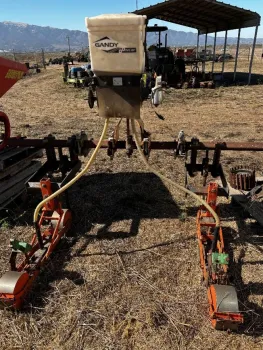
Another approach to planting only furrows or bed tops is to use Gandy boxes mounted on a tool bar (Fig. 6). The main limitation to using a Gandy box is that they are typically motor driven so the tractor speed must be considered in calibrating the seeding rate. Also, the hoppers have limited capacity and therefore are best suited for small, seeded cover crops or planting only furrows.
Germination water
Applying water with overhead sprinklers assures that the cover crop seed will germinate but adds cost. Often a rainstorm in the fall will be sufficient for germinating a newly planted field. If a rain event has recently occurred and the weather has cooled down, cover crops can be germinated without irrigation by planting at a depth that places the seed in moist soil. If planting into dry soil, usually one or two sprinkler irrigations are needed to keep the seed moist until it germinates. It is important to watch the weather when determining when to remove the sprinkler pipe from the field. If an abnormally warm period is forecasted, then leaving the sprinkler pipe longer in the field is prudent. If a period of rain is forecasted removing the pipe would be advisable since the field may become too wet to enter with a tractor.
Weed control
Along with the cover crop, weeds will emerge. Early fall planted cover crops are likely to experience greater weed pressure than a cover crop planted in late fall, since the days will be shorter and temperatures will be cooler. High seeding rates are often used so that the cover crop shades out emerging weeds. Anywhere the cover crop does not emerge or was not planted will likely have weeds. For conventional vegetable fields, a selective post-emergent herbicide can be used to remove weeds. For example, an application of Bromoxinil (Buctril/Maestro) and Carfentrazone-ethyl (Shark) made 30 days after germinating Sudangrass was very effective in killing emerged broadleaf weeds. It is important to control weeds so that they do not develop viable seed. Cultivating unplanted bed tops or furrows or timing the termination of the cover crop to kill the weeds before they go to seed are strategies to consider. Smart sprayers could also be used to selectively kill weeds within a cover cropped field.
Terminating the cover crop
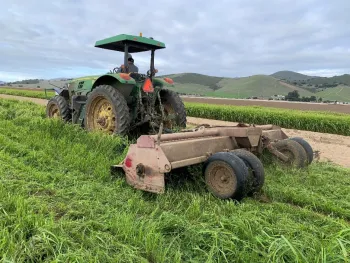
Termination of the cover crop should be timed to limit biomass to less than 1 ton of dry matter per acre. The runoff and erosion control benefits of a cover crop do not require a lot of biomass, so staying on the conservative side (< 0.5 tons of dry matter per acre) may be wise depending on the cover crop species and how soon the vegetable crop needs to be planted. Termination should be timed at least 1 to 1.5 months before the planting date of a vegetable crop. Extra time may be needed to kill the cover crop when applying an herbicide such as glyphosate during cold weather. Also, time may be required for the residue to breakdown before incorporating it into the bed. While winter cereals will need an herbicide application to kill them, Sudangrass and Mustard species can be mechanically killed by a combination of flail mowing (Fig. 7) and a few passes with a Lilliston cultivator (Fig. 8) or bed discs.
Access to the field during a wet period in the winter can be problematic for applying herbicide using a ground rig and has been a major concern of growers when considering bed planted low biomass cover crops. However, the recent availability of agricultural drones for spraying pesticides greatly reduces the risk that the cover crops cannot be terminated in a timely manner.
Incorporating cover crop biomass into beds
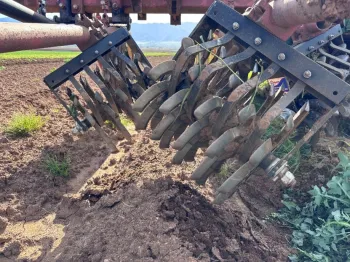
Incorporating the cover crop biomass into the beds can be done in a single operation or spread out over several tillage operations. If the residue has had time to decompose and break down after it is terminated, a pass with a Lilliston cultivator may be sufficient to incorporate the remaining biomass into the soil before bed shaping. More lignified material may first need to be flail mowed to chop it into small pieces or passed over with an implement with bed discs (eg. Sundance) which can cut and mix the material with the soil. Incorporating the cover crop in phases can manage weeds while leaving sufficient residue on the surface to help control runoff. A first pass with a Lilliston can remove weeds and incorporate a portion of the biomass. Residue remaining on the soil surface will help mitigate runoff if more rain events occur.
Summary
Whether or not this winter brings large rain events from the El Niño weather pattern, consider trying low biomass cover crops planted in bedded fields. You can plant just the furrows, bed tops, or both. Potentially, this practice could greatly increase the vegetable acreage that is planted with cover crops on the central coast. In addition to reducing runoff, erosion, and increasing aquifer recharge, low biomass cover crops can add organic matter to the soil and potentially prevent beds from washing out during large rain events so that they are ready to plant in late winter and early spring. The specific strategy will depend on many factors such as soil type, weed pressure, planting date, etc. so it is wise to begin experimenting in a small area before scaling up. Also, we are happy to assist and offer suggestions on how to make this low biomass cover crop strategy more successful for your farming operation.
Acknowledgements: This project was funded by the California Leafy Green Research Board