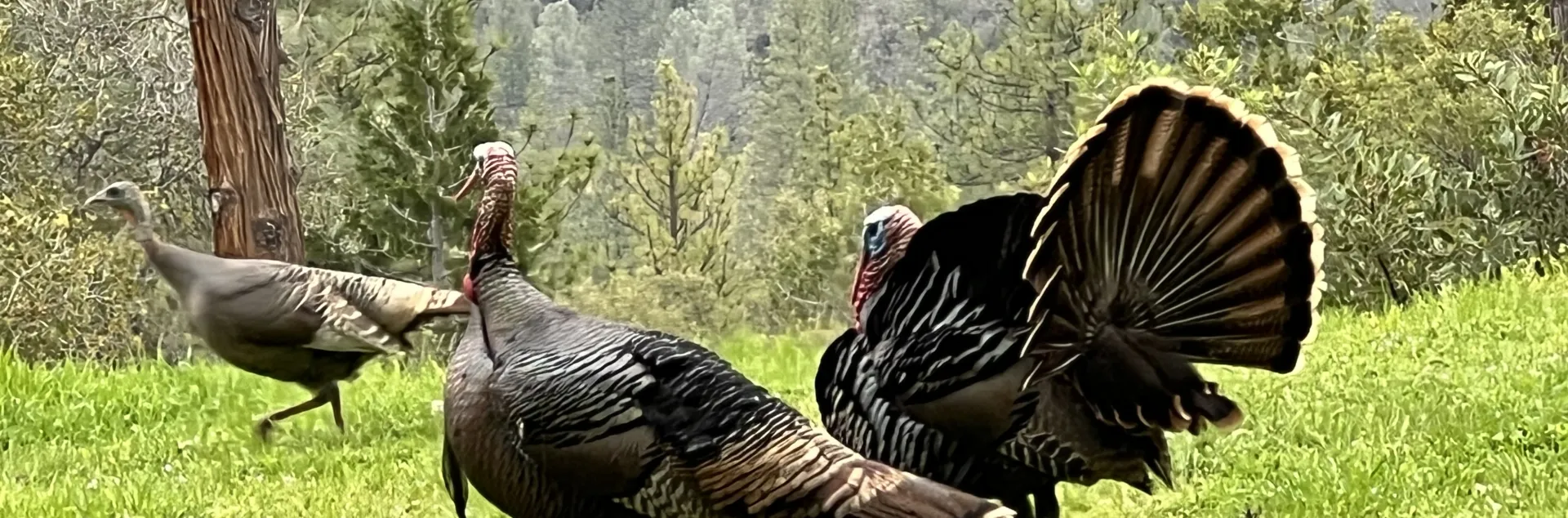
Turkeys are synonymous with Thanksgiving, being the star of the November feast for over 150 years. However, the domesticated turkeys that grace our tables are not the same as the wild turkeys that often symbolize Thanksgiving.
Domesticated Turkeys
While they belong to the same species (Maleagris gallopavo) the domesticated, processed turkey we feast on have a very different lifestyle from wild turkeys. Domesticated turkeys are selectively bred and are raised in sedentary, controlled indoor environments with specialized diet and care. They typically have solid white feathers, are much heavier, walk awkwardly due to being so oversized and cannot fly. Their meat is mild, tender, and generally juicy. While not as brainless as myth has it, they are considered far less intelligent than their wild counterparts.
Wild Turkeys
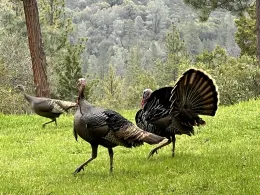
Wild turkeys are large, distinctive outdoor birds with colorful, rich iridescent brown, bronze, and black feathers which provide camouflage. They are members of the Galliformes order, heavy-bodied, ground-feeding terrestrial birds which include chickens, pheasants, grouse, and quail. They roam freely during the daytime, foraging on seeds, berries, acorns, insects, spiders, grubs, mice, and flowering plants by scratching the ground, disturbing the soil and leaf litter. They have keen eyesight, can fly up to 55 mph for short bursts and run up to 25 mph. Wild turkey meat has an intense, rich, flavor with a bit of gaminess.
As any experienced wild turkey hunter knows, these are smart birds who can escape their predators and survive in virtually any situation due to innovative problem-solving skills. They have exceptional memory, remembering and recognizing specific individuals, including birds and humans. Their communication system is not just “gobble, gobble, gobble” since they have a variety of unique vocalizations.
History
Like the bald eagle, the wild turkey is an iconic American species. It was a part of the Native Americans’ diet for centuries and helped sustain Europeans during the early days of colonization in the 1600s. At that time, their population was estimated to be 10 million birds. By 1900, due to development, habitat loss, timber harvesting, and overhunting, they had been reduced to about 30,000. Thanks to conservationists, including President Theodore Roosevelt, protected areas were created, game laws passed, and today their population is approximately 6 million.
Where Found
Wild turkeys live across much of North America, including most of the United States, parts of southern Canada and Mexico. They are found in woodlands foraging during the daytime in adjacent meadows, agricultural fields, and grasslands. Nighttime is usually spent above the ground in trees. Turkeys move around following food availability as the seasons change.
Being omnivores and highly adaptable, they have been expanding to human-altered landscapes in recent decades. Suburban parks, neighborhoods, golf courses, greenbelts, wooded lots, stream corridors and undeveloped land all provide areas turkeys can exploit.
Though not native to California, due to several attempts to establish populations there are now wild turkeys in the state with a population of around a quarter million birds made up of two subspecies: The Rio Grande subspecies (M.g. intermedia) are found throughout the state’s oak woodlands, urban areas and agricultural land, and the Merriam’s turkey (M.g. merriami) who are limited to coniferous forests in mountainous regions.
Mating and Nesting Habits
Wild turkeys are a flocking, social species who breed in the spring. Males are polygamous, often courting in groups, displaying to several females by strutting with wings and tails flared.
After mating, the hens tend to go off by themselves to a safe nesting site on the ground, which are covered in tall grass or shrubs that hide both the hen and eggs. The hen will lay one egg per day for a full complement of 9 to 13 eggs. Once the egg-laying is completed, incubation is about 28 days, with all the eggs hatching at the same time. Newly hatched turkeys, called poults, leave the nest within 12-24 hours of hatching and can fly in 10 days. Poults eat almost exclusively insects for the first couple weeks, gradually adding seeds and fruits. Mortality of the poults due to predators is greatest during the first 14 days.
Problems
Wild turkeys in urban and suburban areas can be a nuisance due to being annoying, destructive, and aggressive. As their populations have grown, so have human-turkey conflicts. They can cause traffic hazards and congestion when crossing streets. They may foul roads and sidewalks with their droppings. During breeding season, they occasionally charge or threaten people. They can destroy gardens, including raised beds, landscape plants, and turf.
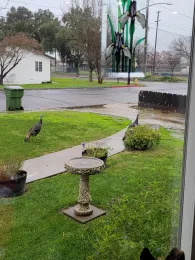
Wild turkeys are protected and managed by the California Fish and Game Commission through laws and hunting regulations. Feeding them is illegal since it can lead to them becoming complacent and dependent on humans.
Managing problem turkey groups may require agreement between community members and collaboration with local state or federal Fish and Wildlife services. Since wild turkeys are likely here to stay, management activities usually focus on conflicts that may take place during the daytime when they are active.
For more information on ways to manage nuisance turkeys refer to UC IPM’s Wild Turkeys: https://ipm.ucanr.edu/home-and-landscape/wild-turkeys/#gsc.tab=0
Thankful for Wild Turkeys!
While the roasted, stuffed domesticated turkey we carve at our table on Thanksgiving is not the same as the wild turkey, without the wild turkey it wouldn’t exist. So, when we share our Thanksgiving blessings with family and friends, we should be thankful for this colorful, fascinating, intelligent, iconic national symbol.
Denise Godbout-Avant has been a UC Master Gardener in Stanislaus County with UC Cooperative Extension since 2020.