
The Issue
Community colleges play a critical role in preparing students for careers in agriculture, yet faculty and staff must continually stay informed about emerging research, innovative technologies, and industry practices to ensure their curricula remain relevant and responsive to workforce needs. Opportunities for agricultural educators to engage directly with research and extension programs can help bridge the gap between scientific innovation and classroom instruction. This can help them to prepare a well-trained workforce equipped with current knowledge of agricultural science, technology, and natural resource management for California's agricultural industry.
How UC Delivers
In May 2025, faculty and staff from the AgTEC (Agricultural Technology and Education Collaborative) programs at Fresno City College, Reedley College, and Clovis Community College visited Kearney Agricultural Research and Extension Center (Kearney REC) to learn about current agricultural research, outreach, and technology development efforts. The tour comprised a tram ride around research fields and facilities with Kearney REC’s superintendent of agriculture, Vincent Silva. It included four stops or stations where educational sessions were hosted by corresponding presenters.
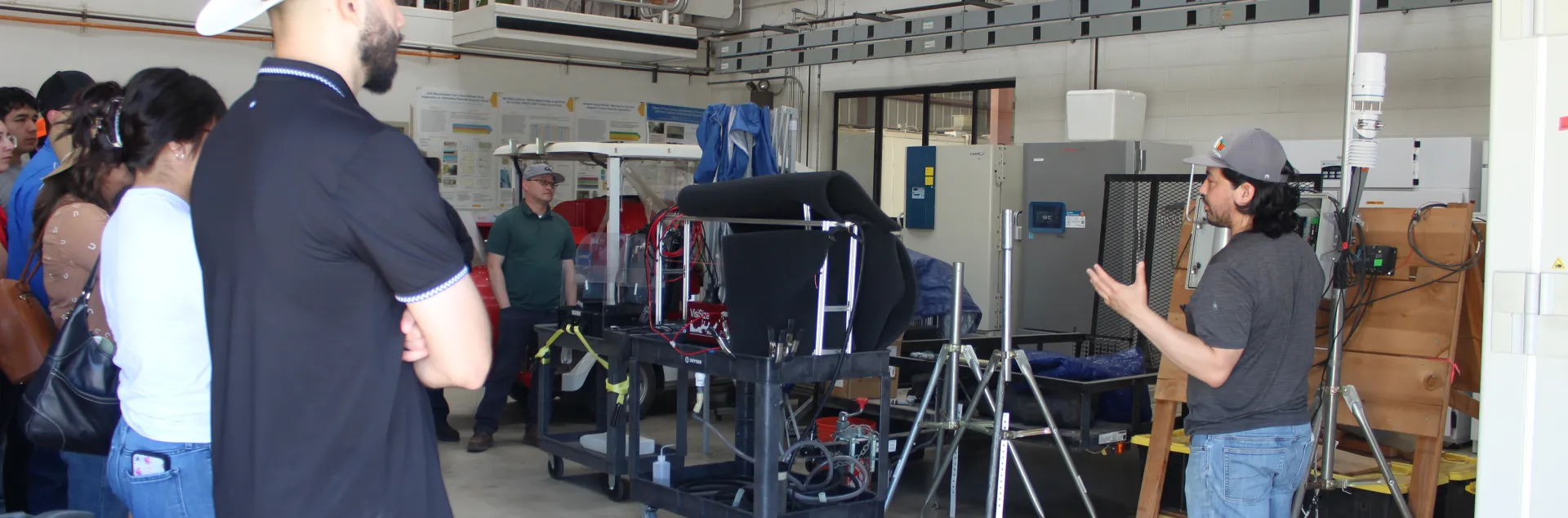
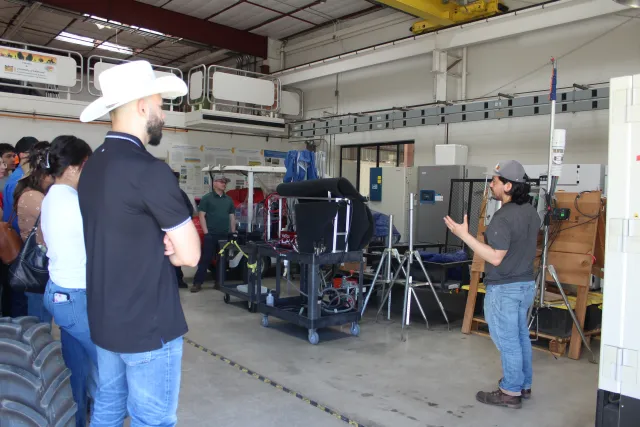
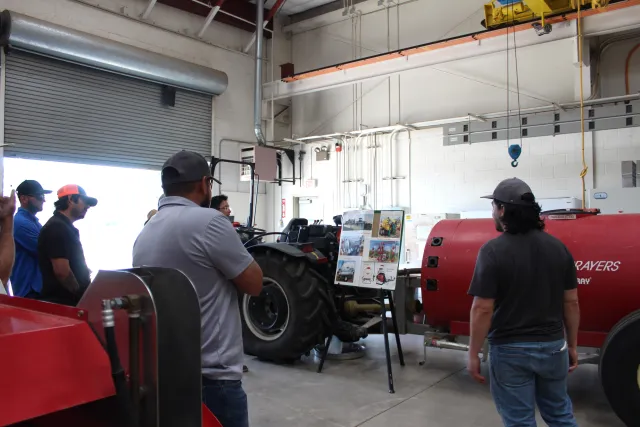
The first stop was UC Cooperative Extension (UCCE) Specialist Dr. Peter Larbi’s Agricultural Application Engineering (AgAppE) Lab where staff research associate Geoffrey Shimotsu presented on agricultural spray application engineering. He outlined the three major goals of the lab, i.e., to develop and evaluate spray techniques and technology, to develop and deploy decision support systems, and to promote best practices for safe, economical, and environmentally sound application, all with a focus on semi-permanent tree and vine specialty crops. Geoffrey also demonstrated an emerging technology from the lab to discuss 3D printing and design prototyping. Logistical assistance and documentation at this session were provided by lab assistant Jackie Martinez.
The tour continued with the remaining stops, including: an alfalfa block where staff research associate Brady Holder talked about groundwater recharge in alfalfa; small farm blocks; and finally, the greenhouse where Vincent Silva gave participants a brief walk-through with little structured content. The greenhouse presentations are usually presented by staff research associate Ryan Puckett who organized the tour but was not available on that day. Ryan usually discusses greenhouse operations, research activities, and ongoing projects.
The tour continued with the remaining stops, including: an alfalfa block where staff research associate Brady Holder talked about groundwater recharge in alfalfa; small farm blocks; and finally, the greenhouse where Vincent Silva gave participants a brief walk-through with little structured content.
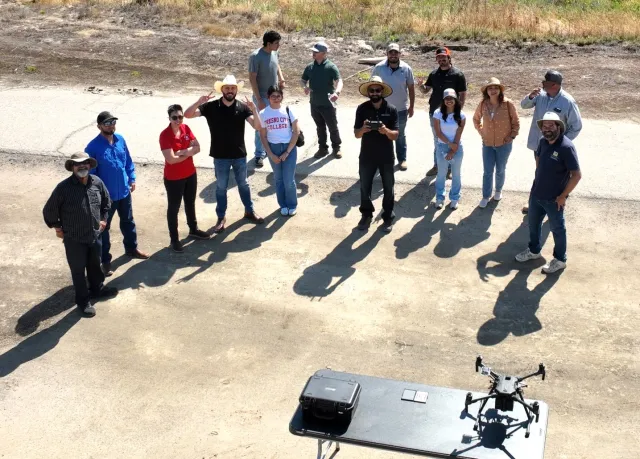
At the Small Farm Blocks, Staff Research Associate, Jose Paz, shared ongoing research and extension projects addressing key challenges faced by small-scale growers, such as water resilience and emerging pests. UCCE Advisor Dr. Manpreet Singh demonstrated a drone-mapping mission and discussed key considerations and settings for successfully collecting aerial imagery. Dr. Singh and Brady Holder also introduced attendees to agricultural applications of drones.
The Impact
The ten tour attendees provided feedback for the event. Written feedback comments were mostly positive with two participants writing:
“All were informative, clear & to the point. Great job!”
and
“Learned a lot & am excited to weave into classes! Thank you!”
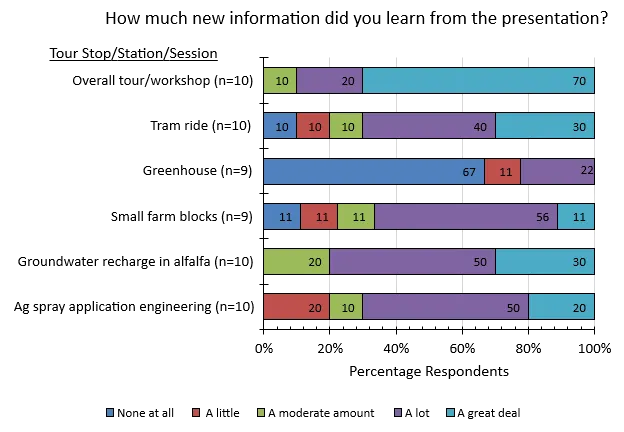
Attendees reported learning across all sessions with 90% learning either “a lot” or “a great deal”. Interestingly, the tram ride appears to have been educational, likely because it provided context, field observations, and exposure to the breadth of ongoing research. Most participants also reported substantial learning from the Ag spray application engineering presentation, and the groundwater recharge in alfalfa session appears to be one of the strongest educational components. The outcome from the small farm blocks session was also positive overall, but the responses were more spread. These results suggest that the tour content may serve as an effective model for future tours designed for similar participants and educational objectives.
The results reported across the tour suggest that participants were exposed to new knowledge and industry developments that can be incorporated into existing curricula. The tour helped address the need for stronger connections between higher education institutions and applied agricultural research programs, providing educators with current information, real-world examples, and potential teaching resources that can be incorporated into classrooms, laboratories, and student workforce training programs. Incorporating such firsthand exposure to research-based innovations can enrich teaching, workforce training, and student career preparation.