
The Issue
Many middle and high school students have limited opportunities to engage directly with professionals and learn how classroom subjects such as science, technology, engineering, and mathematics (STEM) translate into meaningful careers. This gap in career awareness can make it difficult for students to envision future educational and professional pathways, particularly in specialized fields such as agricultural engineering that are vital to California's economy and food production systems. College and career fairs provide valuable opportunities for students to explore professions, interact with practitioners, and gain insight into the diverse educational pathways available after high school.
How UC Delivers
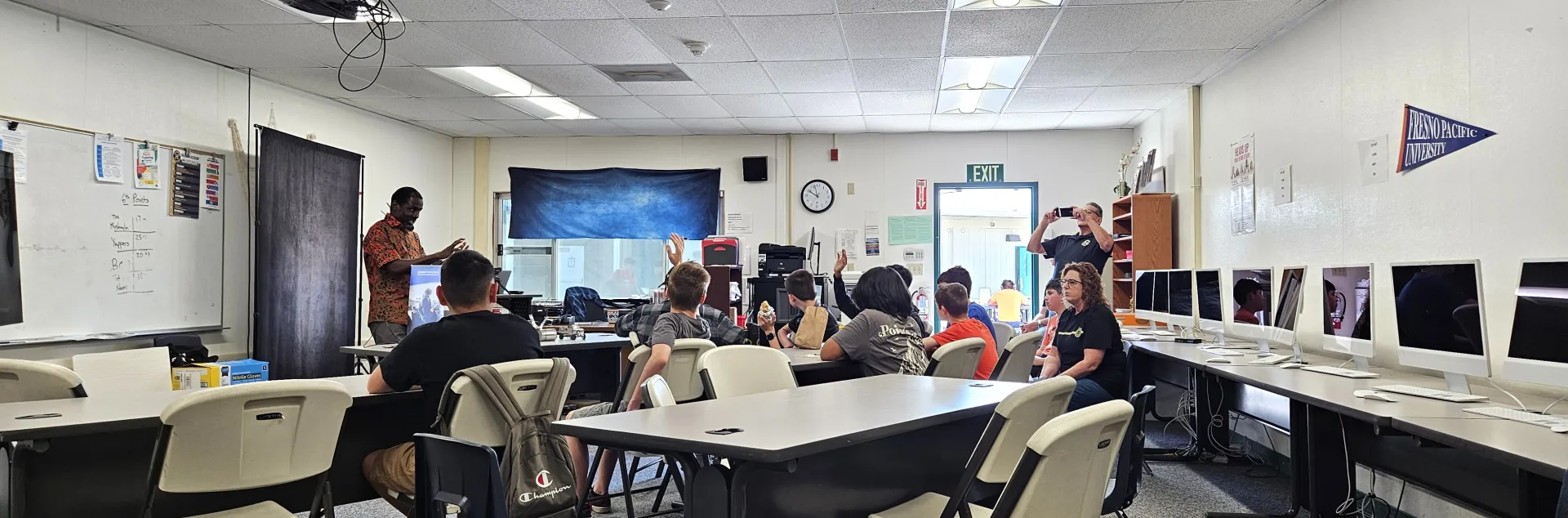
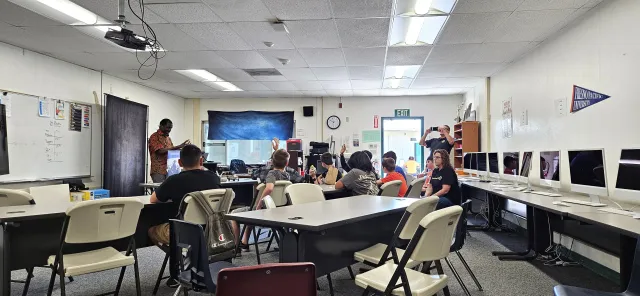
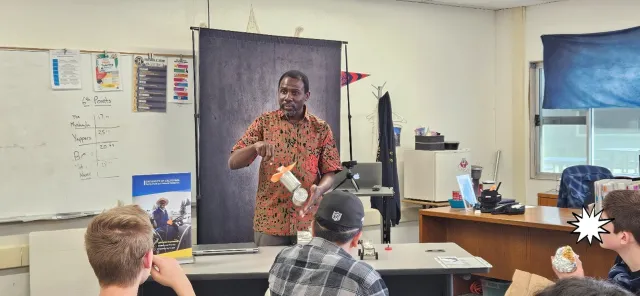
For two consecutive years, in April of 2024 and 2025, UCCE Specialist Dr. Peter Ako Larbi participated in Hallmark Academy annual college and career fair. The fair was targeted at high school and middle school students. In 2025, the event expanded to include students from Kings River High School and Sanger Academy, broadening access to career exploration for youth across the Sanger Unified School District. The fair included classroom presentations from individuals representing different disciplines, including Dr. Larbi’s presentation on “Engineering: A discipline of many career opportunities”.
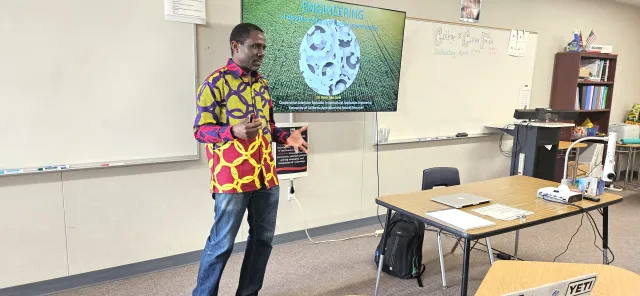
Dr. Larbi began with an overview of what engineering entails and some of the common sub disciplines before dwelling on his specific area of practice: Agricultural and Biological Engineering. In hopes of inspiring the audience to consider pursuing a career in engineering, he went on to share some highlights of his engineering career journey, advising them on how they can make use of the opportunities that will launch them into a fulfilling career. He stressed that since they cannot be certain about their ultimate careers, their attitude should be to make the most of critical career doors that will open in their lives, so they will not have regrets of missed opportunities.
Dr. Larbi concluded by discussing the objectives, outputs, and impacts of his Agricultural Application Engineering research and extension program at UC ANR, including his focus on: 1) developing and evaluating spray application techniques and technologies; 2) developing and deploying spray application decision support systems; and 3) promoting best practices for safe, economical, and environmentally sound pesticide spray application.
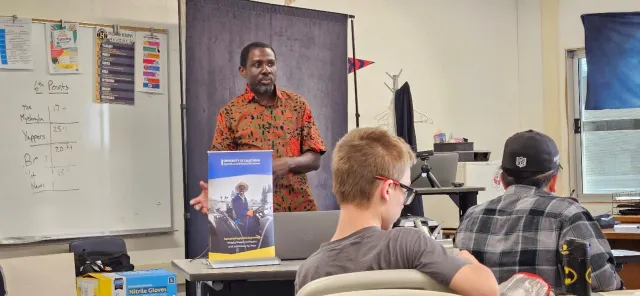
As an add-on in 2025, Dr. Larbi showcased remakes of his childhood play items made from recycled materials to demonstrate simple engineering concepts which he did not realize as a child. He used this final part to demystify engineering and establish that a career in engineering, and for that matter agricultural engineering, is within reach for the students.
The Impact
Ten or more students attended Dr. Larbi’s seminar during both the 2024 and 2025 college and career fair events. The audience comprised mostly middle school level students. The students were highly engaged throughout the 40-minute seminar, and the 2025 attendees were asked to complete evaluation forms to rate their learning at the end of the session. The amount of learning gained by the students was categorized on the evaluation form as “None at all”, “A little”, “A moderate amount”, “A lot”, and “A great deal”.
A summary of students’ grade level, and levels of interest and exposure to STEM fields is shown in Figure 1. The respondents were mostly eighth graders, who were looking forward to high school and were highly interested in engineering and technology. Combined, 77% identified engineering or technology as their primary STEM interest, suggesting strong interest in fields closely aligned with Agricultural Application Engineering and related STEM careers. Across the four STEM disciplines, many responses fell within the "Least" or "Low" exposure categories. This suggests that while students are interested in STEM careers, many perceive their current exposure to STEM opportunities as limited, highlighting the value of career awareness presentations.
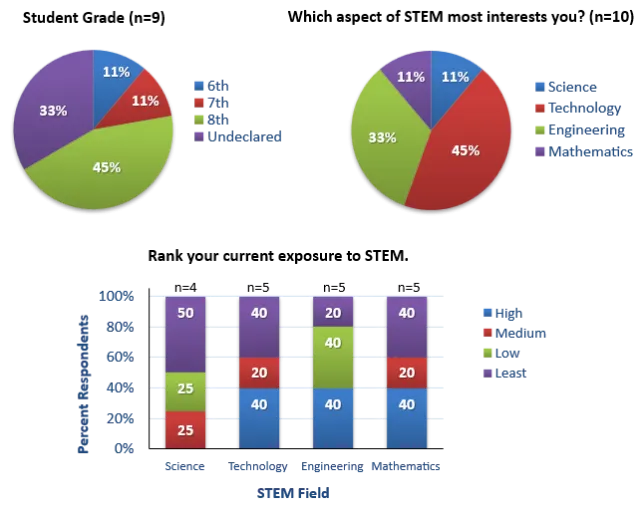
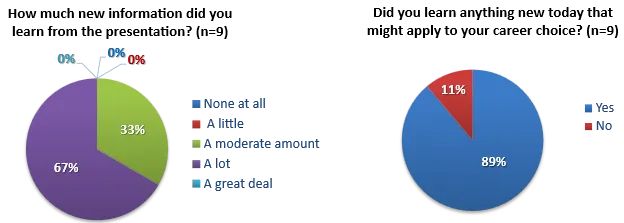
Figure 2 summarizes the learning gains and relevance of the information shared to students’ future careers. Out of nine student survey respondents, all reported learning either a moderate amount (three students) or a lot (six students) of new information, indicating that the presentation successfully introduced concepts that were new to students. When asked whether they learned anything that might apply to their career choice, eight of nine students (89%) answered “Yes”, while one student (11%) answered “No”. This finding is particularly significant because it demonstrates that students were not merely passive recipients of information. Most students saw direct relevance between the presentation and their future educational or career decisions.
Overall, the presentation increased student awareness of and interest in STEM and engineering careers, underscoring the value of exposing youth to real-world engineering applications, including agricultural engineering research and extension programs that address challenges in food production, environmental stewardship, and technology development. As part of UC ANR's commitment to youth development, workforce preparation, and STEM education, there is a continuing need to expose students to careers that address real-world challenges. Agricultural engineering, in particular, offers diverse career opportunities at the intersection of engineering, agriculture, environmental stewardship, technology, and food production. Increasing student awareness of these opportunities can help inspire the next generation of scientists, engineers, and agricultural professionals while highlighting the important role engineering plays in advancing California agriculture and natural resource management.