
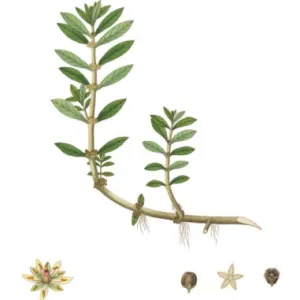
Bergia capensis (white water fire); Botanical illustration. Plants of the coast of Coromandel, vol. 2. 1798.
Introduction
In 2023, a new annual broadleaf weed, White water fire (Bergia capensis L.), was reported in a Butte County rice field. This ID marked the first confirmed report of this pest in California and likely the United States. In recent weeks, we have found new sightings of this weed in Colusa County and Butte County, for a total of four locations.
White water fire is an annual broadleaf weed native to Southern China, tropical Asia, and Africa. It is known to inhabit rice fields in Europe, Central and South America, and the Caribbean, and current theories posit that the introduction and spread of this weed into these areas occurred unintentionally through the cultivation and trade of rice. Occurrence of this weed is reported in paddy fields, grasslands, rice fields, irrigation channels, ditch sides, and riparian areas.
There is no species-specific information available about the dispersal mechanism of white water fire. In general, it is listed as being dispersed by autochory, (self-dispersal), anemochory (wind dispersal), and zoochory (birds or animals) (India Biodiversity Portal, 2019).
While officially identified recently, our working theory is that white water fire has likely been established in Northern California rice fields for quite some time. Because its overall growth habit closely mirrors common field weeds, it has possibly gone unnoticed by being repeatedly confused with redstems (Ammannia spp.).
Identifying characteristics
Accurate identification is critical for detection and prevention of further spread. As this weed is very easy to confuse with redstems, knowing the differences between these plants can assist in identification.
White water fire characteristics
- Broad, thick, ovate leaves with serrated edges
- Round, fleshy stem with a small central pith surrounded by large air spaces known as lacunae
- Small white flowers produced in tight clusters surrounding the stem
- Seeds are dark brown to black, oblong-to-ellipsoid seeds with aligned rows of tiny pits that give them a ribbed look under a hand lens. Very hard to distinguish with the naked eye.
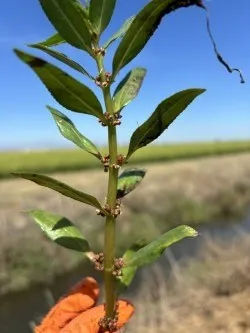 | 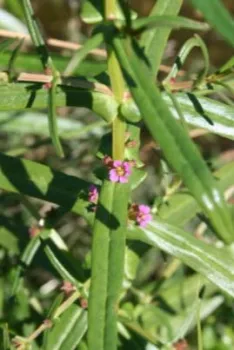 |
White water fire (left) and Redstem (right).
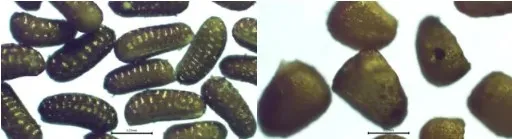
Seeds of White water fire (left) and Redstem (right) (Robinson Johnson)
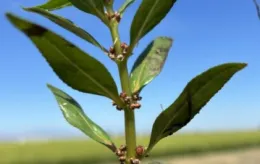 | 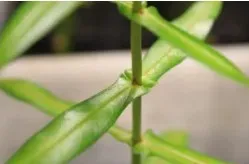 |
White water fire (left) and Redstem (right).
Ongoing Herbicide & Control Research
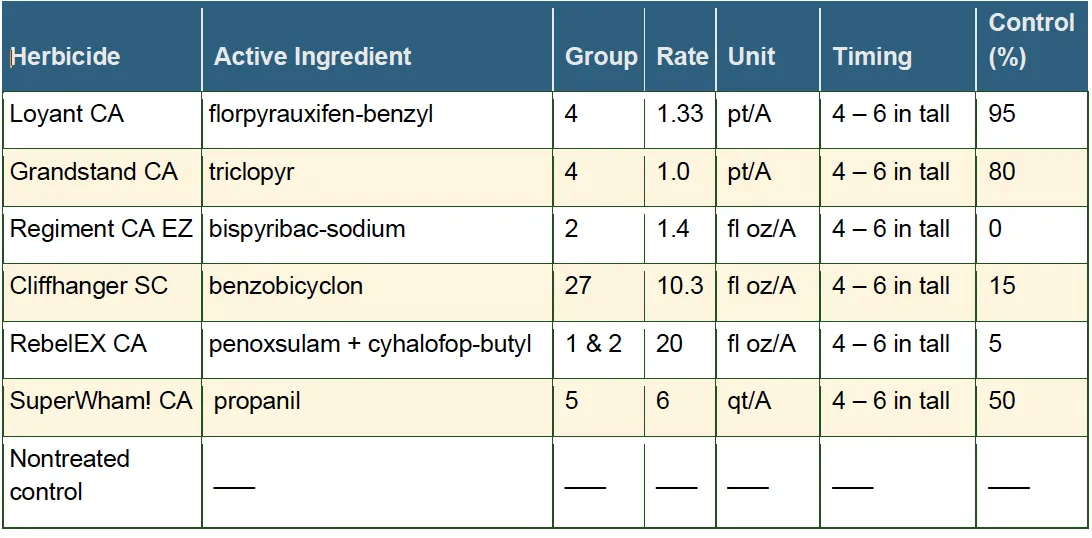
Kassim Al-Khatib’s lab recently evaluated several common California rice herbicides against white water fire in greenhouse trials.
- Loyant CA: Highest efficacy, delivering over 95% seedling control at 28 days post-treatment.
- Grandstand CA: Provided secondary suppression, achieving around 80% control.
- Other Herbicides: Products like Regiment CA, Cliffhanger SC, RebelEX CA, and SuperWham! CA resulted in significantly reduced control.
- Copper Sulfate: Preliminary results show copper sulfate inhibits seed germination and controls young seedlings, offering a potential cost-effective early management tool.
UCCE White water fire scouting
Starting late summer of 2026, UCCE advisors and staff will be conducting a minor survey of Butte, Colusa, Glenn, Placer, Sacramento, Sutter, Yolo, and Yuba Counties to scout for white water fire in rice fields. This survey will give us a better understanding of how widespread this weed is.
If you believe you have this weed in your fields, reach out to your local UCCE Rice Advisor for identification assistance or control advice.