
Johnsongrass (Sorghum halepense L.) is a problematic perennial weed that plagues California orchards and vineyards, spreading through seed production and perennial rhizomes. Established johnsongrass populations are typically controlled through use of systemic post-emergent herbicides (typically glyphosate and clethodim) and pre-emergent herbicides are used for seedling management, preventing new infestations from establishing or expanding. Residual herbicides commonly used for johnsongrass seedling control include pendimethalin, rimsulfuron, and indaziflam. Research conducted in 2025 (posted here) demonstrated suppressive effects of rimsulfuron on established johnsongrass populations when applied in early March, but little is known concerning the ideal time to deploy such an application. Several research trials were installed in 2026 to address this question.
Winter pre-emergent mixes.
A trial was installed in Fresno County raisin vineyard to measure the benefit of adding rimsulfuron in tank mixes with other residual herbicides. Preemergent herbicide treatments (Table 1) were applied February 13th. Every plot, including the control, received a post-emergent mix of glyphosate and glufosinate as well (40 fl oz/A Roundup Powermax 3 [PM3] and 56 fl oz/A Rely 280). Pyroxasulfone was evaluated as a standalone treatment in the study but is not currently registered for use in California. A total of 1.25 inches of rain fell two weeks after the application. Plots included a mix of established johnsongrass and newly emerging seedlings and were evaluated for johnsongrass control 125 days after treatment (DAT).
Table 1. Treatment list and rates for the February 13th application in Fresno, CA.
| TRT # | Herbicides | Rate ( per acre) |
1 | Untreated | 0 |
2 | Pyroxasulfone | 8.25 fl oz |
3 | Indaziflam (Alion) | 5 fl oz |
| Rimsulfuron (Matrix) | 4 oz | |
4 | Indaziflam (Alion) | 5 fl oz |
| Rimsulfuron (Matrix) | 4 oz | |
| Pendimethalin (Prowl H2O) | 134.4 fl oz | |
5 | Indaziflam (Alion) | 5 fl oz |
| Flumioxazin (Chateau) | 12 fl oz |
Including rimsulfuron alongside other typical pre-emergent herbicides in the winter months gave a slight improvement in control. Treatments without rimsulfuron remained around 85% while rimsulfuron treatments were over 96% by 125 DAT (Figure 1). Figure 2 shows the untreated plots, where johnsongrass coverage averaged 64%.
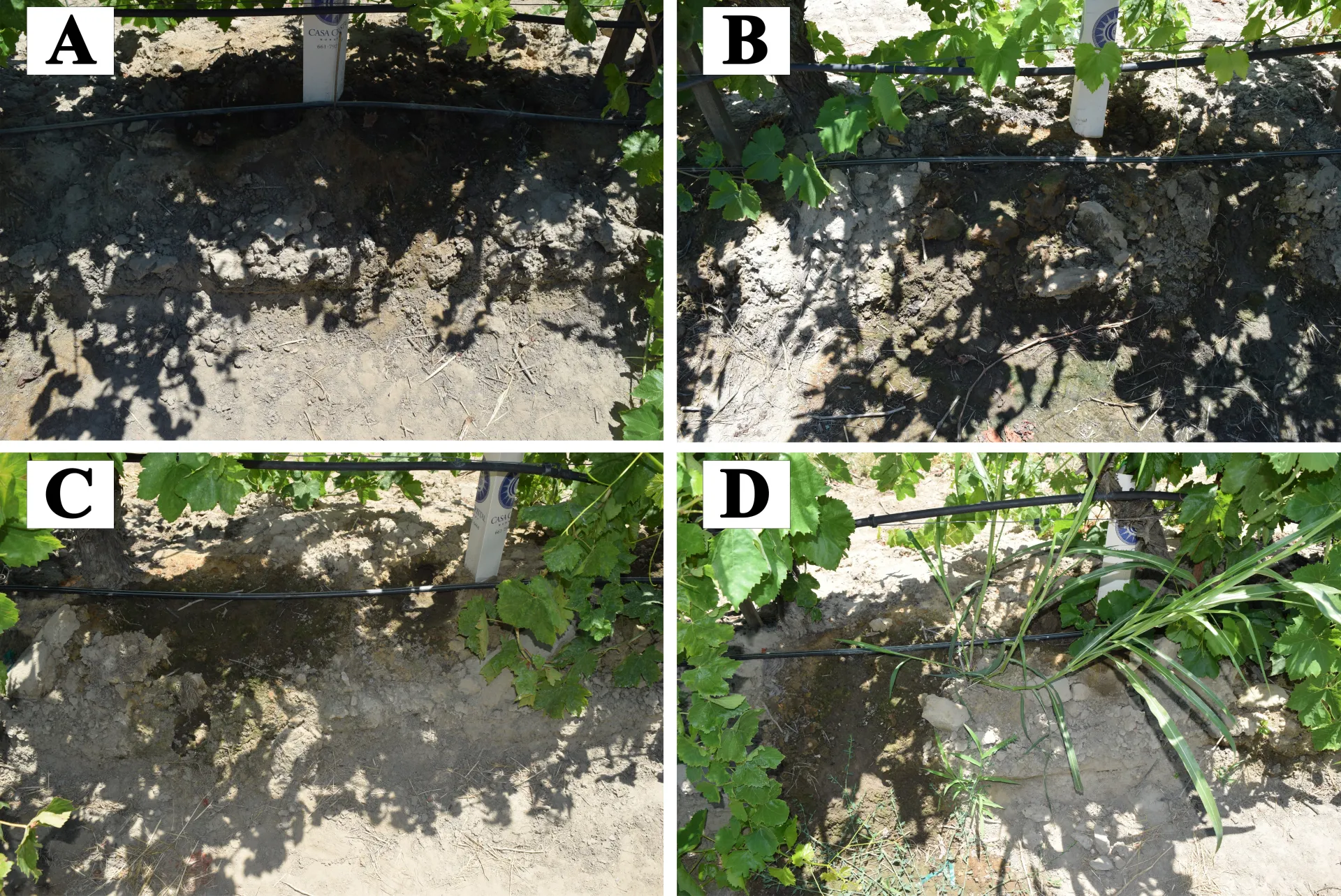
Johnsongrass coverage in plots treated with rimsulfuron-containing mixes was very low, between 1 and 3% (Figures 1 and 3). Plots treated with pre-emergent herbicide mixes that omitted rimsulfuron ended up with approximately 16% johnsongrass coverage by trial termination. This improvement in control was likely due to herbicidal activity on rhizomatous johnsongrass.
Figure 1. Weed Control Efficacy at 125 Days After Treatment (DAT).
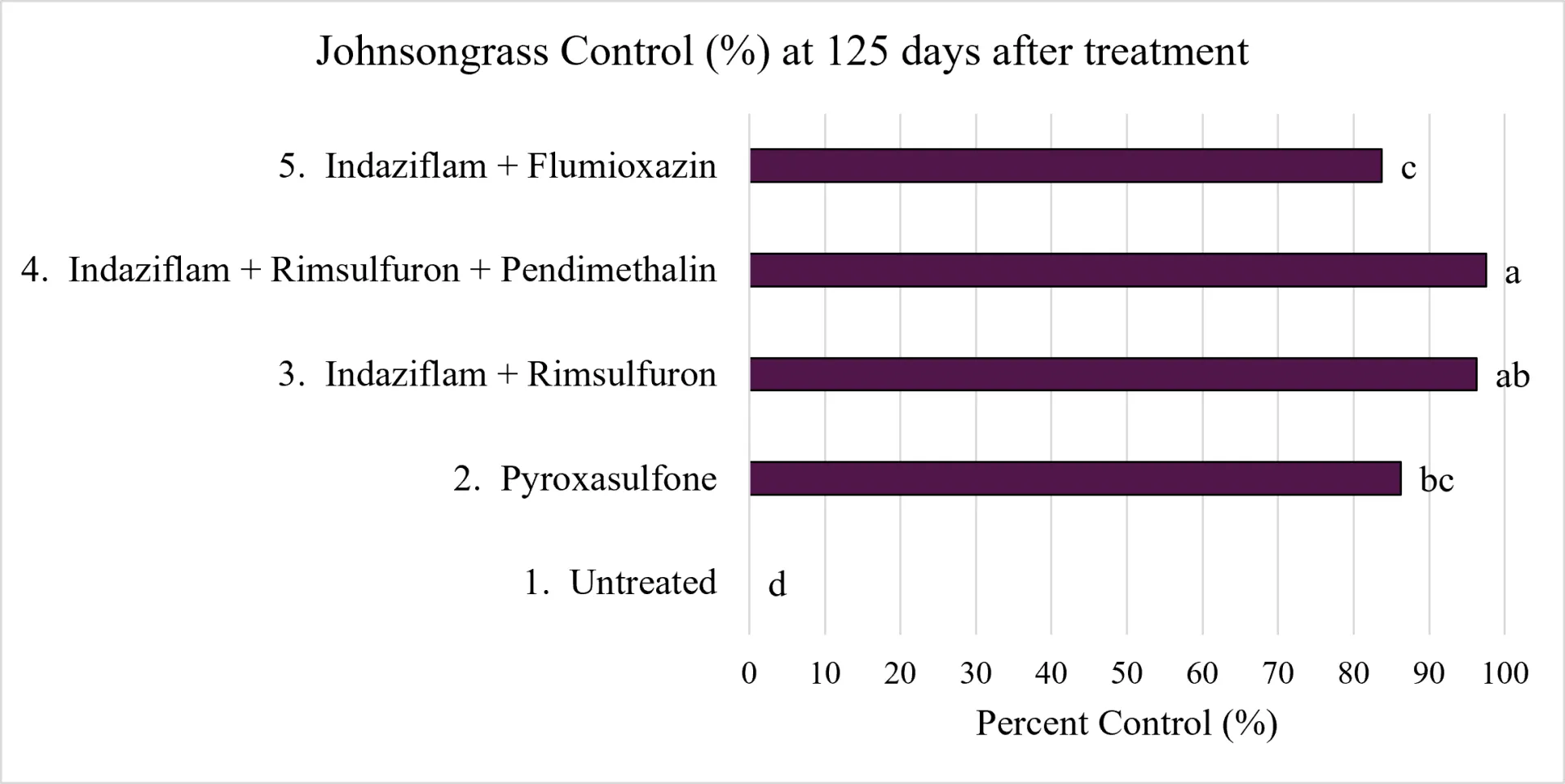
Figure 2. Untreated control from the pre-emergent trial, 125 days after treatment.
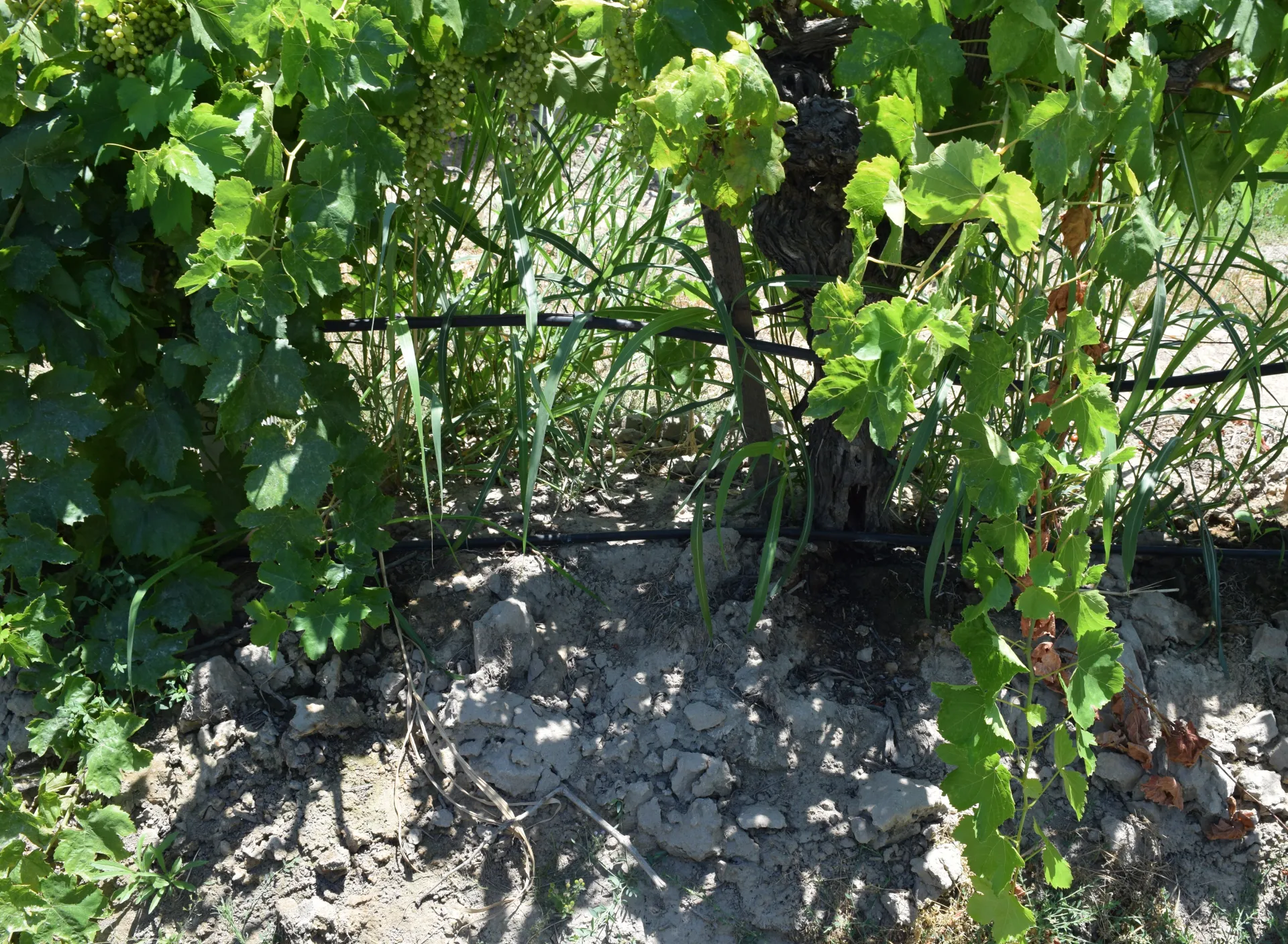
Figure 3. Treatment plots from the pre-emergent trial, 125 Days After Treatment. A) Pyroxasulfone, B) indaziflam + rimsulfuron, C) indaziflam + rimsulfuron + pendimethalin, D) indaziflam + flumioxazin.
Spring post-emergent mixes.
A second trial was installed in a Shasta County walnut orchard on April 7th, 2026 to evaluate rimsulfuron as a tank mix partner for post-emergent herbicides. Treatments and rates are listed in Figure 4. Products used included Roundup PM3 (2 or 4 pt/A) for glyphosate, Clethodim 2EC (8 fl oz/A) for clethodim, and Revolt (4 oz/A) for rimsulfuron. Every treatment containing glyphosate also included ammonium sulfate at 1% v/v. Methylated seed oil was added at a 1% v/v concentration in every treatment that contained clethodim. Each treatment was replicated four times, and the reported weed coverage data is an average of the four plots.
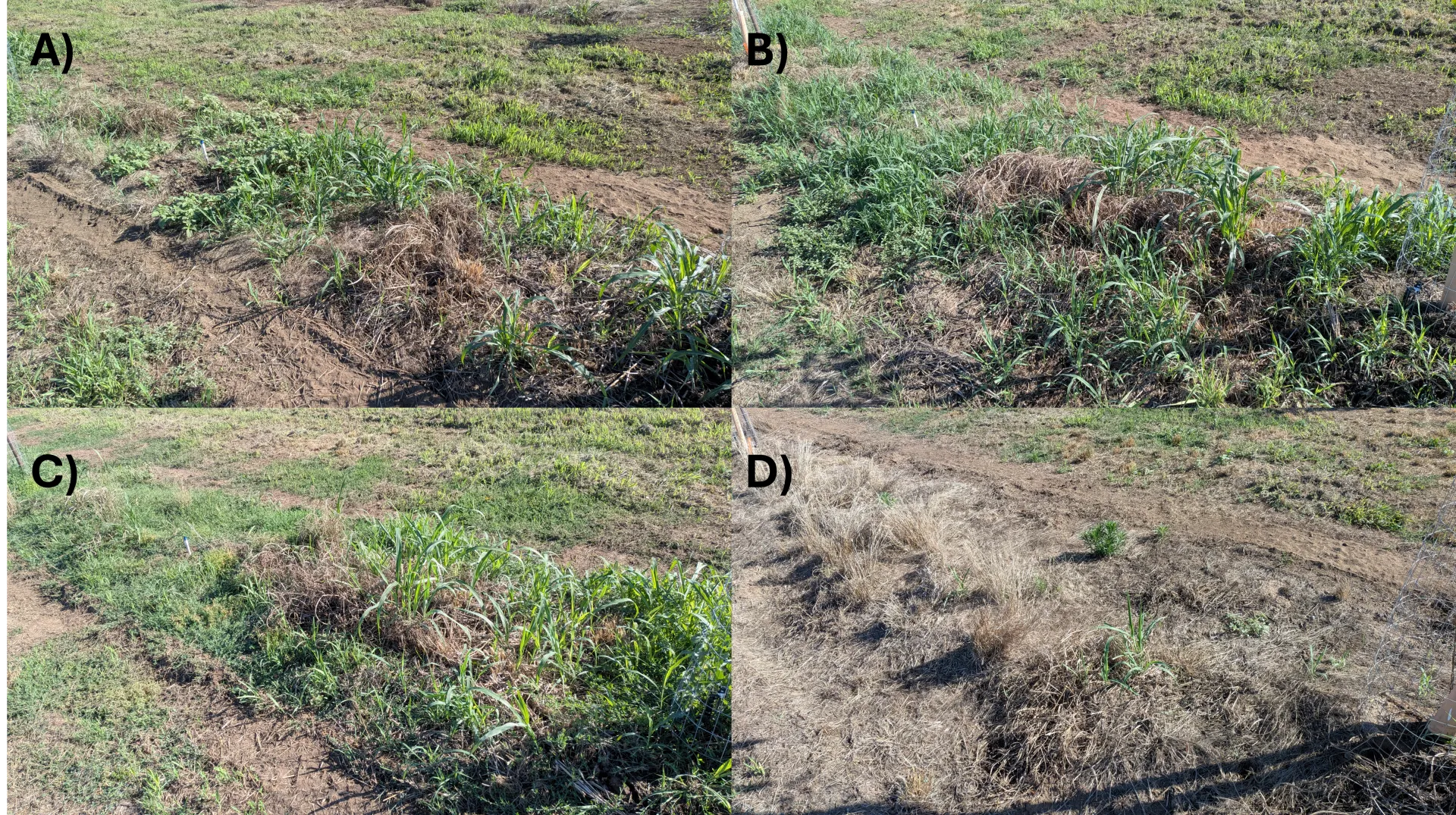
All treatments resulted in high levels of control by 4 weeks after treatment, but by 8 weeks after treatment there was a clear separation among treatments (Figure 4). The addition of rimsulfuron in any treatment mixture resulted in control that ranged from 90-96%, while glyphosate treatments without rimsulfuron seemed to show no sustained control of johnsongrass by 8 weeks after treatment. Clethodim as a standalone treatment was moderately efficacious, with around 70% control, but when mixed with glyphosate it seemed to lose its efficacy (Figure 4). This may be due to new seedling germination, as the clethodim plots had large populations of broadleaf weeds that could have suppressed johnsongrass seedlings through competition. Broadleaf weeds were primarily prostrate pigweed, knotweed, and marestail. Only the plots that received both glyphosate and rimsulfuron were free of the full spectrum of weed species, as shown in figure 5.
Figure 4. Post-emergent treatments were applied to an established johnsongrass population on April 7th, 2026. Weed coverage data were taken on May 29th, 2026. Different letters appending a data bar indicate statistical separation of means at a p<0.05 threshold according to Tukey’s method.
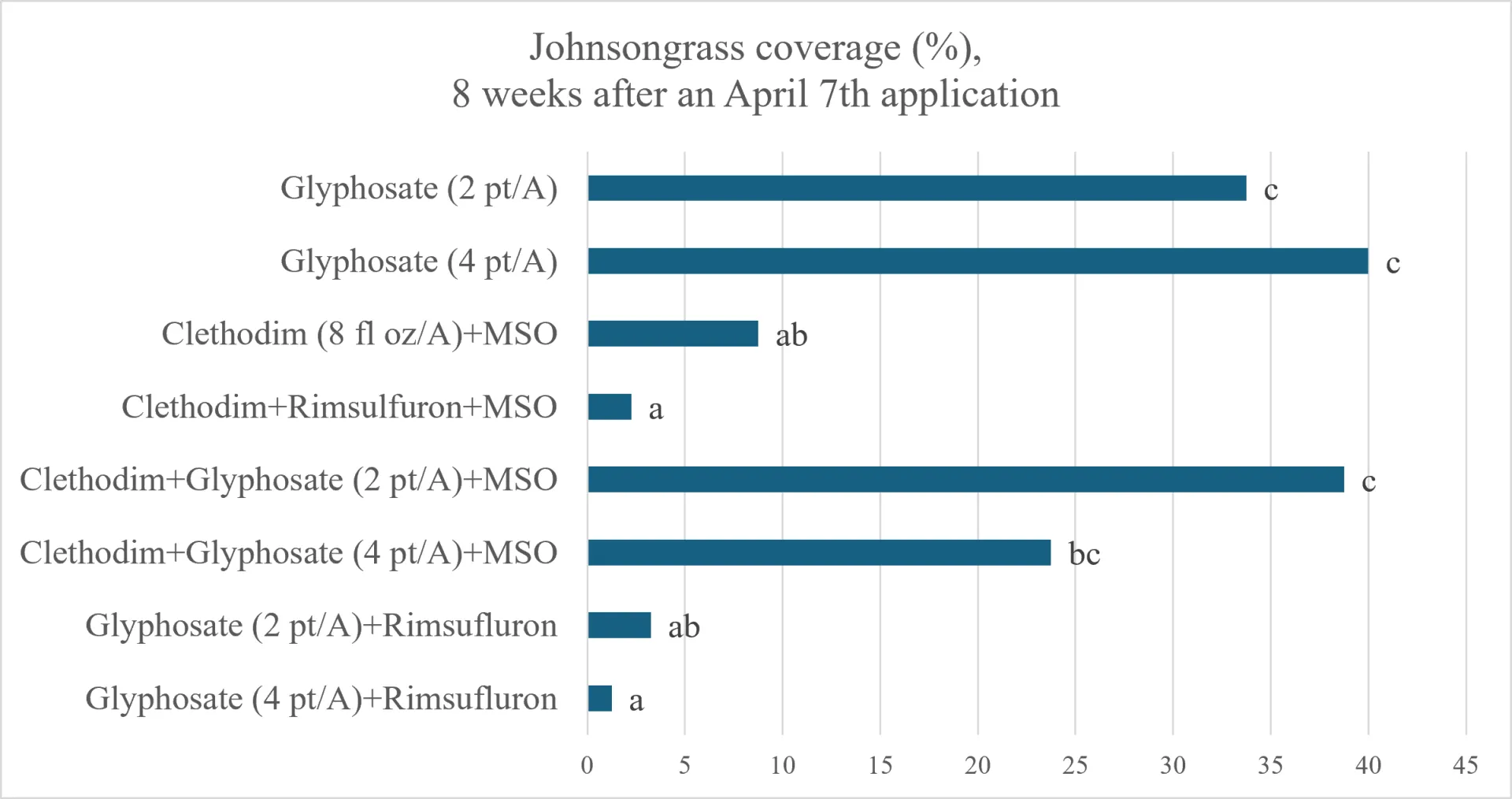
Figure 5. Post-emergent treatments were applied to an established johnsongrass population on April 7th, 2026. These images were taken on May 29th, 2026. Treatments include A) glyphosate (Roundup PM3, 2 pt/A) B) glyphosate plus clethodim (Roundup PM3, 2 pt/A; Clethodim 2EC, 8 fl oz/A) C) Clethodim (Clethodim 2ECm, 8 fl oz/A) D) glyphosate plus rimsulfuron (Roundup PM3, 2 pt/A; Revolt, 4 oz/A).
Rimsulfuron application timing.
Multiple additional trials were installed in olive and walnut orchards in Glenn, Tehama, and Shasta Counties in spring of 2026 to compare rimsulfuron efficacy across the late winter and early spring months. Eight separate applications were made as shown in table 2. In each instance glyphosate (Roundup PM3, 2 pt/A) was applied alone as a reference, or was mixed with rimsulfuron (Revolt or Matrix, 4 oz/A). The only exceptions to this treatment arrangement were when too little johsongrass was available to treat, and in these cases an alternative reference was used, as indicated in Table 2. Matrix was applied in olive orchards and Revolt in walnut orchards, due to crop registration limitations in olive orchards. All treatments were replicated 4 times and trials were all terminated 8 weeks after treatment, except the May 21st application, which was terminated at 6 weeks, due to aggressive johnsongrass growth around the trees. Weed control was assessed as a % reduction in weed coverage relative to control treatments.
Results show that rimsulfuron applications in February and January reduced johnsongrass coverage by 31-37%, while applications in late March and early April reduced johnsongrass coverage by between 85 and 98%. One late-February application achieved the lowest level of control, but no rain was received within two weeks of application in this trial. Late May also saw relatively low levels of control (34%), despite adequate rainfall incorporation (Table 2).
Results from 2025 (posted here) showed improvements in control due to the addition of rimsulfuron that ranged between 40 and 85% when applied in early March. Together, these results suggest that if adequate rainfall occurs rimsulfuron can be a helpful tool for early-season post-emergent management of johnsongrass, with best results achieved in March and April when accompanied by adequate rainfall. Some of the control seen here is from pre-emergent control of seedlings, which may be why control was so effective at the tested application timings.
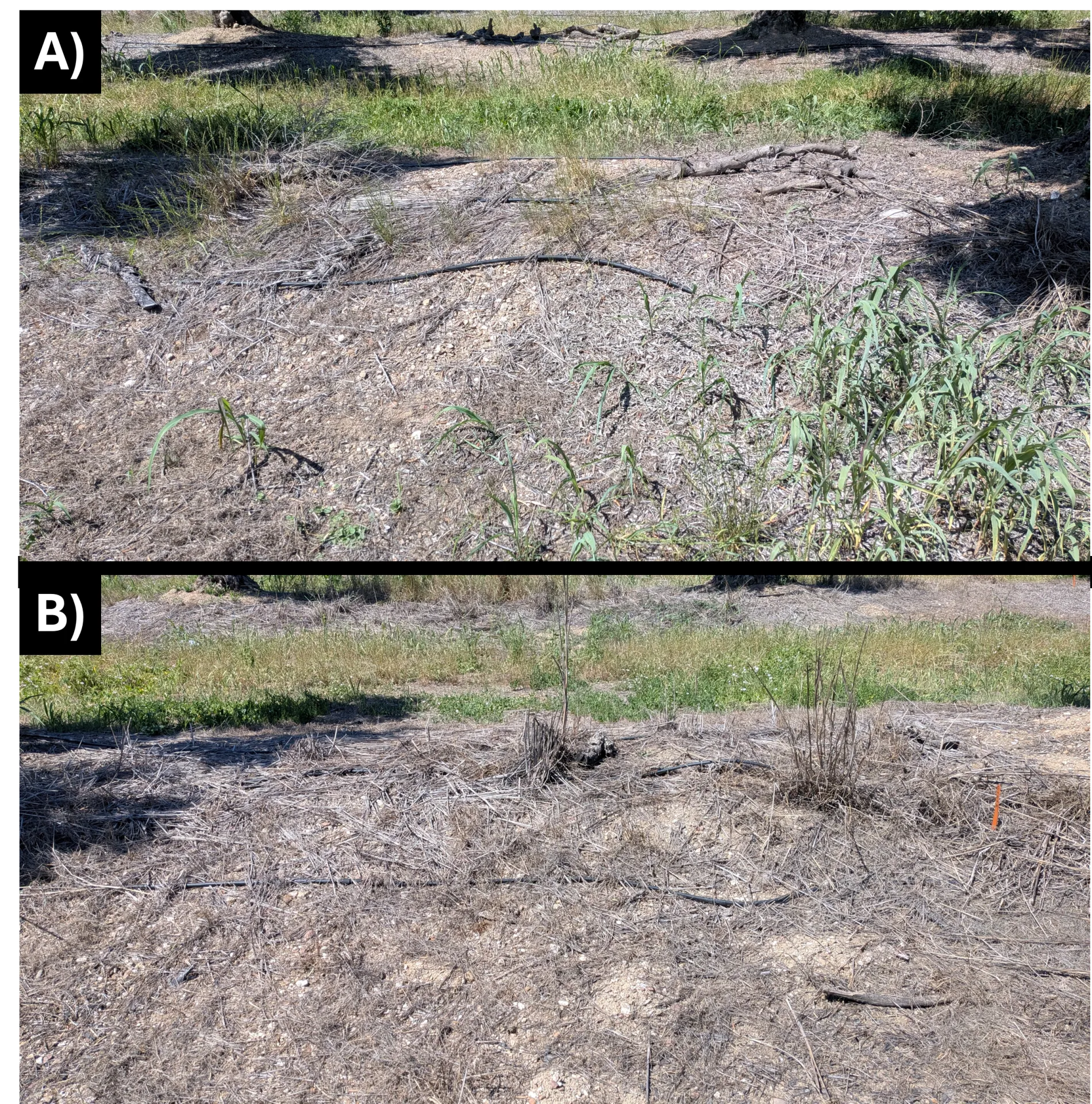
Figures 5 and 6 show weed control efficacy from April 7th and March 27th applications, respectively.
| Table 2. Johnsongrass coverage is here displayed for a series of trials, with each population responding to a broadcast treatment of glyphosate + rimsulfuron (2 pt/A + 4 oz/A) and compared to a control treatment. Control treatments are glyphosate (Roundup PM3, 2 pt/A) unless otherwise indicated. Different letters following a treatment pair indicate statistical separation of means at a p<0.05 threshold according to Tukey’s method. Rainfall within the first two weeks after application is also recorded. | ||||
Johnsongrass % coverage at termination | ||||
Application date | Control treatment | Glyphosate + Rimsulfuron | % improvement in control | Rainfall (inches within 2 weeks of application) |
1/26/2026* | 56 | 35 | 37 | 0.1 |
2/3/2026 | 21 | 13 | 36 | 3.5 |
2/6/2026** | 28 a | 19 b | 31 | 3.5 |
2/25/2026 | 53 | 44 | 18 | 0 |
3/25/2026 | 55 a | 8 b | 85 | 1.4 |
3/27/2026 | 16 a | 0.3 b | 98 | 0.4 |
4/7/2026 | 53 a | 4.8 b | 91 | 2.1 |
5/21/2026 | 16 | 11 | 34 | 0.9 |
| “*” indicates an application that had an untreated control reference, due to minimal johnsongrass present at the application timing. | ||||
| “**” indicates an application that had oxyfluorfen+pinoxaden (Pindar GT; 3 pt/A) as a reference treatment. | ||||
Figure 6: A March 27th application of either a) glyphosate (Roundup PM3, 2 pt/A) or b) glyphosate + rimsulfuron (Roundup PM3, 2 pt/A; Matrix, 4 oz/A) is pictured here 6 weeks after application. The addition of rimsulfuron resulted in 98% control of johnsongrass and 83% control of glyphosate-resistant Italian ryegrass, relative to 25% johnsongrass control and 0% ryegrass control in the glyphosate plots.
Conclusions.
Weed management strategies differ widely across California orchards and vineyards. Nut orchards like almond and walnut often require sweeping the crop off the orchard floor, leading to more intensive weed management activities. Very little johnsongrass can be tolerated in an orchard like this, with eradication being the goal, along with ongoing seedling management. This is likely done through use of residual herbicides like indaziflam (Alion) or pendimethalin (Prowl). The addition of rimsulfuron (Matrix) can complement these herbicides through added residual activity on seedlings and established johnsongrass, if applied at the in the late winter or early spring.
In orchards and vineyards where sweeping is not required (stone fruit, pistachio, olive, etc.) there may be more tolerance for johnsongrass populations, and these populations may be more often managed primarily through use of post-emergent herbicides, with eradication not the exclusive goal. In cases like these, the results reported here also provide a roadmap for use of rimsulfuron as a tank mix partner for post-emergent herbicides. For such orchards applications still ought to occur early in the season, while there is still rainfall to incorporate the pre/post rimsulfuron herbicide, and before johnsongrass plants get too large for an effective rimsulfuron (or clethodim) application.
Orchards and vineyards that heavily rely on post-emergent herbicides will have very few tools for resistance management when dealing with johnsongrass populations. Johnsongrass is susceptible to the development of resistance and our management ought to reflect this reality. Johnsongrass resistance to glyphosate is typically a translocation-type resistance that reduces the amount of herbicide transported to the below-ground portion of the plant. Rimsulfuron is unique in its soil-residual activity that seems to affect the below-ground vegetative structures of johnsongrass plants, possibly through direct absorption. In cases where translocation is reduced, direct uptake of rimsulfuron into the roots and rhizomes of a johnsongrass plant may bypass the glyphosate-resistance mechanism. This may also mean that a glufosinate + rimsulfuron tank mix could be effective on johnsongrass populations, though this mix was not tested in these reported studies.
Rimsulfuron is not a standalone tool for managing johnsongrass but may be incorporated into chemical rotations as a tank mix to improve either post-emergent or pre-emergent herbicide applications that target johnsongrass.