
Overview
Physical consolidation, which connects a smaller water system to a larger provider through new pipeline infrastructure, is the primary long-term solution promoted by state regulators. Sangha (2026) applied the State Water Resources Control Board’s 2024 screening methodology to 210 Failing and At-Risk water systems in Kern, Kings, Tulare and Fresno counties and identified 114 consolidation pairs. The SAFER Consolidation Explorer (Link) extends that analysis to all 794 water systems in the four counties, documenting the screening outcome for each system and allowing any pair of systems to be evaluated against the State criteria. It is intended for water system managers and boards, planners, technical assistance providers and community members.
Tool features
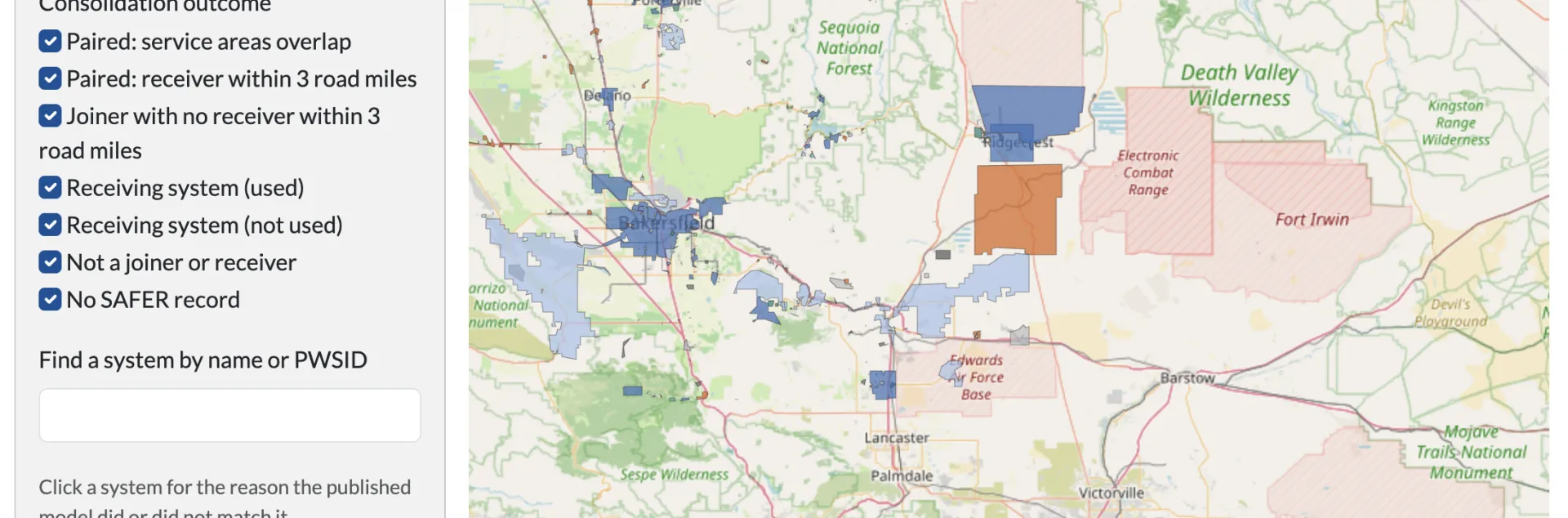
Map
Displays every water system, colored by screening outcome. Selecting a system shows the reason for its outcome and, for systems without a match, the nearest eligible receiving system and its distance.
Pair checker
Users select a joining system and a receiving system on the map. The tool reports each screening criterion, the threshold, the value for the pair and the margin, and states whether the pair meets the modeled criteria.
Screening criteria
Joining systems are Failing systems with 1,000 or fewer service connections and At-Risk systems with 500 or fewer. Receiving systems are Failing systems with more than 1,000 connections and systems of all other risk categories with more than 500. Overlapping service areas qualify automatically; otherwise, the road distance between systems must be 3 miles or less (State Water Resources Control Board, 2024).
Interpreting results
Results reflect the State’s modeled screening criteria and are intended to inform, not replace, engineering, financial and governance assessments. Pairs near a threshold can be identified for further evaluation and help start . Distances for pairs evaluated in Sangha (2026) are taken from the published analysis; other distances use the same method with OpenStreetMap road data.
Explore the tool here
https://lsanghaucanr.shinyapps.io/safer-consolidation-explorer/
References
Sangha, L. (2026). Physical water system consolidation alone cannot resolve drinking water failure in California’s San Joaquin Valley. Scientific Reports, 16, 30407. https://doi.org/10.1038/s41598-026-60638-z
State Water Resources Control Board. (2024). Supplemental appendix: Physical consolidation cost estimate methodology. Drinking Water Needs Assessment.