A Natural Solution for California's Herds: African Catfish Peptides

California's cattle producers and agricultural communities are all too familiar with the rising challenge of antibiotic resistance, making common bacterial infections harder to treat in livestock. But imagine a future where we could tackle these infections with a natural, powerful alternative. Our research points to just that: antimicrobial peptides (AMPs) found in African catfish.

We're really excited about these peptides because African catfish thrive in pathogen-rich freshwater, naturally producing these robust immune compounds in their skin mucus as a defense. This natural origin makes them highly appealing alternatives to synthetic drugs.

Predicted Safety and Potent Action

One of the most compelling aspects of these AMPs is their predicted safety for mammals. Our initial computer analyses suggest that various catfish AMPs are generally recognized as safe (GRAS). We predict they'll be absorbed in the human intestine without causing liver, brain, or heart toxicity. Furthermore, lab tests on a promising peptide, NACAP-II, confirmed it was non-hemolytic, meaning it didn't damage rabbit red blood cells—a strong indicator of its potential safety for mammalian cells.

Beyond safety, these peptides demonstrate effectiveness against problematic bacteria. One study revealed NACAP-II's strong activity against Extended-Spectrum Beta-Lactamase (ESBL)-producing Escherichia coli—a critical concern for both animal and human health due to its resistance to many common antibiotics. Another peptide, ACAP-IV, also showed antibacterial activity against E. coli and Staphylococcus aureus. We believe these AMPs work by directly disrupting bacterial cell membranes, a mechanism that makes it harder for bacteria to develop resistance compared to how they resist traditional antibiotics.
ANR Adventures: Article

Getting ready for the holiday lull

December 18, 2018
By Wendy Powers
I was looking forward to meeting with the Pear Advisory Board last week. It didn't happen. Before the committee reached the UC ANR agenda item, the building was evacuated due to a bomb threat. That was a first for me. Sadly there were eight such threats in Sacramento that morning.
View Article
Primary Image
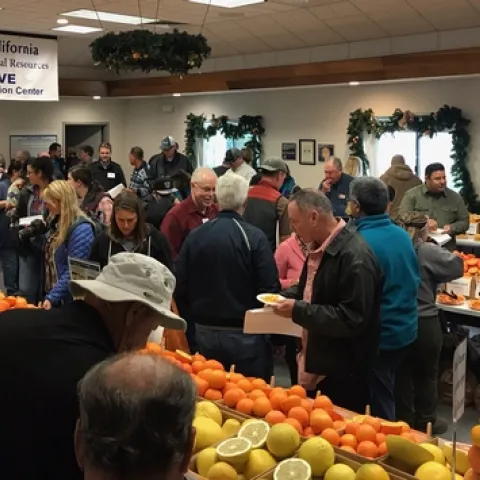
Lindcove REC held its annual citrus sampling.
ANR Employee News: Article

Lindcove REC citrus attracts a crowd

December 17, 2018
By Pamela S Kan-Rice
Lindcove Research and Extension Center hosted its annual citrus variety tasting for growers and other industry members on Dec. 14. The following day, they welcomed members of the public to sample over 100 different citrus varieties.
View Article
UC Cooperative Extension Imperial County: Article

December 2018

December 17, 2018
AGRICULTURAL DRAINAGE IN AIRD AND SEMI-ARID REGIONS IMPERIAL VALLEY CIMIS REPORT AND UC WATER MANAGEMENT RESOURCES 2019 CALIFORNIA PLANT & SOIL CONFERENCE INFORMATION NEW LIVESTOCK SECTION: LIVESTOCK RESEARCH BRIEFS...
View Article
Article

UC ANR - We connect. How we might do this better?

December 17, 2018
By Pamela S Kan-Rice
Being able to connect is key to the success we in UC ANR enjoy in developing and providing solutions to help the people of California. Please provide your input (see #3 under "Where are we?) to see how we might do this even better.
View Article
Primary Image
724
Ranching in the Sierra Foothills: Article

Fall Feed... or Fuel Load?

December 17, 2018
By Daniel K Macon
As a grazer of sheep, at least from a forage management perspective, I live by the rule, "If the worst might happen, it probably will." A corollary to this rule is that pessimists are often pleasantly surprised.
View Article
Primary Image
lantana
Under the Solano Sun: Article

Useful Lantana

December 17, 2018
Sometimes I just need a plant that serves a purpose. I need to put in a ground cover that will fill in an area on a downward slope where the front yard meets the sidewalk. This area gets direct sun as the sun swings across the Carquinez Strait throughout the day.
View Article