What is Virtual Fencing?
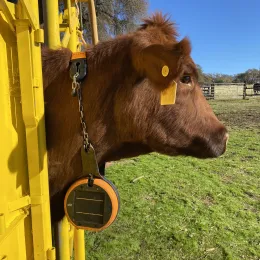
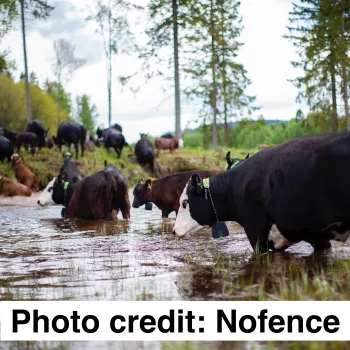
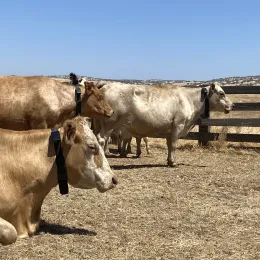
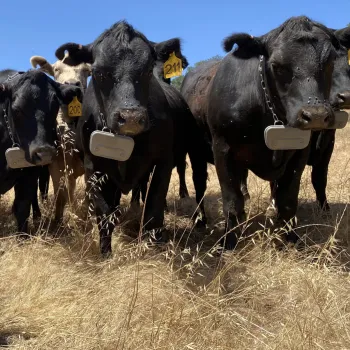
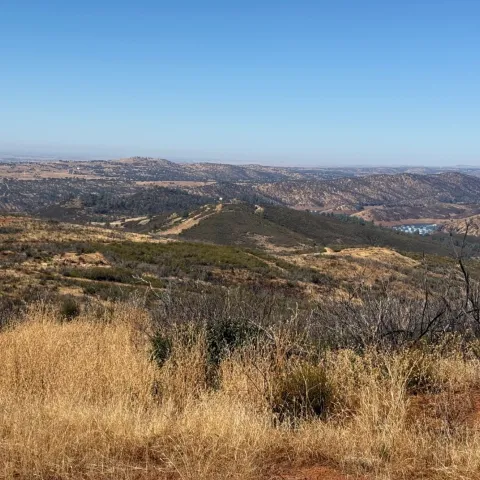
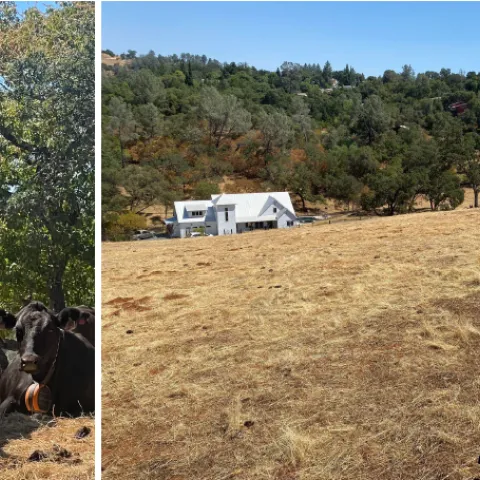
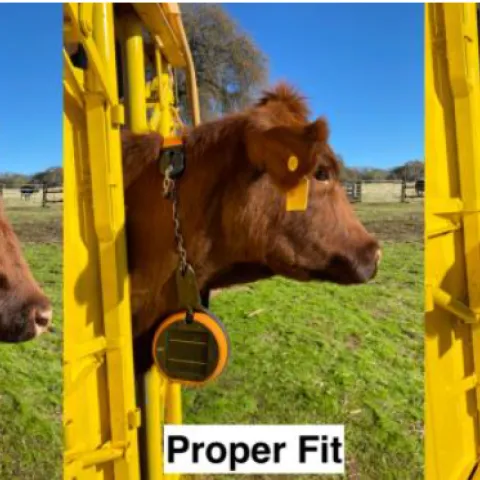
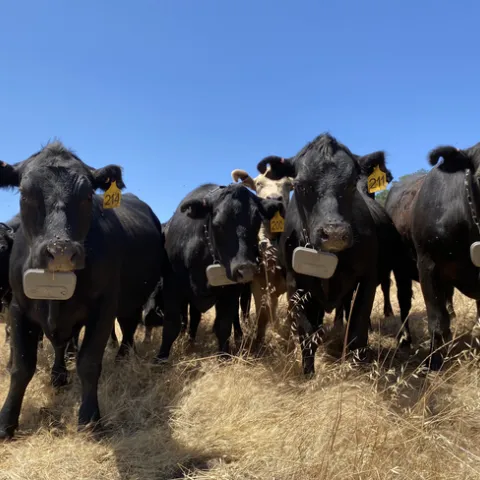
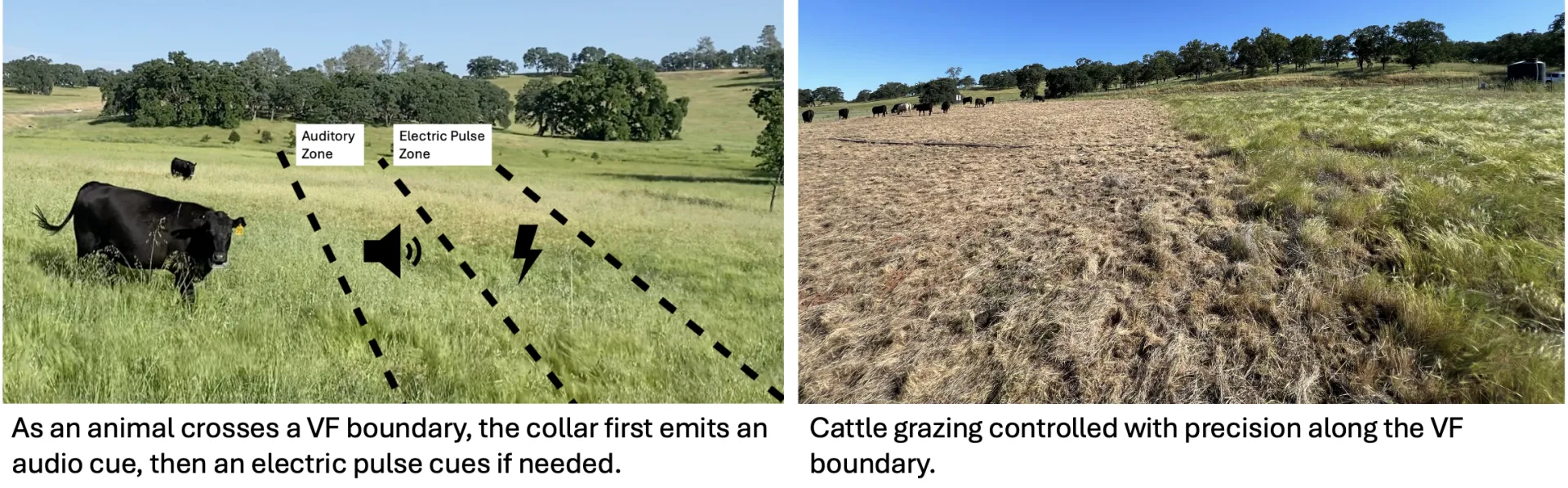
Virtual fencing (VF) is an emerging precision agriculture tool capable of improving grazing systems for both livestock producers and land managers that is growing in use across California’s diverse rangelands. It uses GPS collars to contain livestock without physical fences. Producers set virtual boundaries across their pasture from a computer, which are transmitted to the collars via cellular signal. When an animal approaches the boundary, the collar emits audio cues and, if needed, mild electric pulses to keep the animal within the boundary.
Virtual Fencing for Tracking Livestock
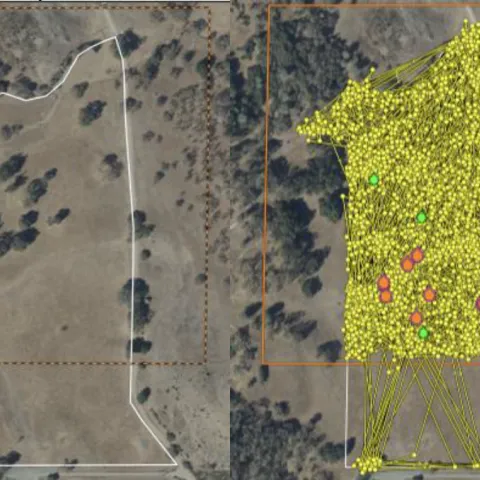
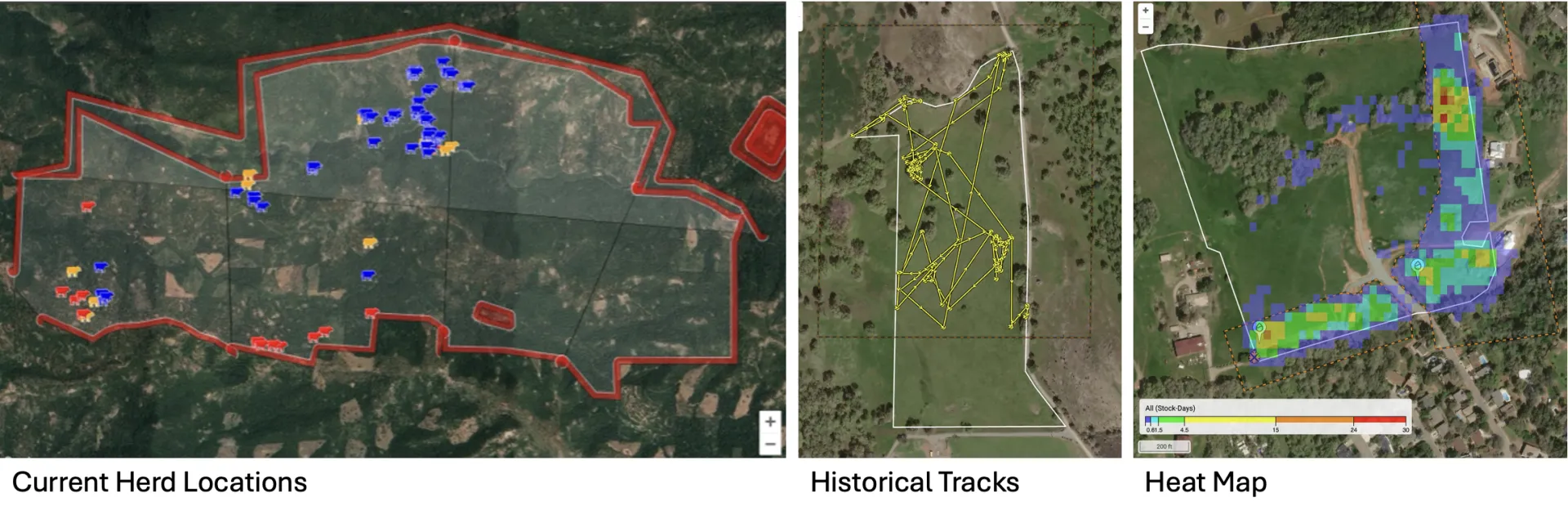
VF collars use satellites to determine their GPS location within a few yards and use cellular signal to send and receive data and updates to the user. Users can monitor each animal’s a) real-time location, b) historical tracks, and c) pasture utilization. This is especially helpful on large, remote, or forested ranges where animals are otherwise hard to locate. Reported benefits include faster roundups, alerts for stationary animals (who may be sick or have lost a collar), and faster response times for escaped animals.
Virtual Fencing for Containing Livestock
VF collars precisely contain or exclude livestock within user defined boundaries without the need for physical fence. Using a smart device, the user draws a VF boundary in minutes and sends it to collars via cell signal, typically within an hour. As an animal crosses a VF boundary, the collar emits an audio cue, followed by a mild electric pulse if needed. In UC ANR trials, livestock quickly and intuitively respond to these cues, eventually responding to audio cues alone more than 90% of the time. Immediately after first collaring, herds are consistently contained within VF boundaries over 95% of the time. VF boundaries also let animals enter freely but contain them if they try to leave. Altogether, this allows animals to be contained exactly where they are needed on the landscape with greater flexibility, deployment, and intention than traditional fencing allows. While not a replacement for secure perimeter fence where 100% containment is needed, VF is a versatile alternative to cross fencing.
Applications of VF
Some applications seeing active use and potential merit include:
- Tracking livestock remotely in real-time across large terrain to reduce trips, shorten round ups, and respond faster to downed or escaped livestock.
- Preventing escapes from open gates or damaged fences.
- Excluding livestock from recent burns, active logging areas, riparian zones/meadows, infrastructure, recreational areas, archaeological sites, etc.
- Offsetting the need for cross-fence construction.
- Minimizing public interaction by keeping herds away from roads, trails, and recreational areas.
- Easier rotational grazing.
- Targeted grazing to control palatable invasive weeds.
- Targeted grazing to reduce flashy and brushy fuels to reduce wildfire risk, including installing long and narrow fuel breaks.
- Rapid reentry to areas impacted by wildfire, allowing grazing to resume in unburned sections without (or while) rebuilding lost fences.
Costs of VF
VF costs include an initial investment in the hardware (typically between $10K to $40K) and annual recurring costs starting in year two (typically between $1K to $7K). Costs vary by:
- Livestock type (cattle, goats, or sheep) and number to collar.
- Cellular coverage across the pasture. Some VF systems use LoRaWAN base stations, while others rely solely on cell networks.
- LoRaWAN: Base stations are solar-powered cellular antennas placed on high points of the range. They are ideal if cell reception is spotty in the area and/or limited to ridgelines. Only the base station needs to be in cell range, it can then relay coverage to the rest of the range through line of sight connection with collars. These cost between $4.5K and $10k each.
- Cellular: Best for ranges with good, consistent coverage. The cost and setup for cellular systems are simpler.
- Whether you prefer to buy or lease collars.
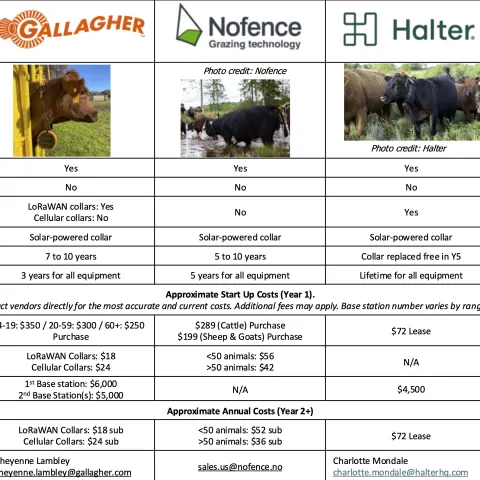
VF Vendor Comparison Guide

![]() | ![]() | ![]() | ![]() | |
![]() | ![]() | ![]() | ![]() | |
| Requires cell reception | Yes | Yes | No | Yes |
| Works with satellites only | No | No | Yes | No |
| Requires base station / tower | LoRaWAN collars: Yes | No | No | Yes |
| Battery type | Solar-powered | Solar-powered | Solar-powered | Single use |
| Battery life | 7 to 10 years | 5 to 10 years | Collar replaced for free in | 3 months to 1 year |
| Warranty | 3 years for all equipment | 5 years for all equipment | Lifetime for all equipment | None for collars. 90 days for BS |
| Company contacts | Cheyenne Lambley | Charlotte Mondale |
Approximate Start Up Costs (Year 1)
*Note: Contact vendors directly for the most accurate and current costs. Additional fees may apply. Base station number varies by range geography.
![]() | ![]() | ![]() | Image ![]() | ||
| Acquisition type | Purchase | Purchase | Purchase | Lease | Lease |
| Cost per collar* | 20-59 head: $300 | Cattle 5 - 24 head: $349 | Sheep & Goat 5 - 24 head: $269 | $96 | $40 + $10 replacement battery |
| Annual subscription cost per collar* | LoRaWAN Collars: $18 | Option 1: Monthly rate | N/A | N/A | |
| Base station* | 1st BS: $6,000 | N/A | $4,500 | $10,000 | |
Approximate Annual Costs (Year 2+)
![]() | ![]() | ![]() | ![]() | |
| Leasing cost per collar* | N/A | N/A | $96 | $40 + $10 replacement battery |
| Subscription cost per collar* | LoRaWAN Collars: $18 sub | Option 1: Monthly rate | N/A | N/A |
University of California Virtual Fence Webinar Series
Episode 1: Basics of Virtual Fence.
An overview of how virtual fencing tracks and contains livestock, how to deploy a VF system, highlights the current vendors available on the U.S. market, and funding opportunities available for VF in California.
Episode 2: Virtual Fence for Livestock Production
Hear from a panel of California ranchers who have at least 2 years of experience integrating virtual fencing into their livestock operations. The discussion focuses on their real world experiences, challenges, and lessons learned.
Episode 3: UC ANR Virtual Fence Research Trials
UC ANR researchers share results and insights from field trials testing virtual fencing on California rangelands. Topics include livestock management on expansive range, targeted grazing of invasive Medusahead (Elymus caput-medusae) and barb goatgrass (Aegilops triuncialis), fuel reduction, and livestock behavior.
University of California Research on Virtual Fencing
The University of California Cooperative Extension Central Sierra is working to understand the applications of VF on California rangelands with grant funding through the United States Department of Agriculture Natural Resources Conservation Service Conservation Technical Assistance: Grazing Lands Conservation Initiative (GLCI) Cooperative Agreements. The UCCE does not endorse any single VF product.
Please click on the links below to learn more about our research trials and findings.
Questions?
Please contact Brian Allen (brallen@ucanr.edu)
Virtual Fencing in the News
The UCCE Central Sierra Virtual Fencing program was featured in Ag Alert, the Newspaper for California's Agriculture, a California Farm Bureau publication. Please click the California Dairy & Livestock header, or this link to read the special report.

The UCCE Central Sierra Virtual Fencing program was featured on the Voice of California Agriculture podcast, episode 5/1/25.
Central Sierra: Virtual Fencing Information
UC Central Sierra research on Virtual Fencing on California Rangelands
Virtual Fencing is a precision agriculture tool gaining traction across California's diverse rangelands that uses GPS collars to contain livestock without physical fences.
Research and trials are ongoing, and many of the findings are collected in the content found here.
Central Sierra: UCCE Central Sierra Hosts Virtual Fencing Workshop for NRCS Staff

Virtual Fence Cost May Be Offset with NRCS EQIP Funds
Virtual Fencing (VF) is a livestock management tool that uses GPS collars to track livestock and guide their movements with audio and electric pulse cues. Instead of building a physical fence, users can draw a virtual boundary on a computer or mobile app, and send them to collared livestock in the pasture. VF is not a legal fence nor a replacement where complete containment is required, such as along busy roads. However, it can be a highly adaptable tool for managing livestock distributions and monitoring locations remotely. Interest in this new technology is increasing among livestock producers and land managers in California, but upfront costs remain a common barrier to adoption. Costs vary by herd size, vendor, and pricing structure. For example, collaring 100 mature cattle may cost between $10,000 and $30,000 in the first year, with subsequent annual subscription or leasing costs of about $2,000 to $10,000.
Virtual fence is now eligible for support through the USDA Natural Resources Conservation Service (NRCS) Environmental Quality Incentives Program (EQIP). This creates new opportunities for producers interested in using the technology to support conservation grazing practices. EQIP provides technical and financial assistance to agricultural producers and forest landowners implementing conservation practices on working lands. Applicants work with their local NRCS field office to complete a site visit, identify conservation needs, and develop a conservation plan. For approved EQIP projects, the initial investment in VF may be supported through Practice 382 (Fence). Subscription or lease costs in years two through five may be supported through Practice 528 (Grazing Management) to implement the grazing plan.

On May 12, 2026, UCCE Central Sierra hosted NRCS field staff from across California for a virtual fencing workshop in Amador County. The workshop was organized due to a growing interest among NRCS staff seeking practical guidance on the technology as they work with applicants considering VF through EQIP. Participants traveled from field offices throughout the state, including Visalia, Napa, Susanville, and other regions.
The workshop covered how VF tracks and contains livestock, recent advancements in the technology, vendor comparisons, system costs, producer feedback, app functionality, and lessons from UC ANR field trials (Figure 1).
These trials explored the use of VF for targeted grazing of invasive medusahead and barb goatgrass, linear fuel break installation, livestock exclusion from sensitive and recreational sites, and rotational grazing with small ruminants. Participants also discussed practical implementation considerations, including how to evaluate cellular coverage across a new pasture, and emerging direct-to-satellite options.
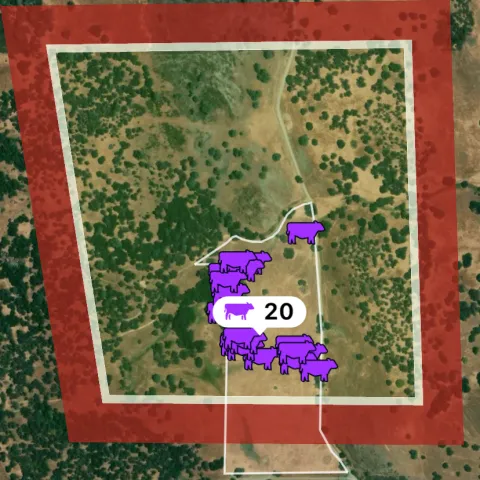
The afternoon included a field demonstration with Leisel Finley, a fifth-generation cattle rancher in Amador and El Dorado Counties, and owner/operator of Mt. Echo Ranch (Figure 2).

The ranch has used virtual fencing since the 2021 Caldor Fire destroyed significant physical fencing infrastructure on their summer grazing allotment on the El Dorado National Forest. NRCS staff were able to see collared livestock up close and speak directly with a producer experienced in the practical opportunities and challenges of using virtual fencing on working rangelands.
More information about EQIP is available through local NRCS field offices and at: https://www.nrcs.usda.gov/programs-initiatives/environmental-quality-incentives-program
Central Sierra: UCCE Researchers Bring Virtual Fence Technology to Local BLM Lands
Central Sierra: Virtual Fencing Enables Cattle to Install Fuel Breaks in the Wildland-Urban Interface

Strategically placed buffers help slow the spread of wildfire
California’s annual rangelands are famous for their green, rolling hills in winter and spring. But as the grass dries out, these landscapes become highly flammable and pose a significant fire risk. According to CAL FIRE’s Wildfire Activity Statistics Annual Reports, grass fires were the most common type of vegetation burned in the Central Sierra counties of El Dorado, Amador, Calaveras, and Tuolumne. From 2019 to 2023, they accounted for approximately 78% of all acres burned in the region, averaging about 3,033 acres annually (CAL FIRE, 2019–2023).
Mitigate wildfire risk by reducing fine fuels and adding fuel breaks
Reducing fine fuels is a critical proactive step in mitigating wildfire risk, especially in high-priority areas where grasslands border human activity. Fuel breaks are often most effective when placed near likely ignition sources, such as roads or powerlines, and around vulnerable assets like homes, communities, or critical infrastructure. In both cases, these strategically placed buffers help slow the spread of wildfire, improving the chances of containment and reducing the risk of catastrophic damage. Every year, fuel breaks are created and maintained by private landowners and livestock producers, county road and public works crews, local Fire Safe Councils, Resource Conservation Districts, CAL FIRE, private contractors, and others.
Methods for creating and maintaining effective fuel breaks include targeted grazing
Common techniques include mowing, herbicide application, prescribed fire, grading, cultivating, and targeted grazing. Choosing the right method depends on many factors, including site conditions, ownership, ecological concerns, and available resources.
Targeted grazing can make a lot of sense on annual rangelands because it leverages livestock’s natural foraging behavior to turn fine fuels into marketable weight. This reduces labor for landowners and generates income for producers. Fuel breaks can protect ranchers from losing feed to fires that start along roads, and just as importantly, they help protect surrounding communities from fires that may start on the pasture. However, implementing fuel break grazing typically requires fixed or temporary infrastructure, often electric fences, parallel to the outer perimeter fence to concentrate grazing for the desired fuel reduction.
Virtual fencing as a flexible, labor-saving alternative to fenced fuel breaks
In June 2024, UCCE tested whether virtual fencing (VF) could provide a more flexible, labor-saving alternative to fenced fuel breaks by eliminating the need for an inner physical fence while still achieving comparable fuel reduction. The trial was conducted on a privately owned pasture adjacent to the city of Sutter Creek. After a productive growing season, the grass stood over 3 feet tall in many areas and averaged 4,269 pounds of dry forage per acre (the equivalent to about 71 bales of hay per acre, assuming 60 pounds per bale). Several homes stood within 50 feet of the fence line, making the fuel load a clear fire hazard. Removing such fuels could help achieve the 100’ of defensible space that CAL FIRE recommends.
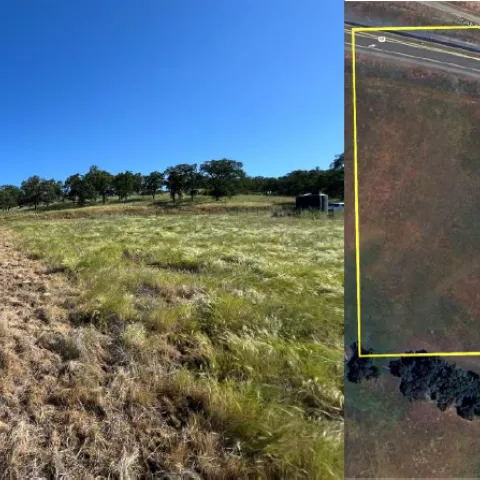
Thirty-seven cattle of mixed age and breed with no prior exposure to VF were selected for this trial (Figure 1 Left). A single VF base station was placed near the trial site to allow the collars to properly communicate. After an 8 day training period, the herd was confined to a 150 foot wide grazing area between the outer hardwire perimeter fence and the VF boundary. The herd received salt and protein supplement during the trial to account for the decreasing forage quality of the dry grass. These were placed away from water and loafing spots to encourage more uniform utilization. Over 19 days, the herd grazed the 7.7 acre fuel break down to 780 pounds per acre (about 13 bales of hay per acre), an 82% reduction of flammable fuels (Figure 1 Right).

Figure 1. Left: Herd wearing VF collars. Right: Results of the fuel break grazing. The dashed line shows where grazing stopped along the VF boundary.
The herd respected the VF boundary 99% of the time (Figure 2), being contained by the audio cues alone 81% of the time (Figure 3). Visually, the livestock appeared calm throughout the trial. The only water in the pasture were troughs placed inside the fuel break. As VF boundaries only prevent animals from leaving an area, the few cattle who did escape would eventually return voluntarily, drawn either by thirst, supplement, or the presence of the herd.

Figure 2. GPS locations (blue dots) of the herd during the 19-day trial. These points outline the location of the fuel break in relation to the city of Sutter Creek.


Figure 3. Top: Percentage of audio and electric pulse cues received by the herd each day. The livestock learned to respond primarily to the audio cues alone as the trial proceeded. Bottom: Audio and electrical pulse count for the 37 member herd per day. Fuel Break 1 was the smallest and therefore required the most cues for containment. Given the herd size of 37 cows, ~600 cues per day equates to about 1 cue per animal every 1.5 hours.
Virtual Fencing offers extraordinary levels of flexibility compared to traditional fencing
Compared to physical fencing, VF offers extraordinary levels of flexibility to adapt grazing and exclusion areas to meet ongoing management needs. In this trial, a newly paved road crossed the fuel break, so we split the fuel break into two VF zones to exclude livestock from the road. The herd was easily moved to the second fuel break after grazing the first.
The primary tradeoff with using VF in this trial instead of electric fence was the width of the fuel break. While John Allen, the participating rancher in this trial, typically installs 60 foot wide fuel breaks using electric fencing, we chose a 150 foot wide VF to account for GPS inaccuracy and to reduce stress on the animals from excess audio and electric pulse cues. While this wider area provided a greater level of protection from wildfire, it also took approximately twice as long to graze to the same level of fuel reduction.
“VF is quicker, easier, and more reliable than the electric fence we use nearby to graze a firebreak along the roadway. Also, it’s probably better suited to cows rather than calves that are going to the market,” says rancher John Allen.
Trial suggests Virtual Fencing may be an effective way to create linear fuel breaks in rangelands
This trial suggests that VF is an effective solution to install linear fuel breaks in fire prone rangelands, and it will likely gain value as the technology continues to mature. This application seems most practical as an added benefit for ranchers and land managers who have invested in VF to improve other areas of their operation, such as monitoring and managing livestock across vast or difficult-to-fence areas, as is common in many summer ranges. In this scenario, VF collars could be deployed slightly earlier in the season to schedule fuel break installation in critical areas just before cattle are moved to summer pasture.
Want to learn more?
Reach out to Brian Allen at brallen@ucanr.edu
Or join our Livestock and Natural Resources Newsletter email list
Sign up to receive email news about future research
This work was funded by the USDA Natural Resources Conservation Service.
References
1) California Department of Forestry and Fire Protection (CAL FIRE). (2019–2023). Wildfire Activity Statistics Annual Reports. https://www.fire.ca.gov/our-impact/statistics
Central Sierra: How to Collar & Train Livestock to Recognize Virtual Fence Boundaries
Central Sierra: Introduction to Virtual Fencing for Livestock and Land Management
Central Sierra: Virtual Fencing Directs Cattle to Graze Medusahead Grass on California Rangeland

Infestations of Medusahead can be suppressed by targeted grazing
Medusahead (Elymus caput-medusae) is a common invasive grass on California’s annual rangelands. It accumulates high levels of silica as it matures, making it unpalatable to livestock and slow to decompose. As a result, livestock tend to avoid it for more desirable forage, potentially allowing it to form a dense thatch layer that persists on the landscape. This can suppress more desirable forage species and allows medusahead to spread over time.1,2
Medusahead seeds remain viable for only a few years, so disrupting seed development can control infestations. While herbicides and mechanical removal are viable control methods, we explored whether high intensity, targeted grazing guided by virtual fencing (VF) could offer an effective and practical alternative.1,2 Fortunately, there is a brief window when the developing plant has produced immature seeds and has not yet accumulated high silica levels.3 During this time cattle may find medusahead palatable enough to consume, potentially interrupting its reproductive cycle.4
UC Cooperative Extension Central Sierra Advisors used Virtual Fencing for targeted grazing
In May of 2024, we used Virtual Fencing (VF) to concentrate 25 steers and heifers on a 3-acre Medusahead infestation along a fenceline within a larger pasture in Amador County. Water and shade were provided within the enclosure. The livestock stayed in the VF area 100% of the time for nine days. On the tenth day, however, the livestock left the area, presumably for better forage. Despite this escape at the end, we were satisfied with the result.
Only 5.6% of the pasture in the target area still had ungrazed Medusahead with viable seed heads that could grow next season, whereas immediately adjacent to the grazing area, ungrazed Medusahead had turned into a thatch that covered 87.3% of the pasture (Figure 1). All animals gained weight during the trial.

Figure 1. Left: The viewer's left demonstrates the impact of high-intensity, short duration grazing on immature medusahead, contrasted with the ungrazed control area showing high levels of medusahead infestation, identifiable by its glossy yellow green color. The VF boundary is visualized by a line in the pasture that the animals are trained not to cross. Right: VF collar location data (blue dots) during the trial. The VF boundary is represented by a yellow line and the barbed wire fence is represented by a white line.
Effects of high intensity targeted grazing using VF collar
The effects of this single high intensity targeted grazing treatment carried over into the following year. While the control plot remained nearly unchanged, the grazed plot displayed the following improvements one year later compared to the original condition:
- Medusahead cover remained far lower in the grazed plot, from 22% originally to 6%.
- Other grasses and broadleaf plants (forbs) doubled.
- Thatch cover was nearly eliminated.
- Bare ground remained low.

Figure 2. Estimated percentage cover of vegetation types immediately before the grazing trial (blue) and one year after (gold). Left: Impacts of grazing on vegetation types. Right: Ungrazed control.
Results of this Virtual Fencing grazing trial
These results suggest that virtual fencing has merit as a tool for targeted grazing of medusahead during its short vulnerable phase, offering ranchers and land managers a flexible and labor-saving option to improve rangeland health. Currently, we are conducting a similar trial on barbed goatgrass (Aegilops triuncialis), a similar problematic annual grass weed. We are excited to share those results with you in the future.
Want to learn more?
Reach out to Brian Allen at brallen@ucanr.edu
References
1.George, M. R. (1992). Ecology and management of medusahead. University of California Range Science Report, 23, 1-3.
2.Young, J. A. (1992). Ecology and management of medusahead (Taeniatherum caput-medusae ssp. asperum [Simk.] Melderis). The Great Basin Naturalist, 245-252.
3.Murphy, A. H., & Turner, D. (1959). A study of the germination of medusa-head seed.
4.DiTomaso, J. M., & Smith, B. S. (2012). Linking ecological principles to tools and strategies in an EBIPM program. Rangelands, 34(6), 30-34.