
Armyworms have long been a pest of rice, but 2015 was an outbreak year, and high populations have continued in subsequent years. UC Cooperative Extension has responded to the problem by providing outreach on UC IPM guidelines, including monitoring and treatment thresholds. We also monitor populations using pheromone bucket traps deployed across rice-growing regions. In the Delta, I have been monitoring populations since 2016. Because small armyworms are hard to scout and large armyworms are hard to treat, we use trap counts, field scouting, and Growing Degree Day modelling (i.e. a temperature measure of time) to determine whether treatment is needed.
Our observations over the years lead us to believe that it is the true armyworm (Fig. 1), rather than the western yellowstriped armyworm (Fig. 2), that is most damaging to rice. So, since 2021, we have only monitored true armyworms. In the Delta, I have observed true armyworms in rice fields but also in wetland areas and summer cover crop mixes that include small grains. Therefore, when scouting populations in rice, I suggest also checking nearby fields growing other grasses that might be harboring the pest. Also noteworthy, we observe a lot of variability in populations from year to year. For example, in 2023, the peak population occurred two weeks later than what has been typical, which was likely due to the wet winter, cool spring, and later planting. In 2026, however, the peak population occurred nearly a month earlier than what has been typical, possibly due to the unusually warm spring. I have observed that feeding damage is highly variable across the three Delta farms where traps are located but also across fields on the same farm. We have not observed high populations later in the season after heading, even though a second peak has sometimes been observed in the Sacramento Valley.
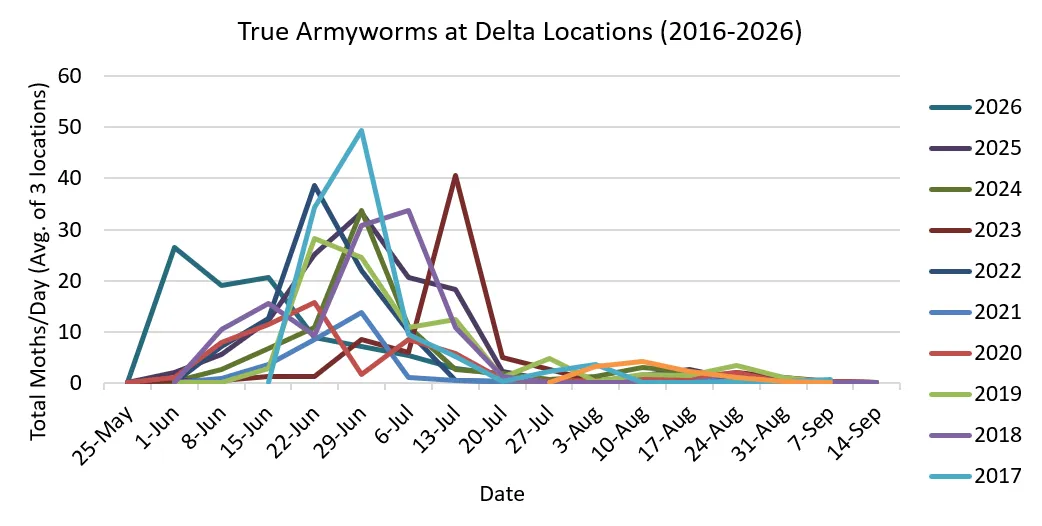
Fig. 1. 2016-2026 Delta True Armyworm counts.
