
Water Quality, Sampling, and Testing
The following resources provide guidance on how to properly collect and analyze water samples to assess agricultural water suitability. Water quality parameters (e.g., nutrients, salts, metals) affect crops and soil health. Understanding water quality is critical for protecting crop productivity and preventing long-term soil degradation. Proper sampling and testing are essential for making informed irrigation and nutrient management decisions and meeting regulatory or food safety requirements. Click on the links below for more information.
- Assessing Water Quality and Taking a Water Sample
- Selected Plant and Soil Laboratories in Northern and Central California
- Click "Services Provided," at the top of the page to see lab testing capabilities.
- Testing Agricultural Water for Fruit and Vegetable Production and Postharvest Handling
- Water Quality Technical Notes & Resources
Irrigation Management
Deciding when and how much to irrigate depends on crop water requirements, soil conditions, and climate. The below resources provide information on irrigation decision support tools such as evapotranspiration estimates, soil moisture monitoring, and plant-based measurements to improve irrigation management. Effective irrigation management improves system efficiency, optimizes yield and quality, and reduces environmental impacts. Click on the links below for more information.
Irrigation Design and Maintenance
Information on selecting appropriate irrigation system components and ensuring they are properly maintained to deliver water efficiently and uniformly. Good system design and upkeep reduces failures, prevents clogging, and supports consistent crop performance over time. Click on the links below for more information.
- Choosing the right irrigation system and equipment
- Filtration, Treatment, and Maintenance Considerations for Micro-Irrigation Systems
- Irrigation Clogging
- Irrigation Filtration
Irrigation efficiency
Resources to optimize crop water use while minimizing losses to runoff, evaporation, and deep percolation. Improving efficiency helps reduce costs without compromising crop performance. Click on the links below for more information.
- Calculation of drip irrigation application rate
- How to sample emitters for distribution uniformity
- Irrigation system distribution uniformity
Irrigation scheduling and vineyard water use
Resources to guide when and how much to irrigate based on vine water demand, growth stage, and environmental conditions. Proper scheduling helps balance yield, fruit quality, and water efficiency. Click on the links below for more information.
- Determining Irrigation Requirements
- Specialty Crops Water Management
- Vineyard Irrigation with a Limited Supply of Water (video)
- When to start irrigating vineyards
Irrigation and water management tools
- CA Irrigation Management Information System (CIMIS)
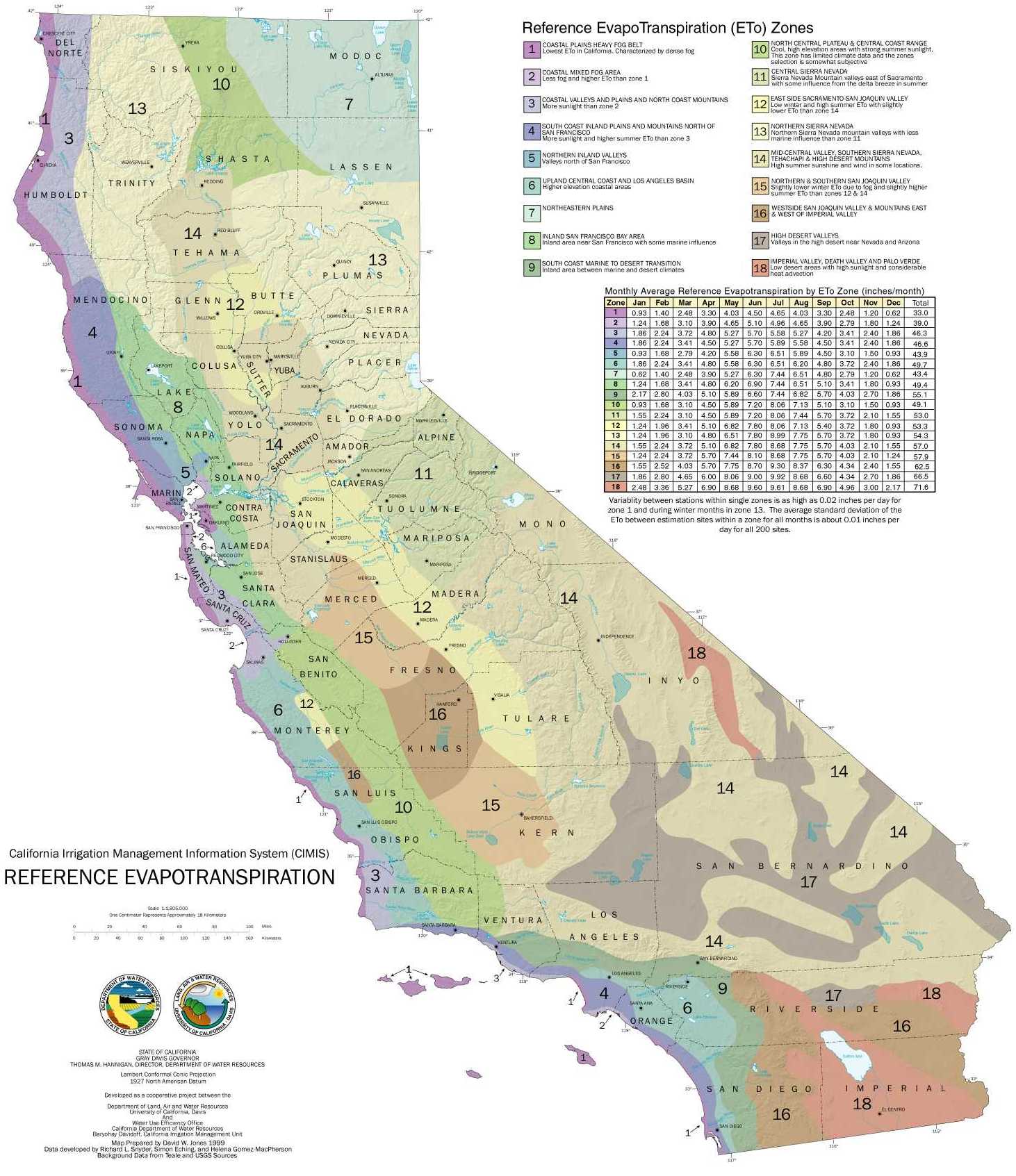
- CIMIS ETo Zones Map
- CA Water Watch - DWR
- Measuring Grapevine Water Stress - Stem Water Potential (video)
- Soil moisture sensors
Groundwater Policy & Management
CA's Sustainable Groundwater Management Act (SGMA)
SGMA is the statewide program for managing groundwater sustainably through local agencies and basin-level planning. These resources explain requirements, data tools, and how groundwater use is monitored and regulated. Click on the links below for more information.
Sonoma County Groundwater
Local groundwater programs, monitoring efforts, and tools available to well owners and groundwater users. Click on the links below for more information.
Napa County Groundwater
Local groundwater programs, monitoring efforts, and tools available to well owners and groundwater users. Click on the links below for more information.
Marin County Groundwater
Local groundwater programs, monitoring efforts, and tools available to well owners and groundwater users. Click on the links below for more information.
Mendocino County Groundwater
Local groundwater programs, monitoring efforts, and tools available to well owners and groundwater users. Click on the links below for more information.