
Recognizing Drought Stress
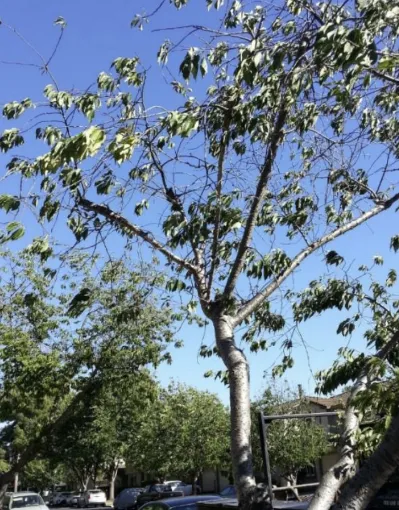
Concord, June 2015. Photo courtesy of Arti Kirch.
According to the Arbor Day Foundation’s website, landscapes with trees increase property values by as much as 20%. For this reason alone, you may be wondering if the drought is affecting your trees. The short answer is a definitive “yes”. Most of our trees are suffering some form of drought stress. In fact, some of what we are seeing may have started up to 2 years ago, including:
- Tree leaves that are wilting, curling at the edges, and yellowing.
- Deciduous leaves that exhibit scorch, brown outside edges or browning between veins.
- Evergreen needles that have turned yellow, red or purple. They may also be browning at the tips with some of that browning progressing towards the twig.
- Leaves that are smaller than normal, drop prematurely or remain attached to the tree even though brown.
Drought stress itself may not kill a tree, but instead may create conditions for pests or disease in following years. In addition, many trees entered the drought already handicapped, having been inexpertly pruned over many years, doused repeatedly and continuously with chemicals and air pollution, or situated in compacted soils with inadequate availability of oxygen and water.
Deciding Whether to Keep the Tree
What to do then for these precious assets? Nothing will substitute for calling in an arborist to help you assess a tree’s condition and create an action plan. However, contrary to what you might expect, the first step is to decide whether to keep the tree.
Some trees in our urban and suburban landscapes are simply inappropriate for our climate and soils. Those trees will always demand water or nutrients – often funded by your bank account – in their struggle to survive.
Other trees may be, or may become, a liability. Perhaps roots are perilously close to your house’s foundation, or branches hang precariously over the spot where your neighbor parks their car. Maybe the tree has reached the end of its natural lifespan.
Whatever the reason, my favorite arboriculture instructor advocates for the courage to take a tree – and you – out of its misery, instead of investing more resources in a project with a poor return on investment.
Keeping the Tree
If you decide that the tree is worth keeping, then the list of do’s is very short: keep the tree properly watered for its species (type) and age. This is important as some trees can be killed if watered improperly. For example, fungi that are activated in the presence of warmth and water can attack many native California oaks. You also need to take the tree’s age into consideration.
This is a big commitment and might mean forgoing your lawn or tomatoes. But, replacing non-woody plants is usually far cheaper than replacing a tree, and non-woody plants typically grow to their mature sizes more rapidly, whereas waiting for a tree to gain its mature size could take a lifetime. Can you wait that long?
Watering Correctly
The critical factor is to apply water to the soil slowly. Why is that important? Well, if you had to swallow 10 gallons of water in 10 minutes, you might be able to do it, but some would likely run out of your mouth. A tree’s physiology vis-a-vis water is somewhat different, but the concept of too much water to absorb at once still applies. Moreover, repeated shallow watering promotes shallow roots, which are nearer the soil surface and therefore dry out faster.
Trees in pots, or those that are newly planted, ~may~ benefit from the use of hydrogels. These products, developed for professionals in the nursery and landscape industries, are becoming more available to home gardeners. However, author and educator Dr. Linda Chalker-Scott makes a powerful case against the most commonly available gels, because they contain polyacrylamide (PAM). In addition to breaking down into toxic by-products, PAM hydrogels do not work well in clay soil (which is nearly omnipresent in our East Bay landscapes). Moreover, the University of California notes that with regards to their efficacy, “...field research studies with polymers so far are relatively few and inconclusive".
If you have a young tree, the Sacramento Tree Foundation recommends the following:
- Collect water in a bucket while your shower warms up.
- Drill a very small hole (1/8") near the bottom of a second bucket. Place the bucket near the trunk of your young tree.
- Transfer the shower water you saved to the drilled bucket. Your young tree only needs 10-15 gallons of water per week. That's the same amount of water used in a 6-minute shower!
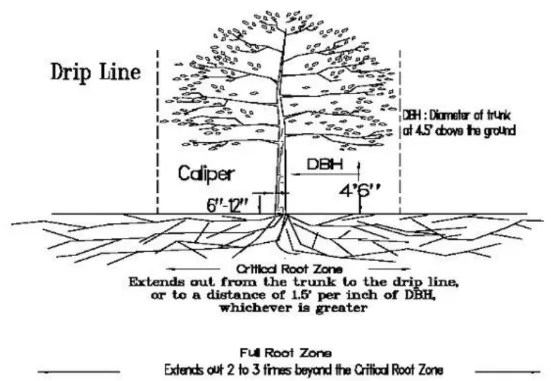
Watering a mature tree differs from a young tree in the frequency, amount, and location of where the water is applied:
- The frequency of watering is a function of the tree species, but the University of California Center for Landscape and Urban Horticulture (UC CLUH) at https://ucanr.edu/sites/UrbanHort/ advises that established trees should perform well if watered every 5-10 days. Also, it is always better to water deeply and less often. Water applied should soak into the soil to a critical depth of at least 12 inches. More frequent, shallow watering is much less effective at maintaining tree health. A soil probe can help you check how far the water has penetrated.
- Having identified the tree species also provides the information for how much to water. One rule of thumb is 10 gallons for every inch of the tree trunk’s diameter. The UC CLUH also notes that trees “perform acceptably with 20-40 percent less water than they are typically given".
- Water should be applied in the area referred to as the critical root zone. This is the area radiating from the tree trunk to the drip line as shown in the illustration. Some of the choices for watering this area include:
- Deep drip watering stakes;
- Deep root forks;
- Deep root needle;
- Soaker hoses, surrounding the tree in a spiral or wagon-wheel pattern;
- In-line drip systems such as Netafim/Agrifim.
Conserving the Water You Apply
Once you have applied the water, the trick is to keep it in the soil as long as possible. The easiest and possibly most effective tool for achieving this is ulch. The benefits of mulch are practically magical!
- Mulch insulates the soil, reducing water evaporation and keeping the tree roots cool.
- Mulch suppresses weeds, which compete with the tree for moisture.
- Mulch enriches the soil as it breaks down.
- Mulch promotes conditions that favor the development of mycorrhizae, the beneficial soil fungi that are actually more effective in nutrient and water absorption than plant roots themselves.
Apply 2-6 inches of mulch. The coarser the mulch, the more thickly it can be applied, but too much can cut off oxygen exchange with the soil. Keep the mulch at least 6 inches away from the tree’s trunk(s). Wood chips (often free from local arborists) are the most cost-effective way to achieve maximum benefit.
Avoiding Mistakes
This article would be incomplete without a “to don’t” list, therefore, here’s what NOT to do:
- Don’t fertilize in drought. Fertilizer promotes growth, demanding water to form new structures, which in turn demand more water to survive. An exception to this is compost, which provides numerous benefits and can be applied just like mulch.
- Don’t prune unless it is for safety or liability reasons. Cutting live branches at any time removes live tissues, stimulating a growth response and forcing the tree to expend energy to defend against the pruning cuts. Removing live foliage can also expose more tender parts of the tree to sunburn.
- Don’t plant any new trees yet. Wait until autumn, by which time the fierce summer sun will have passed, and the rains will (hopefully) be on the horizon. The drought is making us aware not only of the ways we use water personally, but also how crucial it is to the life around us that we depend on.
Fun Fact
We each need 7-8 trees for our annual oxygen needs. All hail the tree!
Sources for Additional Reading
- Chalker-Scott, Linda. The Informed Gardener, University of Washington Press, 2008
- University of California Center for Landscape and Urban Horticulture: Landscape Water Conservation and Irrigation—Questions and Answers about Water Conservation & Drought in the Landscape.
https://ucanr.edu/sites/UrbanHort/Water_Use_of_Turfgrass_and_Landscape_Plant_Materials/Water_Demand_Calculators/ - Science Focus: How many trees does it take to produce oxygen for one person?
https://www.sciencefocus.com/qa/how-many-trees-are-needed-provide-enough-oxygen-one-person
Article by Arti Kirch, UC Master Gardener, Contra Costa County. 2020-02-23
Produced by UC Master Gardener Program of Contra Costa County
2380 Bisso Lane, Concord, CA 94520
Web: https://ucanr.edu/site/uc-master-gardener-program-contra-costa-county