
Introducing the good, the bad, and the ugly
by UC Master Gardener of Lake Tahoe Basin, Bonnie Turnbull
Bugs. ICK! Annoying flits circling your eyes. That tickle on your skin after dark. The whine of a mosquito. Stingers. Okay. I agree--to a point. Who could love a mosquito--an insect which kills a million people a year? I keep my distance from big spiders, too.
But after that things get complicated for me. No bees? I’d be hand-pollinating my squash one blossom at a time. If I poisoned every caterpillar that chewed the tender innards of my cabbage, I’d lose all those dancing white butterflies. Like I said, complicated…
It’s a recent fascination for me. What changed my heart and mind was my kindergartener. She cavorted through the yard with homemade butterfly net seeking “fairies”. To her, those tiny creatures were fairies. My first instinct was to correct her and then, I remember deciding, why? Why aren’t they fairies? They both live in their own tiny communities, inside a world of flowers, each with their own personality.
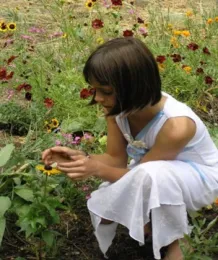
What really surprised me was how many she found as she grew. She showed them to me, at first trapped inside her “bug box” and later in her photos. On my own, all I saw were the butterflies and grasshoppers and she taught me to look closely at the wonders of that unseen world. Together we found the mites that were sickening my beans. A few years before, I might have assumed they needed more water.
I invite you to get to know your tiny garden companions. The vast majority of the insects you will find in your yard are either benign or helpful. So I encourage you to get out your hand lens, go outside and look closely. Soon, you will start to notice that they are everywhere (sorry if that ruins your sleep). At our house, we don’t call them fairies anymore, but I do affectionately call them The Good, The Bad, and The Ugly.
The Good (Pollinators): Bees
1600 species of bees live in California alone. Though you know something about (non-native) honey bees, and something about bumble bees, you probably have never even noted other kinds at all. But their names inspire the imagination--leaf-cutting bees, long-horned bees, carpenter bees, ultra green sweat bees, wool carder bees, and cuckoo bees.
They can be a just a few millimeters or a few centimeters long. They can be green, grey, black, blue, or yellow with patterns of dots or stripes. They can be long and slender, fat and round, fuzzy or metallic.
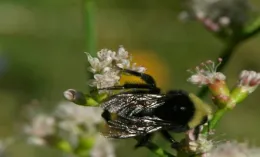
Our native bees will seldom bother you. In fact, my daughter has learned to pick up and pet some of the slow, fuzzy ones in our garden. Their first instinct is always to fly away and males cannot sting at all. Bees get a bad reputation because we confuse them with yellow jackets (wasps) which aren’t the same creature at all.
Before the clearcutting of Tahoe, (The Bad AND The Ugly!) large trees grew farther apart. Wildflowers and their pollinators inhabited the sunny meadows in between. Now, much of that habitat is gone and with it, those interconnected webs of life,. Our landscaping does not usually substitute at all. This is true nearly everywhere in the world and bee populations have plummeted.
That’s not so bad, you might be thinking. Fewer bee stings! However, most wildflowers, and one third of food crops, depend upon pollinators--mainly bees--for seed and fruit production. But, if your image of bees is of Pooh-Bear’s tree-hanging hive, you will be surprised to learn that hive-dwelling is very much the exception with bees.
70% of our native bees live alone, usually in holes the ground but also in hollows in plant stems or wood. The different species emerge from their nests at different times to coincide with the blooming of their favorite, native food source. Some remain in their nests until late summer.
After a few weeks of feasting, the females build a nest for her own young. Depending on species, it might be oh-so-soft lambs' ears hairs, or wax, or pebbles to name a few materials. Then she dies. The young over-winter in the nest and emerge the following year.
Please welcome native bees to your garden so you will foster our unique Tahoe web of life.
Feed them. Create a continuous sequence of blooms spring to fall. Dead-heading and watering natives creates an extended “spring”. Planting later-blooming flowers will create color in your yard as well as providing food sources for those last to emerge.
Plant a variety. 20 or more seems ideal--and especially natives, to support a variety of pollinators, and, also support those pollinators which need variety. Planting a bed of a single type of flowers at least 10 square feet will draw their attention and help them thrive by saving energy searching for food.
Give them a place to live. Grit your teeth for this advice! Leave some areas “weedy” and leave some soil bare or lightly mulched to provide habitat and avoid using poisons like pesticides and herbicides.
For more information on bees
- Interested in learning about different species? Visit UC Berkeley’s Urban Bee Lab site.
- Native Bee Nests: Where to Find or Make Nesting Sites for Native Bees.
- How to Attract and Maintain Pollinators in Your Gardens, from the ANR Catalog (now at eScholarship)
- An extensive list of spring and summer bee-attractive plants can be found at Berkeley's Urban Bee Gardens list.
The Good (Predators): Lacewings (Chrysopa spp., Chrysoperla spp.)
With their large, golden eyes, delicate, antennae, spring-green bodies, and four, clear, “lacy” wings, adult lacewings seem like the fairies my daughter was looking for.
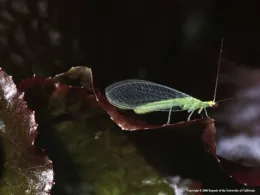
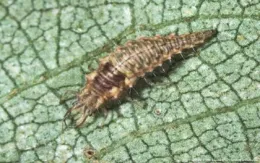
But it’s when those lacewings are scuttling around as a teeny-tiny, many-legged “alligators” (The Ugly!) that they work their fairy-magic in your garden. Who would think to connect these two creatures? Like butterflies, they do a complete metamorphosis from larvae to adult.
For two to three weeks the larvae gobble up just about any insect they bump into--thrips, leafhoppers, mites, whiteflies, aphids, and small caterpillars. They grab them with their pincers, inject venom, and suck out their body juices. YUM! One can eat up to 200 aphids a week during its 3–4-week lifespan.
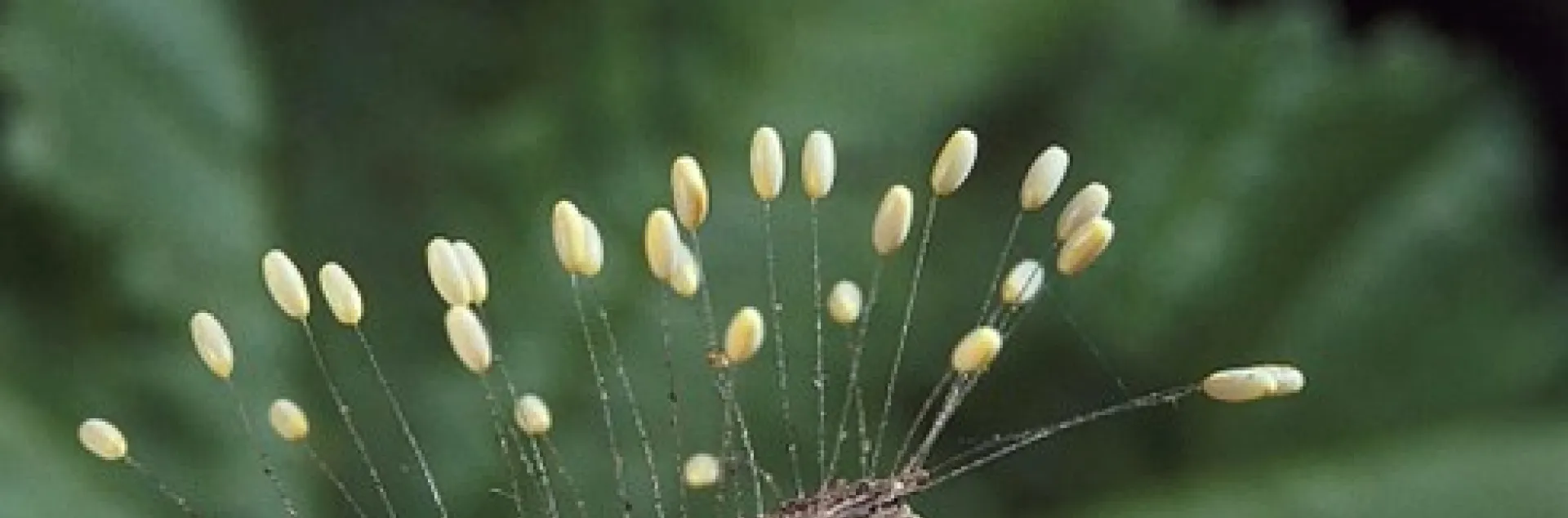
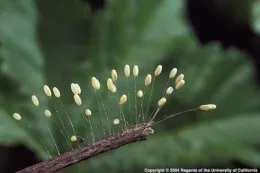
Look for the eggs, too. An adult may lay up to 300 eggs. They are a marvel of intelligent design and grace. Scientists believe that because lacewing larvae hatch absolutely ravenous, they might be tempted to devour a sister or brother, so each egg is suspended on its own slender stalk. Then he/she spins a cocoon and a few days later--it’s miraculous to me--the adult “fairy” emerges. You will seldom see those adults in your yard unless you leave a floodnight on some summer night. They’ll gather there--and hopefully survive for another day of aphid-eating. Encourage them to move in with you by growing lots of the flower food they need----nectar, and pollen.
For more information, see:
The Bad (Pest): Aphid
Here’s a scary thought. Almost every plant in your yard has an aphid species which feeds on it! Even prickly pine needles can serve up “smoothies” for these soft-bodied insects that suck plant juices from through their tiny “straws.” So, as you might expect, aphids vary. They range in colors (from green to red), sizes (though all tiny), lifecycle stages (from winged to wingless) and textures (wooly to smooth).
However, they are not too hard to identify with a hand lens. Look closely. (This is The Ugly part.) They are all soft-bodied and somewhat pear-shaped. They tend to feed in huddles which can make them easy to spot. But what always proves it’s an aphid are the pair of tiny tube-like protrusions from their hind ends, cornicles, which make them look something like a Volkswagen Beetle with two over-long tailpipes. They are the only insects with them.
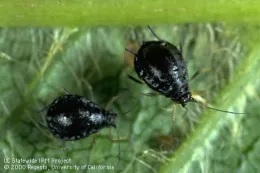
Start checking around and you may be surprised to find them in small numbers on many of your plants living very much in balance with your yard ecosystem. You never noticed them before because they do little damage. However, given the perfect environment, they are marvels of reproduction. They can give birth to 80 live babies a week. And the babies are born pregnant! Yup you read that right. And as you’ve realized, this adds up very quickly. They only lay eggs for overwintering. It’s the population booms which produce the damage you will notice.
Aphids cause leaves to curl or turn yellow. New shoots are stunted. Most obvious may be the “honeydew” aphids produce, a shiny, sticky substance that glints in the sun when the leaves flutter. But here is The Good part. Though the damage can be ugly, aphids seldom kill a healthy, mature plant. Even better, ladybugs, lacewings, soldier beetles, parasitic wasps, and syrphid flies will eat vast numbers of those tiny, sugar-filled aphids for you.
Instead, try other strategies until predator populations build up:
- Prevention: Look closely at any plant before purchase. Somehow, I thought that nurseries were magically immune to pests until one day I bought a shrub at a local nursery and by the time I arrived home, little green aphids peppered the car rug.
- Pruning: Prune out the shaded inner parts of the plant where they thrive and remove or immediately treat foliage with signs of infestation.
- Manage ants: Prevent ants from protecting aphid populations. Create a barrier for the ants by circling the trunk with a band of sticky material, like Tanglefoot*. You will have to check it frequently because once the barrier is pepper with trapped insects; ants can cross over on the bodies like you stepping rock to rock over a stream. Ant bait and traps around the tree will also help but do introduce poisons into your yard.
- Do not foster excessive plant growth: Aphids love tender new growth, so avoid over-fertilizing and use only slow-release, organic types. Don’t over water.
- Oils and soaps: Sprays of oils or soap will kill aphids--as well as other insects, too, without introducing poisons into your yard. It is thought that these chemicals kill by damaging the skin of the insect.
- Insecticides: Insecticides can be very effective in the short term. However, they destroy all insects present including predator insects. The aphid population will probably bounce back first and you will be back where you started. Worst, long-term use will cultivate an insecticide-resistant forms and imbalance in your landscape.
More information:
- For more detailed information on aphids (and other insects) read UC Davis Pest Notes
- Learn about the reproductive cycle of aphids
- Get specific information on relative toxicity of pesticides
The Bad (Pest): Ants - A Marvel of Adaptability and Diversity
Some Tahoe ants keep slaves. Some shepherd “herds” of other insects to keep fresh food available. Some have jaws strong enough to tunnel into rotting wood. Is that Bad enough for you?
But in reality, of the 270 different species of native and nonnative ants that live in California, fewer than a dozen are pests. They are so diverse; ants could be The Good, The Bad OR The Ugly--and everything in between. Though their colonies may be a thousand strong, and physically intertwine, different species can co-exist in your yard because they inhabit different environmental niches and so avoid direct competition.
Species choose different foods, for example, and consume nearly everything in your landscape: flowers or flower nectar, live or dead insects, seeds, nuts, leaves, or decaying organic matter. But watch out! Those that prey upon other insects may have venom which makes an irritating bite to us. We get have learned to live with them, but we do get concerned when they interfere with our plans for our yard or home. Then we see them as pests.
The vast majority of ants nest outside your home in soil or rotting wood--or under your walkway pavers where the stones stay warm all night, My neighbor was so annoyed with the excavated sand on her pavers that she had the stones reset into concrete and sprayed insecticide on every ant hole she could find.
Here in Tahoe where nature’s beauty is the foundation of our love for this place--and of our economy, too--we seek ways to coexist with that nature. One ecologically sound solution for her sandy pavers would be to lay weed barrier underneath. Water still infiltrates, but her ants will move elsewhere.
And yes, many species of ant move regularly as conditions change, so trying to rid her yard of one of the most prolific species on earth by spraying with poison is unrealistic and in the process, she is tainting the place where her three dogs play. Take heart. Ant tunnels improve our poor soils by introducing air and compost into the root zone
To me, their “baddest” behavior--but also one of their most amazing--is when they act as tiny shepherds tending “herds” of aphids or other pests. Ants guard those aphids from other predators and move them to new food sources so they can “milk them” for sweet honey-dew. So as crazy as it sounds, one of the most effective ways to manage aphid outbreaks is to manage the ants which tend them.
Ants may suddenly appear inside your home, too. Usually at seasonal changes, they go in search of new sources of food or shelter. Keep them moving on by caulking entry points and eliminating enticing food and water sources. Usually, they will look for someplace better quickly move on in search of better quarters.
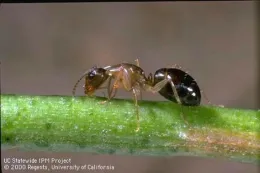
But your worst fear is probably carpenter ants. They maintain the same next for years. Unfortunately if you have them, you actually have a bigger problem-like a plumbing leak. They only tunnel in wood already damp and starting to rot. They do not damage solid, dry wood. So locate the leak, replace the rotting wood and carpenter ants will find another home.
For a fuller discussion of ants and management strategies, start with the UCDavis IPM site.
Details on ant vs termite identification
The Ugly (Predator): Parasitic Wasps
Wasps! You probably pictured yellow jackets. Yes they are wasps, social wasps, which live in a large groups. However, thousands of species of wasps live in North America. Most of them are solitary, and most of them lack stingers of any consequence at all--well, to you at least.
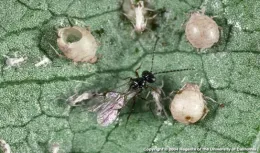
Parasitic wasps are almost as diverse as their prey--and almost every insect species has a wasp that preys upon it. There are so many, yet I bet you have never seen one because they are usually smaller than 1/10 of an inch--and some are 1/10th of that! Most parasitic wasps are a help to you, the home gardener, because they attack your prey insect pests.
In Tahoe, parasitoids likely help control our populations of needle miners, stink bugs, bark beetles and caterpillars but we gardeners especially appreciate their taste for aphids. But the story of how is almost too gruesome to believe.
Parasitoids deposit their eggs on--or inside--another insect using an ovipositor. The host insect survives with the egg inside, protecting the egg as it develops.
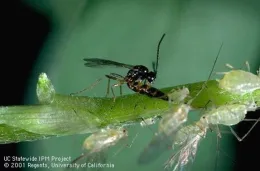
Once the egg hatches, the larvae eats an escape hole and flies off leaving the swollen exoskeleton, the “aphid mummy”, behind. Does this sound like your worst nightmare? You may be able to see evidence of this tiny army of predators with a hand lens. Then you will know they are at work in your yard, too. Their impact can be so large, that farmers sometimes buy them as biological pest controls.
Create an environment for the adults to thrive, and they will complete their lifecycle in your yard.
The adults eat pollen and nectar, but not just any flower will do. They need tiny, shallow flowers to match their tiny mouthparts. So think of the tiniest flowers you know. You will often find them clustered in umbel-shaped blossoms which may look like one big flower but they are really composed of many tiny flowers. Think of Queen Anne’s lace, for example, or native yarrow, coyote mint or (the center of) asters. If you plant edibles in your landscape, you might see these tiny wasps on your dill, cilantro, mints, carrots, parsnips or sunflowers.
So if you are helpless to manage your dandelion or native yarrow “crop,” just tell your neighbors that you are feeding your parasitic wasps that keep everyone’s flowers bug-free.
Identification: Natural Enemies Gallery: Aphidius spp.
If you have questions about the insects living in your Lake Tahoe garden, don't hesitate to reach out to the UC Master Gardeners of the Lake Tahoe Basin!