
Many residents in Tulare and Kings Counties live in the countryside on the valley floor or in the foothills. These areas are more susceptible to wildfire damage than city residential zones. Because of drought and climate change, fire season is expected to start earlier and last longer throughout all of California. So, everyone needs to be extra alert and cautious.
Meadow and ornamental grasses, shrubs, trees, and other vegetation surrounding your home become a dangerous fuel source when climate conditions become dry and windy. When vegetation is cleared away, pruned, or spaced apart, the chance of ignition during a wildfire diminishes. Does that mean that all plants should be removed? No.
UC Forestry Specialists and the CA Dept. of Forestry and Fire Protection (CAL FIRE) have several recommendations for property owners in high-risk wildfire areas. Home landscaping for fire "prevention" incorporates some safety concepts that won't eliminate fire damage but can help homes survive a wildfire.
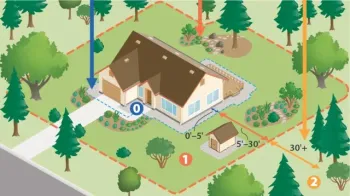
Create Three Zones on Your Property
A fire safe landscape can be divided into 3 zones: the house and immediate zone (the home and 5 feet from the exterior), the intermediate zone (5-30 feet from the house), and the extended zone (30 – 100 feet from the house). Larger zones are needed when your home is on a steep slope or in a windswept exposure.
The general concept is that trees should be kept furthest from the house, shrubs can be closer, and bedding plants and lawns are closest to the house. The goal is to create landscape conditions that don't support the spread of fire to other vegetation or to a building or structure.
The House and Immediate Zone: 0 – 5 feet
Ignition-resistant building materials, construction techniques, and vegetation and debris removal play a vital role during wildfires. Debris around fireplace chimneys, gutters, and roofs should be removed. Dead vegetation and ground debris should be frequently removed. Hardscaping (stone, gravel, concrete) should be installed around the perimeter of the house. Wood mulch in this zone should be removed and replaced with noncombustible mulch such as crushed stone or gravel.
The Intermediate Zone: 5 – 30 feet
Close to the house, the goal is to have vegetation with high moisture content. Keep plants relatively short and spaced far apart and away from the home and surrounding structures. Keep plants pruned so that they are airy and not densely layered with leafy branches. Plants that are green and lush, like lawns, groundcovers, and bedding plants, form a greenbelt and should be kept watered. An occasional individual tree or shrub is okay in this zone, provided they are located at least 10 feet from the house.
To minimize the movement of fire from landscape plants to the home structure, avoid putting plants adjacent to the siding of the home, under vents or eaves, under or near decks, and eliminate all tree limbs over the roof. Also, be aware that organic mulches like straw, pine needles, and chipped or shredded bark can also ignite and smolder. Be sure to remove all combustible materials (such as stacks of firewood, twigs, needles and leaves, dry or cured grasses, shrubs, building materials, cardboard boxes, and solvents) within 30 feet of the home, garage, sheds, and propane or other fuel tanks.
The Extended Zone: 30 – 100 feet
The main goal in this zone is to reduce the number of shrubs and trees and remove lower tree branches. For property slopes that are less than 20%, trim or space existing trees so that there is a minimum of 10 feet of space from the limb tip of one tree to another. If trees are taller than 18 feet, prune lower limbs up to at least 6 feet from the ground, but 15 feet is even better. This greatly reduces the chance of grass fires spreading into the tree crowns and then leaping onto the next tree.
From a wildfire fuel standpoint, vegetation is described as vertical and horizontal fuel continuity. In a firefighter's lingo, the vertical component is also referred to as "ladder fuel". Most wildfires begin as surface fires. They will not reach the crown of a tree if the ladder fuel has been removed.
Fire-Resistant Plants
Even though some plants are marketed as fire-resistant, all plants can burn under dry conditions. In general, select plants that are low growing, open rather than densely branched, and low in resin content. Common forest trees such as junipers, pines, spruces, and firs are resinous and highly flammable. Whether a plant ignites or not is less a factor of the species and more a result of the landscape maintenance, including spacing, pruning, irrigation, and clutter.
For more detailed information on this topic, consult the article "Californians must adapt their lives to fire" by Jeannette Warnert.
Maintenance of your property is critical to wildfire safety in high-risk areas. Memorial Day Weekend is coming up. It is time to get your chores done!