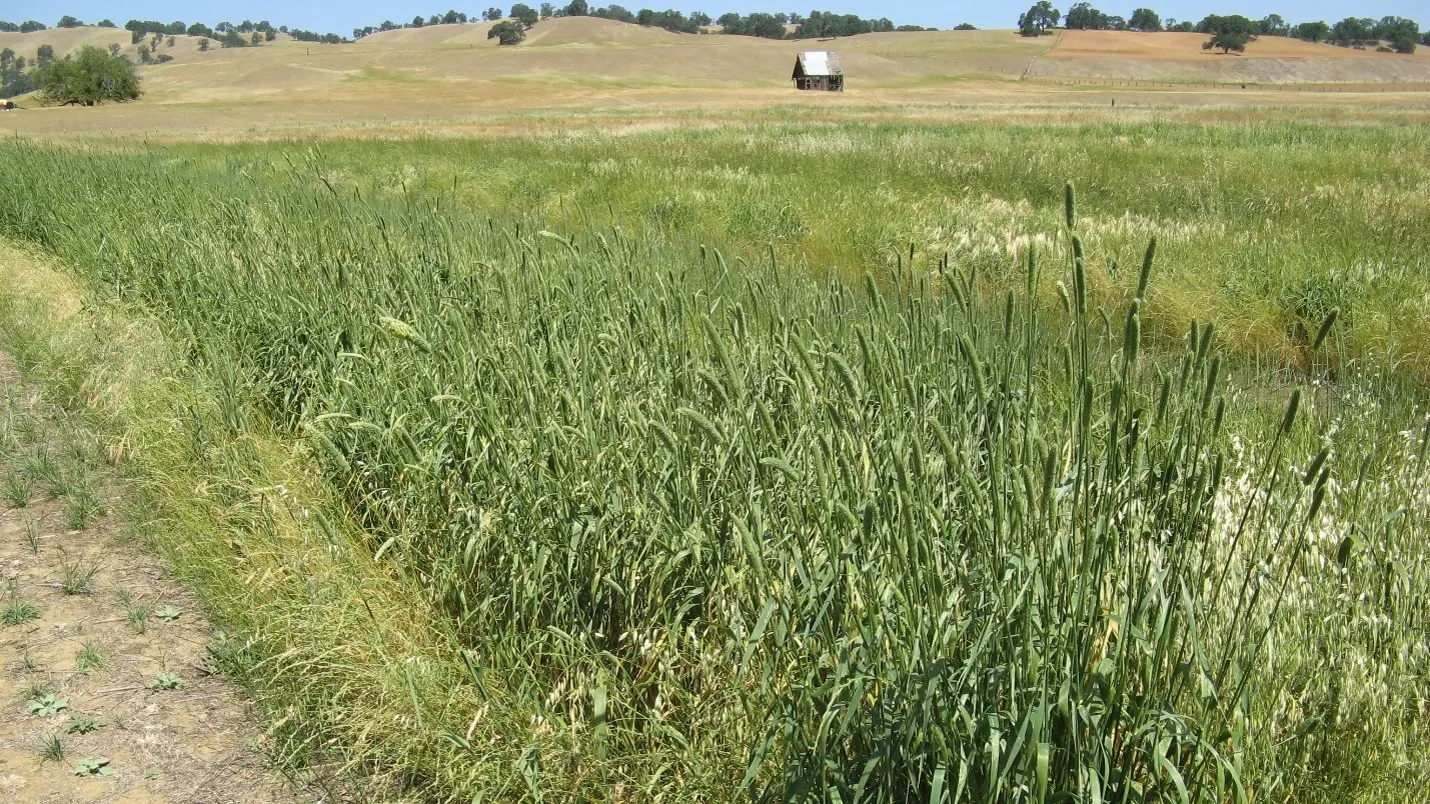
Over the past few years, a host of studies have been published addressing the rejuvenation of perennial grass stands in unirrigated pastures through use of herbicide treatments (check here, here, and here). This is for good reason, as annual weeds can invade productive perennial grass ecosystems and reduce forage quality and decrease the life of a stand. Several residual herbicides like indaziflam, imazapic, and aminopyralid can rejuvenate perennial grass stands by limiting competition from annual weeds. In California’s foothills the challenge is quite different than elsewhere in the western USA, as the perennial grasses here have almost entirely been replaced by annuals, so residual herbicides used to control annual grasses and broadleaf weeds may leave bare soil instead of a rejuvenated perennial grassland. Some exceptions exist, such as areas that have been planted back to perennial grass through the interventions of local ranchers, as has happened in parts of the northern Sacramento Valley. These grass stands can last for generations if fertility and grazing management if managed correctly. However, overgrazing, drought, or fertility issues can be difficult to avoid. The results can cause the thinning of stands leaving gaps for annual weeds to gain a foothold. The study discussed here was undertaken to identify whether residual herbicides can boost health of perennial grass plantings in Northern California, with the intention of prolonging the life of the stand.
Our article, published in Rangeland Ecology and Management, reported on rimsulfuron, indaziflam, and aminopyralid treatments applied to 7-year-old stands of wheatgrass (Thinopyrum and Elytrigia species), hardinggrass (Phalaris aquatica), tall fescue (Schedonorus arundinaceus (Schreb.)), and dryland orchardgrass (Datylis glomerata) in Tehama County. Treatments were applied in October, prior to the first germinating rains of the season. Plots were monitored for 18 months after treatment, with a focus on crop coverage, forage productivity, and weed species composition.
The data collected show that herbicide effects on weed species composition are highly dependent on the planted perennial grass species and in some cases this effect was dependent on the variety planted. All species reduced yellow starthistle (Centaurea solstitialis L.) coverage, while soft chess (Bromus hordaeceus L.) was controlled by every herbicide treatment tested. Medusahead (Taeniatherum caput-medusae [L.] Nevski) coverage was increased by rimsulfuron at 35 g ai ha-1 in four out of the nine varieties planted. The same effect was also caused by indaziflam at 73 g ai ha-1 in two out of nine varieties. Plots treated with a mix of indaziflam with rimsulfuron saw an increase in filaree coverage and plots treated with aminopyralid increased annual ryegrass coverage dramatically. Ryegrass and filaree are desirable annuals in California rangelands.
The highest yielding treatment in our study was "Perla" koleagrass (an American variety of hardinggrass’ which are usually developed in Australia) treated with rimsulfuron at 70 g ai ha-1. This treatment resulted in the highest biomass and crop coverage observed in the trial with 18,541 kg ha-1 yield and 82% crop coverage, though variability in production made it difficult to separate statistically. This represented a 70% increase in crop coverage and a 73% increase in productivity relative to the untreated plots.
The greatest biomass production in every other species (except "Perla") was associated with the 245 g ai ha-1 aminopyralid treatment. This was due to the increase in annual ryegrass coverage. In “Advanced AT” hardinggrass this treatment was associated with a 62% increase in crop coverage and a 51% increase in productivity relative to the untreated control.
Aminopyralid treatments induced 10–20% injury at the 245 g ai ha-1 rate in "Alkar" tall wheatgrass and "Berber" orchardgrass resulting in low coverage at 18 months after treatment. "Australian II" hardinggrass also showed reduced coverage resulting from the 245 g ai ha-1 aminopyralid treatment. Though crop coverage was reduced, the overall productivity in these aminopyralid plots was still the highest numerically overall, due to high ryegrass populations.
For more information please refer to our publication, available open access from Rangeland Ecology and Management, linked here.