
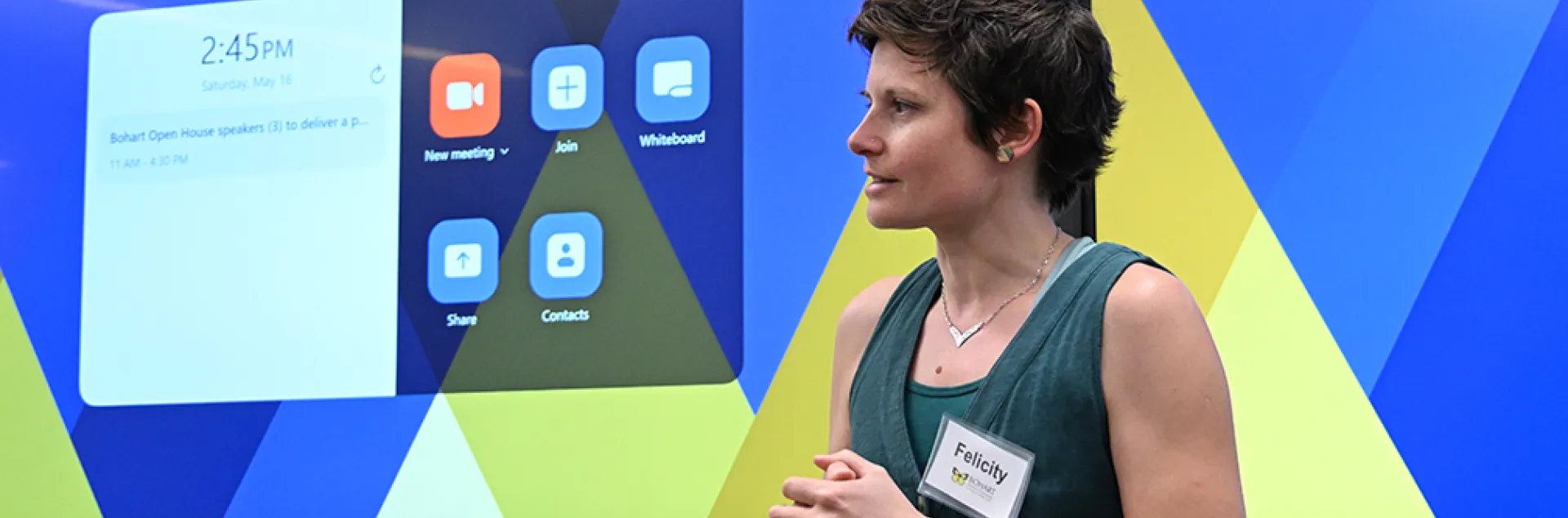
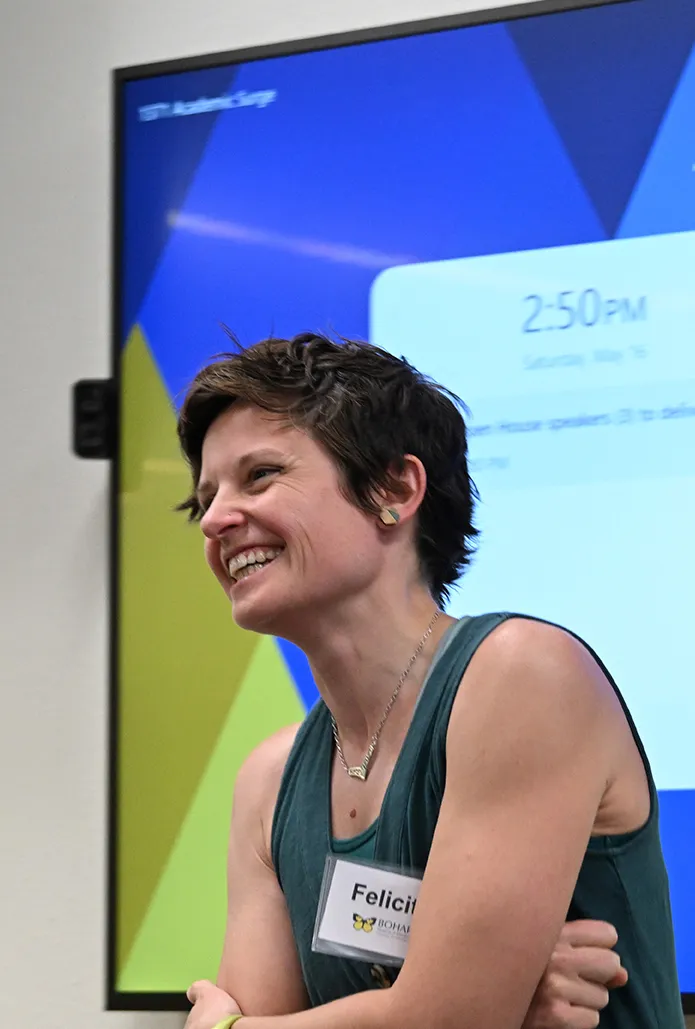
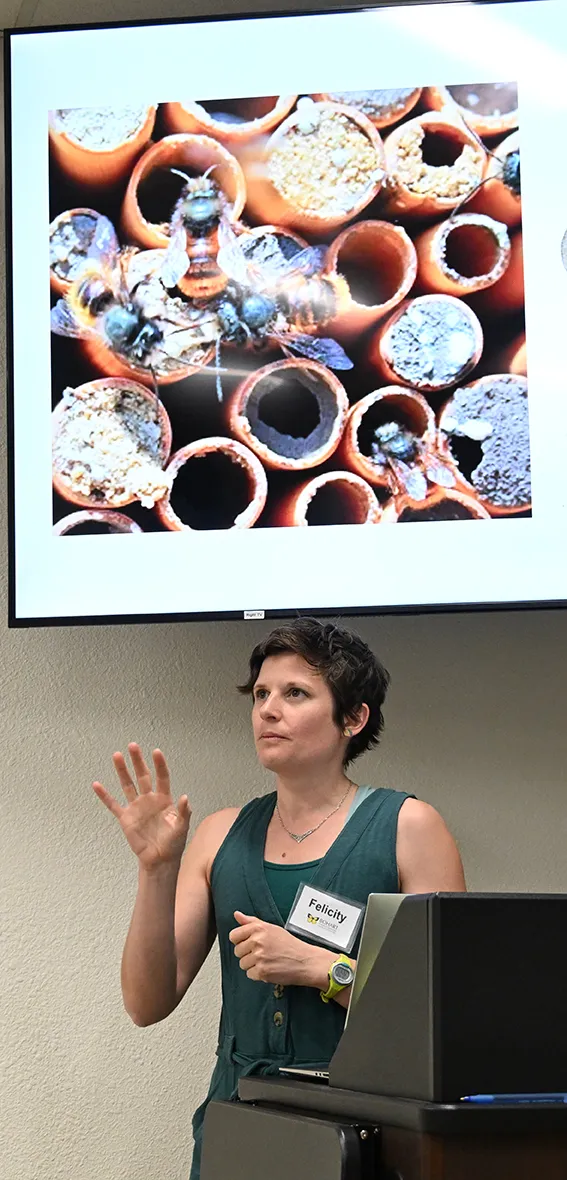
UC Davis bee researcher Felicity Muth educated the crowd, including adults, children and teens, about native bees at the Bohart Museum of Entomology's recent open house on "Buzz Words: Insects in Literature."
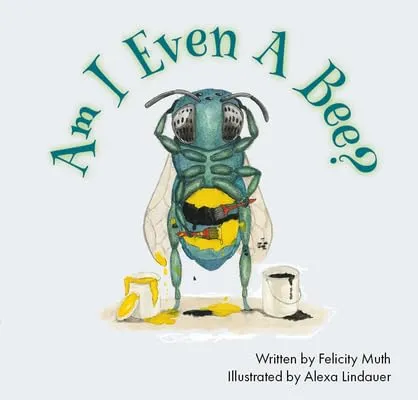
Muth is the author of the highly acclaimed children's book, "Am I Even a Bee?"--about an Osmia bee (family Megachilida) that wonders just that.
Text from her amievenabee website: "Osmia has always believed she is a bee, (her mom told her so), but recent run-ins with people, and even other insects, leave her wondering, 'Am I even a bee?!' Confused, Osmia faces an identity crisis, and she turns to her meadow for comfort. It is here that she meets her new friend and guide Xyla, a carpenter bee who, like Osmia, does not fit the black-and-yellow social mold. Through some adventures and chance encounters, Osmia and Xyla meet a slew of non-honey bees, each special and important to the meadow in their own unique way. Osmia discovers that while fame is great, diversity and acceptance are essential to a happy ecosystem. As it turns out, there is no one way to be a bee!"
Cognitive Ecology of Bumble Bees
Muth, an assistant professor in the Department of Neurobiology, Physiology and Behavior, College of Biological Sciences, studies "the cognitive ecology of wild-foraging and lab-based bumble bees, focusing on cognitive abilities that have a clear function in bees’ natural environments," she writes on her website. Current projects in the lab include investigating cognition in relation to complex floral rewards and comparative cognition in wild bumblebees. We also work on anthropogenic effects on bee behavior and cognition, in particular focusing on pesticide exposure."
Muth, who holds a doctorate in biology (2012) from the University of St. Andrews, UK, began her talk by commenting that "when people think of bees, they think of the European honey bee, and they're not thinking of all the amazing diversity of bees that we know exists."
Globally, there are some 20,000 species of bees, and 1600 call California home.
"And so, for me, you know, I work in bumble bee cognition day-to-day," Muth commented. "I basically train bumble bees to do things and try and understand their minds. And I absolutely love this. Like that's what gets me out of bed in the morning."
Chronicling how the book became a reality, Muth commented: "I had a kind of a little gap between finishing my postdoc position and starting as a faculty member. And during that time, I had a bit of a--don't know, we call it a mini-crisis--where I was like, what am I doing with my life, right? I am spending all my time trying to understand bees. Meanwhile, these animals are going extinct, and people don't even know that they exist, right? People don't even know about the bees that they're losing. And so this led me to think that, okay, if I could write a kid's book, and just teach children that there's more than one type of bee out there, that might have a bigger impact than all of my science career combined."
At the time she was residing in Reno.
"And so I sat down one night and wrote a kid's book," Muth said. "And I asked around and a friend of a friend knew somebody who was a beautiful illustrator (Alexa Lindaurer)." The two visited the Sundance Books in Reno. "Unfortunately, it's closed down now," Muth said. "But they have a publishing branch that is still going called Baobab Press (which published her book.)
"And we got chatting to the people who run Baobab Press. And they were like amazingly kind of intrigued about our idea and bought it. And so this led to about a year-long or a two-year-long process of working as a group--tweaking the text that I had written; the illustrator, doing sketches of various kind of ideas that she had; and then all of us chatting together very collaboratively to put this together into a book."
Muth showed the crowd various images of insects, starting with a male Valley carpenter bee. "Is this a bee?" she asked. She also queried the crowd about the identities of a robber fly, a moth, a mason bee and an orchid bee.
Open House Coordinators
Three members of the UC Davis Entomology Graduate Student Association (EGSA)--Grace Horne and Mia Lippey and Marielle Hansen Friedman--coordinated the open house. Horne and Friedman are doctoral candidates in the lab of urban landscape entomologist Emily Meineke, associate professor, UC Davis Department of Entomology and Nematology. Lippey, who received her doctorate in entomology in April 2026, studied in the labs of Meineke and UC Davis Distinguished Professor Emeritus Jay Rosenheim.
Other speakers at the open house were:
- Krystle Hickman, a noted bee conservationist photographer and author of the book, The ABCs of California Native Bees
- Christofer Brothers, a UC Davis doctoral candidate who studies dragonflies and who writes rhyming prose about his research
Moth Night on July 18
The next Bohart Museum open house is "Moth Night," set from 7 p.m. to 11 p.m., Saturday, July 18. It will include a blacklighting exhibit and moth displays, in keeping with National Moth Week. All open houses are free and open to the public.
The Bohart Museum is located in Room 1124 of the Academic Surge Building, 455 Crocker Lane, UC Davis campus. It houses a worldwide collection of eight million insect specimens, plus a live petting zoo, and an insect-themed gift shop.