
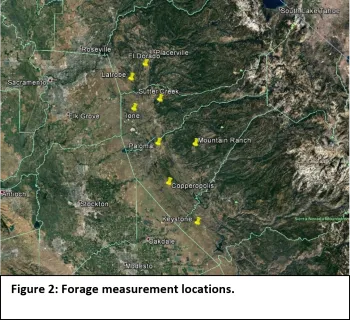
June 19, 2026 - The University of California Cooperative Extension has monitored annual rangeland forage production throughout the central Sierra Nevada foothills since 1995. Our goal continues to be to accurately gauge the total forage production on an annual basis. Data is gathered at eight locations throughout the central Sierra Nevada foothills in El Dorado, Amador, Calaveras and Tuolumne counties (Figure 2).
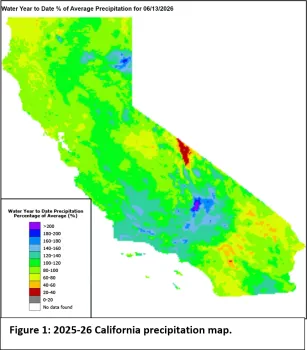
According to the California Department of Water Resources, precipitation in the Mid-Central Valley Drainage Area, which includes the Central Sierra region, is 89% of the historic average year-to-date (Figure 1). The daily mean temperature for the region of 69.97° F is close to the historic maximum and significantly higher than the long-term average of 58.82° F. Similarly, the snowpack in our region was much lower than average – especially below 6,000 feet. The April 1 snow water equivalent at Carson Pass (8,353 feet above sea level) was just 19% of the long-term average; Deadman Creek in the Stanislaus watershed (at 9,250 feet) was slightly better at 40% of normal. But Black Springs (at 6,500 feet near Highway 4 had just 1% of the long-term average snow water equivalent on April 1. The drainages to the immediate north and south are slightly above average. Statewide, precipitation was nearly average for most of Northern California, and slightly above average for the Central and Southern Coast.
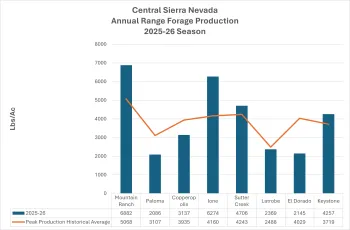
But while March 2026 was warmer and much drier than usual, the “miracle April,” with more than 6 inches of precipitation falling in some foothill locations, resulted in substantial late-season forage growth. We gathered peak forage production data between May 19 and May 29, 2026. As usual, forage production was variable compared to the historical long-term average at most sites (Figure 3). From north to south, both El Dorado County sites were slightly to well below average this season. The two Amador County sites were above average, while the three Calaveras County sites were mixed. The Tuolumne County site was slightly above average. Once again, we suspect that the variability of forage production this year reflects the variable nature of our precipitation (timing and total) and temperatures during the 2025-26 water year.
As reported in previous years, we continue to see an increase in the number of noxious weeds on annual rangeland. Medusahaed (Elymus caput-medusae) is becoming more widespread and in some pastures, it represents up to 80% of the total biomass. Medusahead is a non-desirable forage species, and most livestock will selectively graze around it late in the growing season. In addition, barb goat goatgrass (Aegilops triuncialis) continues to spread throughout the region. Much like medusahead, barb goatgrass matures much later in the season and will stay green after many of the desirable forages have died. Most livestock will avoid it. Over the past few years, barb goatgrass has expanded its range at an alarming rate. While prescribed fire can be an effective tool for managing both weeds, we have also experimented with a variety of control measures, including targeted grazing with cattle and sheep using virtual fence technology.
For more information on control options, see the Medusahead Management Guide.
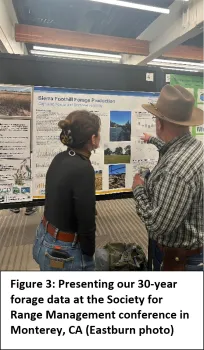
Finally, the 2026 Society for Range Management annual conference was held in Monterey, California, in February. We presented a poster (figure 3) describing this long-term monitoring project, highlighting the variability of forage production in our foothill annual rangelands geographically and temporally. This variation makes managing grazing system incredibly complex; we appreciate the long term commitment of the landowners and ranchers who have collaborated with us over the years--thank you!
Dan Macon, Livestock & Natural Resources Advisor
Bill Frost, Emeritus Natural Resources Advisor
Scott Oneto, Farm Advisor
|
 |
 |
 |