
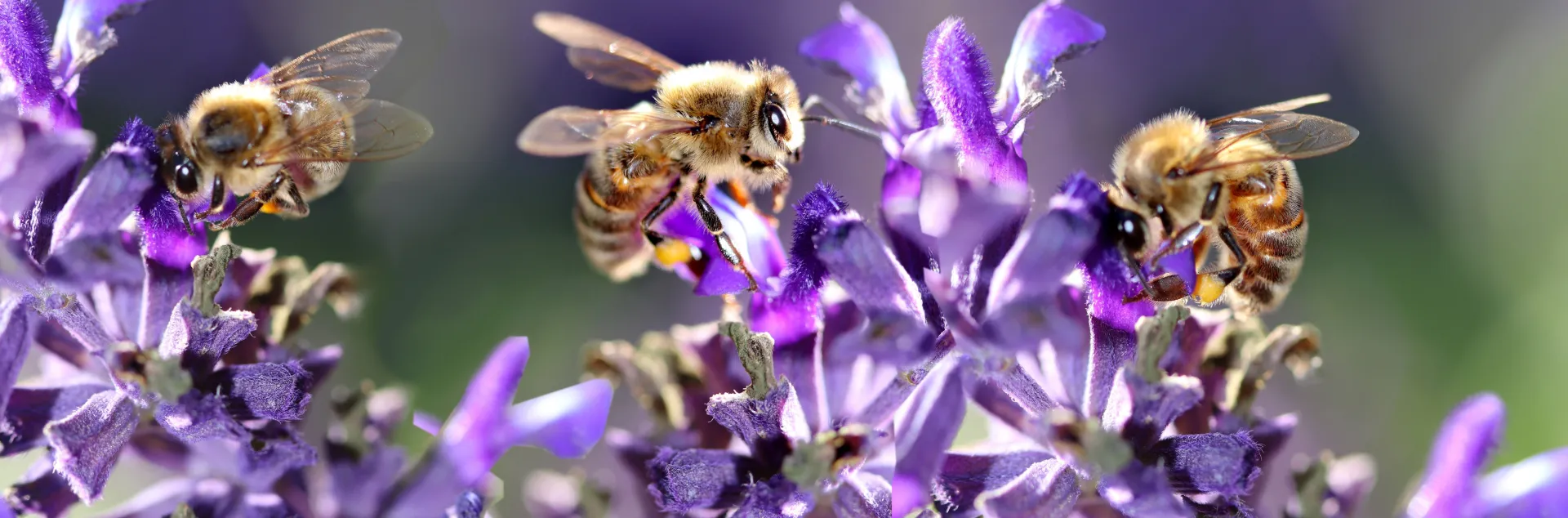
By Penny Pawl, UC Master Gardener of Napa County.
I was recently in my garden looking at my milkweed (Asclepias) and Jupiter’s beard (Centranthus ruber) when I noticed another flower with long spikes and different foliage peeking through the dense forest of stems. What was it?
Its stem was squarish, not round, and the leaves had an unusual odor. Turns out I had discovered a self-planted salvia. Like my Juniper’s beard, this salvia may have been planted from seed dropped by a bird. Or maybe the autumn wind moved seeds around. In any case, I liked what I saw.
Salvia is one of the largest plant families with approximately a thousand varieties found worldwide. There are many benefits to growing salvias as they are drought tolerant, bloom in a variety of colors and quickly fill empty spaces. (Some would call them invasive.) The rosemary we use in the kitchen is in the salvia family (Salvia rosmarinus), as is the sage we put in turkey dressing (Salvia officinalis), but not all salvias are edible.
When you plant salvia, be sure to leave room for expansion as some varieties do not know when to stop. A Salvia ‘Hot Lips’ that I started from a 1-gallon container is now taking up 8 feet or more in one of my garden beds. It is starting to crowd other plants in the bed, but the bees, hummingbirds and butterflies love it. I have dug up, repotted and given away several gallon containers of ‘Hot Lips’ but still it keeps growing.
I love to watch bumblebees feed on ‘Hot Lips’ flowers. They enter the open bloom, go to the back and drill a hole to get to the nectar. Hummingbirds also often feed on this plant.
Salvias come in annual, biannual and perennial varieties. The ones I grow are perennial and survive our mild winters and dry summers. They grow best in full sun and well-draining soil. Supposedly, they can draw aphids, spider mites and whitefly, but I have never seen any of these pests on my salvias. Occasionally I find that spittle bugs have nested on the salvia, but I never have noticed any damage and leave them alone. Their foamy spittle is a mixture they produce to hide in as they grow to adult size, which is not very big.
Salvias are easy to propagate. I use a cloner, a hydroponic machine that continually washes the plant stem with water. The leaves do not get wet, and it is amazing how quickly some cuttings produce strong, healthy roots in the cloner. In fact, sometimes the roots get too big, so when I plant them I give them a haircut. You can also propagate salvia cuttings in a mixture of sharp sand and pumice, but the cloner is faster.
Once the plants have roots, move them to a container with a good, well-draining potting soil. When they are strong enough, transplant them to their permanent home in the ground and water well until they are established. One of my salvia cuttings rooted and was ready to plant in three weeks. Once the transplant settles in, you can cut back the watering.
Salvias need a good pruning occasionally. I have cut them back from 3 feet to 1 foot. The plant will regrow and bloom again for you.
As for the volunteer salvia trying to establish itself under my milkweed and Jupiter’s beard, I had a helper cut it back, dig it up and move it to a large pot. When it recovers, I will move it to its own space in the garden. Some of the pruned stems are now in my cloner, creating new roots and waiting for their new homes. Some plants are so happy in the cloner that they bloom.
Tree walk: Join UC Master Gardeners of Napa County for a docent-led tree walk through historic Fuller Park in Napa on Friday, July 10, from 10 am to 11:30 am. Discover some of the many exotic and native trees in this 120-year-old arboretum. Meet at the corner of Oak and Jefferson Streets. Space is limited and registration is required for each participant.
Workshop: Join UC Master Gardeners of Napa County for a workshop on “Succulents: Out of the Pots, Into the Ground” on Saturday, July 25, from 10 am to noon, at University of California Cooperative Extension, 1710 Soscol Avenue, Napa. Learn how to design, plant, and maintain a sustainable garden in your own landscape. Register here.
Library talk: Join UC Master Gardeners of Napa County and Napa County Library for a free talk on “Be a Butterfly Angel” on Thursday, August 6, from 7 pm to 8 pm via Zoom. Learn how to help support our declining population of Western Monarch Butterflies. Register to receive the Zoom link.
Help Desk: The Master Gardener Help Desk is available to answer your garden questions. Use our online Plant Problem Help Form or email us at mastergardeners@countyofnapa.org. Include your name, address, phone number and a brief description of the problem. You can also visit us in person on Mondays and Fridays from 10 am until 1 pm at the University of California Cooperative Extension Office, 1710 Soscol Avenue, Suite 4, Napa.
Image by Beverly Buckley from Pixabay