
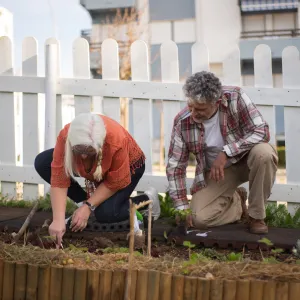
Take a moment to think about the movements needed to garden. Bending, kneeling, gripping, standing, lifting, hauling - these are just a few that come to mind. What parts of your body start to hurt during or after gardening? Is there anything that can be done to erase any discomfort before it even starts? Tools can certainly help.
Many people lose upper body strength with age and/or disability. Loss of grip strength is common. Well-fitting gloves help. Gloves with gripper dots or with palms made of sticky, grippy material are even better at keeping a held item held. What also helps is a larger diameter of the handle being held. Smaller diameter handles force your hand into a curled position that is difficult to maintain for very long. A padded tool handle distributes a tool’s pressure across the palm. If the tool doesn’t have padding, adding some might help. Foam pipe insulation placed over the handle could be one way to add diameter and ease discomfort.
Sturdy, well-made hand tools that weigh two pounds or less with good grips and that are ergonomically designed also make a difference for those with less upper body strength and/or grip. For years I have used Fiskars® tools. The orange handles/accents also make them easier to locate. Workpro® makes a 6-piece set with padded handles in either bright green or pink. Esow® has a 3-piece set with red & black handles. The handles on these tool options are mostly straight. Radius® has been making curved-handle hand tools for many years. The advantage of the curved handle is that less stress is placed on the hand, wrist and arm. I gave a set of these to a Secret Pal, a gardener who was developing orthopedic problems, about 20 years ago, and she still uses them. Easi Grip® garden tools have upright handles, great for those with weak or arthritic wrists. Held kind of like a joystick, muscular movement comes from the upper arm and shoulder. Trowels are designed to be held near the top of the handle and used with the upper arm, not the wrist, and are not for prying. I have apparently been abusing my tools (and my wrist) for years!
When choosing pruning shears, look for ratchet shears, which, with each compression of the handle, lock the blade further into the stem. This lets you release your grip, but the blade stays in place until you can regrip and finish the cut. Non-stick steel blades are especially helpful with sticky sap.
A garden kneeler seat is even better than a kneeling pad. Many kneeling pads are about 1½ inches thick and compress to the ground with a kneeling 180-pound adult. When picking a kneeler, look for one made of steel and without plastic parts. Try it out by kneeling on it and reaching a few inches ahead (like you were going to get that weed) and see if it tips. If it does, try another brand. Then flip it over and try it as a low seat. The better-made models have a 10.2-inch width and an EVA foam cushion. I often walk by a lady who had a stroke some time ago who regularly weeds her front yard from a low seat. During COVID, I would sometimes see people using these at outdoor religious services. One that comes highly recommended is the Flinter® Garden Kneelers Seat. This company also makes a rolling garden seat that doubles as a cart and is rated to 400-pound capacity.
For weeding, a stirrup hoe (AKA Hula Ho) helps your back – no getting down on the ground, no bending over. With any long-handled tool, look for one that is adjustable in length. Adaptations can be made to the pole/handle by adding a D-Ring to the pole, usually about halfway down or fitted to the gardener, or by adding an upright T to the pole that the gardener can grab. Parts for these can be found at hardware stores.
Lightweight adjustable/telescoping pole pruners can help a shorter gardener or wheelchair-bound gardener prune shrubs or trees. I use one that I bought at Hida Tools in Berkeley at least 25 years ago to pick citrus. The brand name has long since worn off. I can clip the stem and gently hold it all the way to the bucket. It does take a little practice before you can keep your just-clipped fruit from hitting the ground. The main thing for me is that I am not on a ladder trying to get all the fruit off the trees. If the goal is just to prune, choose a model that the gardener can lift. Fiskars® is well-rated and can clip up to 1 ½ inches thick per their website, but it weighs 4 ½ pounds, and not all people can lift that much extended weight for as long as it takes to do the work.
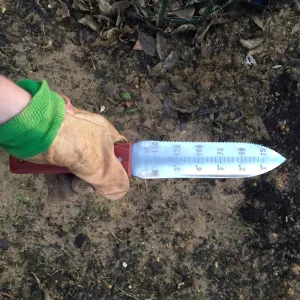
Another tool I picked up from Hida Tool was a Hori Hori knife. An ergonomic model is also made by Radius® and is called the Root Slayer Soil Knife and is a highly rated ergonomic tool, as are Radius® tools in general.
My last idea for this article would be a lightweight hose. Buy a retractable hose reel for it. A lighter hose is also easier to put on its holder or hose reel. Just keep it out of the sun during non-use so it will last awhile. Attach an adaptive hose nozzle with thumb control or a wand that has multiple patterns. Self-watering planters are wonderful. Automatic drip irrigation is the best.
Toni Gattone in The Lifelong Gardener - Garden with Ease & Joy at Any Age has a whole chapter on tools that she has used and recommends. She is a UC Master Gardener in Marin County. These suggestions are a drop in the bucket for adaptive gardening tools. Buying all these tools at once would be expensive. If you want new, visit the local hardware stores and nurseries. Touching these items and seeing if they fit the need is much better than online guessing. Another way to test a tool first is to see if the library has it and if it’s available for checkout. The library has no renewals on gardening equipment. My suggestion would be to shop yard and estate sales. There are lots this time of year. Bring cash and inspect any prospective purchases carefully. Peruse local thrift stores and secondhand shops. Check out eBay and Etsy. You will likely find some diamonds that don’t cost a mint.