
Women integral to prosperity of farms, ranches, communities across sparsely populated region
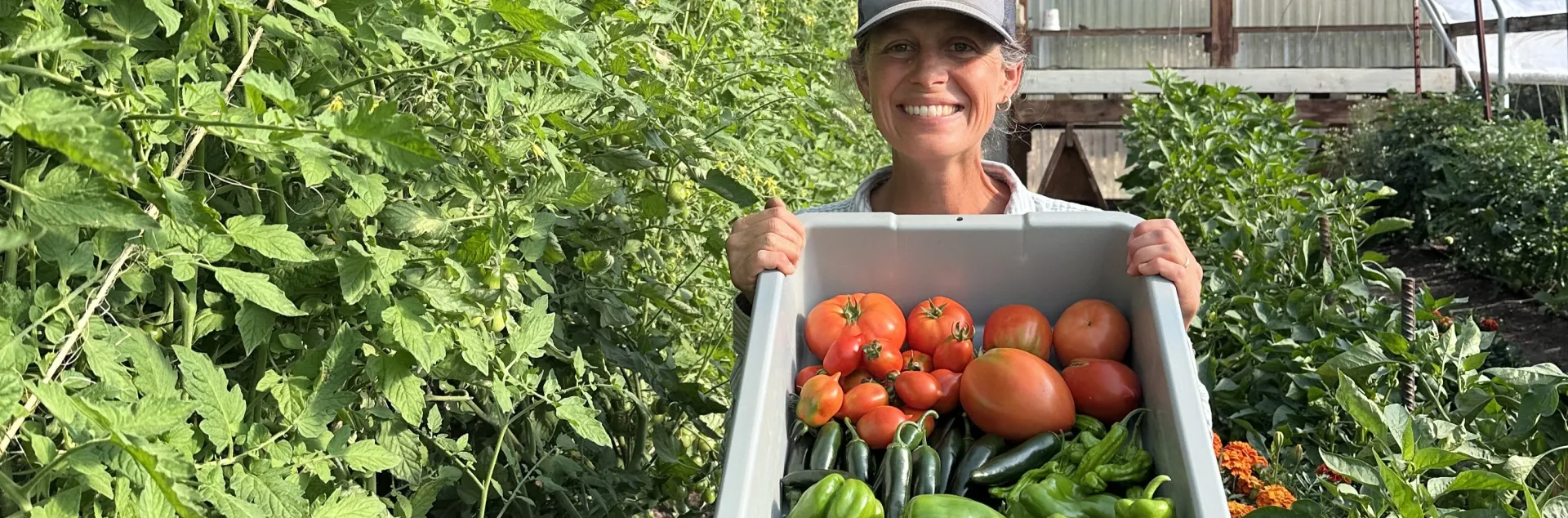
Ary West just wants to farm and market her produce. But, as one of only 8,600 residents of far-flung Modoc County in California’s northeastern corner, she finds herself producing “everything” to help feed the scattered communities across the region.
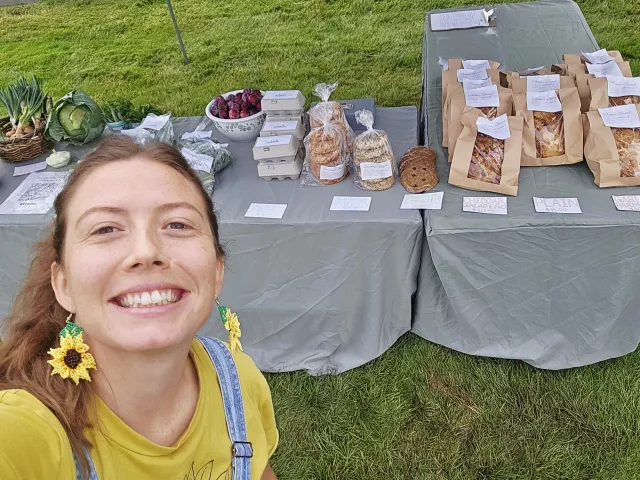
In addition to growing fruits and vegetables in her garden and orchard at Trouble Valley Farm, West also sells chicken eggs, pasture-raised pork and a variety of baked goods.
“I don’t necessarily want to sell everything, but I’ve slowly picked up items that nobody else is offering because I’m trying to round out the farmers market and the food hub,” West said.
“The second I find someone else who will make bread, I will stop making bread!” she added with a laugh. “I really want to grow produce and I just kind of got stuck doing absolutely everything right now.”
In Modoc, the general task of “doing absolutely everything” quite often falls to women – even though they comprise about 51% of the population. That includes supporting agriculture, the primary economic engine of the region’s private sector.
“You really can’t talk about agriculture in Modoc County, specifically, without talking about women,” West said.
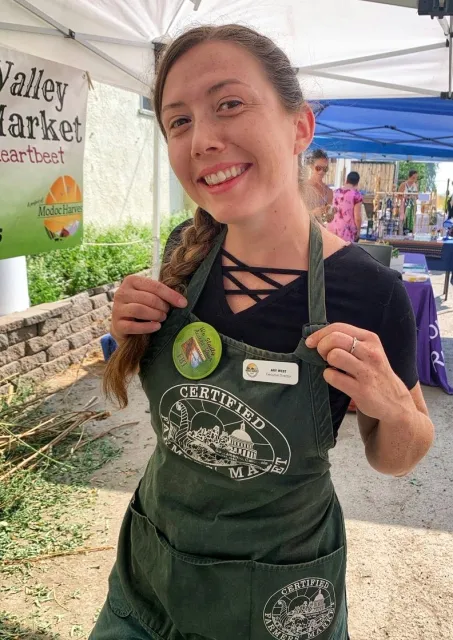
On top of operating her own farm business, West also oversees Modoc Harvest, a program under local nonprofit T.E.A.C.H., Inc. Originally created to administer the farmers market and advocate for stronger food systems in the area, Modoc Harvest now encompasses a range of food access and nutrition education programs.
In her capacity running two farmers markets and a food hub that aggregates and distributes farm products, West works to market the wares of 16 local agri-food operations. All of them – save for one – are owned or co-owned by women.
“Women are not a small or specialized part of agriculture; they are, at the least, a piece of the backbone of the entire system here in Modoc,” West said.
‘No paper ceiling’: Opportunities for women abound in rural communities
Laura Snell, director of University of California Cooperative Extension in Modoc County, said that when she arrived in Modoc in 2015, the majority of the five-member Board of Supervisors were female. Currently, two women lead the board, Chair Geri Byrne and Vice Chair Kathie Rhoads.
“We have strong representation in our local government, city council [of Alturas, the county seat] and school boards; and women play a really important role in agriculture in Modoc,” said Snell. She noted that it’s rare in California for the county agricultural commissioner and deputy agricultural commissioner to both be female – as is the case in Modoc.
Snell herself exemplifies the “do everything” modus operandi of women in the area.
“I’m currently president of our morning Rotary Club; I'm running things at home and raising two kids; I’m director of county Cooperative Extension; I’m doing research on livestock; I’m treasurer of our train historical society,” Snell explained. “It’s just a lot of hats.”
In Modoc County, all people – including women – have greater opportunities to take on roles that might be closed to them in other places. West, who grew up in Petaluma, moved to Modoc from Reno. She described herself as a “career bartender” who had held every type of position in the restaurant business, from dishwasher to manager.
But without formal post-secondary education, she felt she was not “paper qualified” when she became the executive director of Modoc Harvest. In this “sink or swim” situation, she learned on the fly and leaned on the wisdom of the nonprofit’s co-founder, Laurie “Lio” Wayne.
“There’s no ‘paper ceiling’ here, and that’s something that doesn’t happen everywhere; there’s a lot more opportunity to be whatever you want to be out here – and not just if you want to run a food nonprofit,” West said. “Literally anything.”
And it’s not just Modoc’s remote location that presents greater opportunities for women – it’s the very nature of agricultural work itself.
“Agriculture can be a way for women to kind of do it all, which is really special,” said Snell, who has two children, ages 2 and 4, and also manages an agritourism business on the side. “There’s flexibility so they can run a home agri-food operation…while also really being a central part of raising their kids.”
‘Town jobs’ crucial to sustaining livelihoods of farmers, ranchers
Laurie Wayne, who now serves as the UCCE community nutrition, health and food systems advisor for Modoc, Lassen and Siskiyou counties, works to expand markets for local producers. But given the short growing season and the limited number of potential customers in the area, many farmers and ranchers pursue other forms of income.
“Virtually every farm that’s of any size depends on off-farm income, sometimes just for benefits,” Wayne said.
In addition to owning Bidwell Canyon Farm, Leah Larsen co-founded the Surprise Valley Farmers Market and Modoc Harvest with Wayne to open up more opportunities to sell the produce from their farms. Even still, Larsen said both she and her husband have to supplement their sales to support their family.
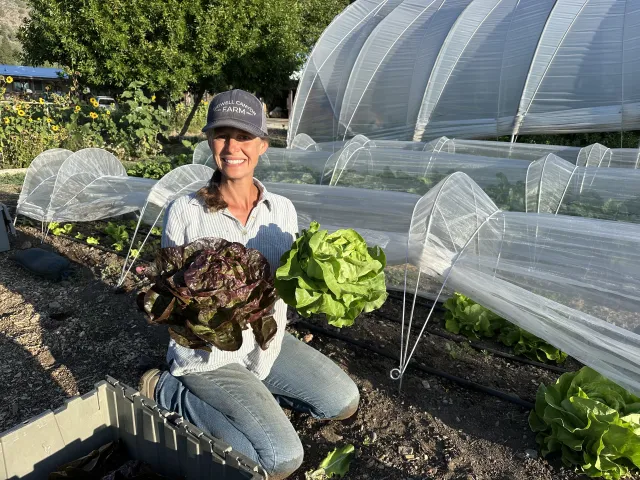
“It’s really hard to make a living just in agriculture in Modoc County – unless you’re sending your products outside – because our population is so small,” said Larsen, who grows fruits and vegetables on one acre in Fort Bidwell. “Income from our fresh produce, it’s not something we can raise our family on, unfortunately; I wish it was enough, but we just haven’t found a way to do that. So we have always had a job off-farm for other income.”
Historically, in rural communities, it would often be the husband who worked on the ranch while the woman held the “town job” for benefits like health insurance, according to Snell. But in more recent times, the roles are reversing for heterosexual couples.
“I feel like now it’s more equal opportunity – I see a lot of women who are staying home and they’re sending their husbands to go get the job in town,” Snell said. “Due to the capacity needs in our rural community, there are a variety of jobs for people that can be filled by either spouse.”
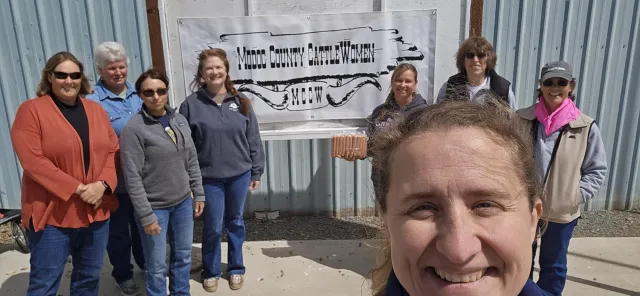
In her role as UC Cooperative Extension livestock and natural resources advisor, Snell helps organize the Modoc County Cattlewomen’s group, which comprises about 50 members. Over the last 10 years, she has observed that women are increasingly part of the day-to-day tasks of ranching operations.
“We’ve had to start meeting in the evenings and weekends because they’re not home during the day – they’re out working cattle, branding, doing the actual operations of the ranch,” Snell said.
Women balance family demands, farming, ranching and office work
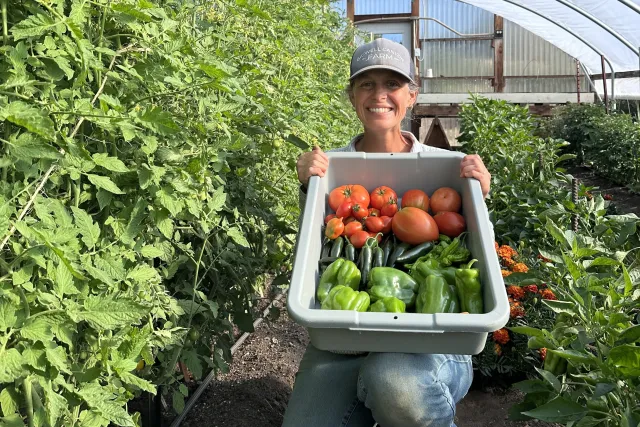
Larsen, who grew up in Susanville, moved back to the area 13 years ago to be closer to her parents. With her builder husband tackling the infrastructure projects on their small farm, Larsen started growing produce and added new crops to the garden block every year. She also worked to cultivate the local food movement by establishing and managing the farmers market and a local food nonprofit…all while raising two young daughters.
“Women tend to know how to do a lot of things, because there’s a lot of pressure to be caring for your family and also contributing financially and potentially running a farm or a business,” explained Larsen, who handles the planting, weeding, harvesting, processing, marketing, accounting and payroll for two part-time employees on the farm.
“I think it’s in the nature of women to nurture and want to feed people,” Larsen added, “and they have the ability to make that happen because they can focus on a lot of different areas at once and get things done.”
Kelsey Arreche can certainly relate. Growing up on a commercial cattle ranch in Sierra Valley, Arreche gained experience in animal husbandry and the business side of agriculture by participating in 4-H throughout her youth. By raising and selling sheep and steers, she was able to help pay for her own college education.
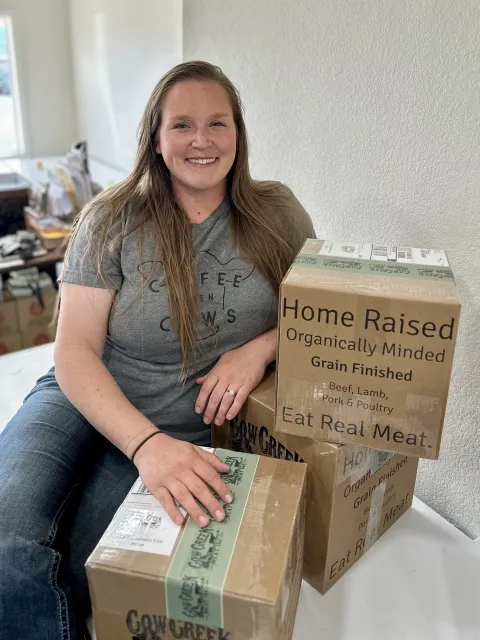
“I learned a lot about responsibility and the importance of work ethic – taking care of animals before taking care of yourself,” Arreche explained, “and how to manage money, recordkeeping, keeping everything straight and knowing the cost of things.”
She has put all those skills to use at Cow Creek Meat. Arreche and her husband purchased his family’s ranch in Cedarville and started their cattle herd in 2017. Beginning by selling beef in 2022, they have since expanded to a full spectrum of proteins – pork, lamb, chicken and turkey, all raised with natural and organic principles.
While managing many behind-the-desk aspects of their operation, Arreche also takes on the daily tasks of animal stewardship. Feeding is still her favorite job, as it gives her a “sense of peace” simply being with the animals.
“We used to feed our cows and just want to sit there and watch them eat because it was really therapeutic,” Arreche said. “We could kind of get away from everything else going on and just relax.”
Contributions of female farmers sometimes undervalued, underappreciated
As with any occupation, however, there are aspects of ranching and farming that are less pleasant. For Arreche, it’s the social media part of marketing – which conflicts with how she wants to bring up her two young children.
“I don’t want to be on my phone in front of my kids all the time,” she said. “Social media gets really old; you try to find ideas on there and then you find yourself scrolling and you’re like, ‘Oh my gosh, I’ve been sitting here doing nothing for 30 minutes and I haven’t produced anything!’”
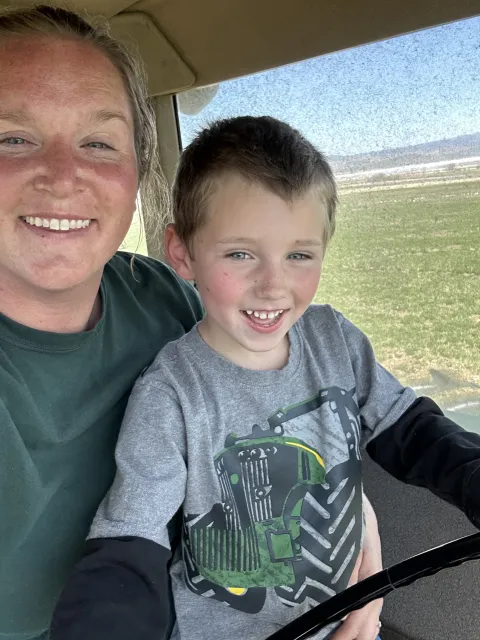
While recognizing the importance of raising the visibility of their products, Arreche also acknowledges that the marketing work is difficult for her.
“Raising the animals is easy; sure, things can go wrong with them, but in the grand scheme of things, it’s very easy compared to juggling those other tasks,” she said.
It’s not unusual for ag producers to struggle with the off-farm or off-ranch aspects of agriculture, according to West, the Modoc Harvest manager who is also a farmer.
“People who go into farming are typically not people who are good at or interested in marketing and advertising and talking to the public,” she said. “The person growing your carrots is usually not the best person to tell you why you should buy their carrots.”
In heterosexual couples, women often are assigned those communications and public relations functions – along with other tasks that might be taken for granted. West said that women frequently do the “unpaid or underpaid work,” whether it’s talking to customers or applying for grants or cooking for everyone in the household.
“Even when a farm is run by ‘just a man,’ he’s often being fed by a woman, right?” West said. “There’s the behind-the-scenes and unacknowledged labor of agriculture that we might not really consider – but that is actually ‘ag work.’”
Another challenge West has experienced is that people sometimes assume that her fiancé – a man – is the one running the operation. She credits him for being supportive of her farm dream, but the business is totally hers.
“There’s sort of a reluctance to deal with me as the farm owner, the second that there’s a man nearby,” West explained. “People see a man around and they feel like they should be dealing with him – when actually he’ll be the first person to redirect the question and be like, ‘Ask the boss.’”
Such assumptions flow from long-ingrained gender stereotypes of farming as a vocation.
“Historically you’ll see the image of ‘the farmer and his wife,’” West said, “And you’re like: What was the wife doing while her husband is farming all day? Oh, she’s also tending to the farm! So it’s not ‘the farmer and his wife’ – it’s just two farmers.”
Women fill larger role in leadership, entrepreneurship and innovation
There is hope that those stereotypes can change as more women play a prominent and visible role in agriculture – a trend plainly visible in Modoc County. Snell, the UC Cooperative Extension livestock advisor, said that she is seeing more families incorporate girls into the operations of their ranch.
“There are more daughters and more granddaughters, I think, than there’s ever been,” Snell said. “They’re taking the opportunity to nurture the next generation on the ranch.”
Beyond raising children, women are also cultivating the future of agriculture by pioneering new enterprises and strengthening local food systems.
“Women are making a pretty significant contribution on that front, especially from the standpoint of being willing to try something new,” Snell observed. “In Cooperative Extension, we talk about those ‘early adopters,’ and I find a good chunk of our early adopters, especially in food systems, are women.”
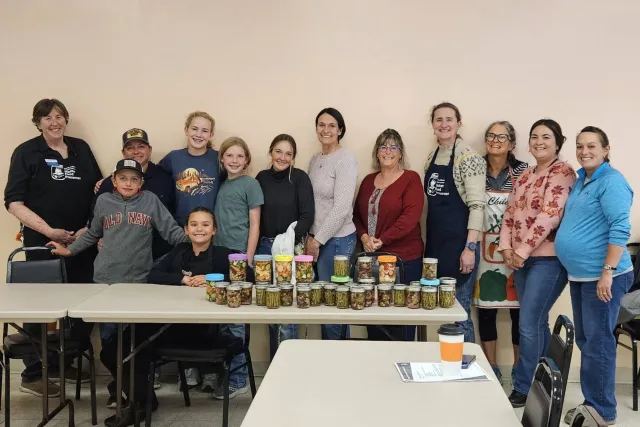
As a case in point: The Modoc County Cattlewomen’s group held – for the first time – a beef preservation workshop this past spring. The 30 attendees (nearly all women) made beef jerky, used a freeze dryer to make MREs (Meals, Ready to Eat) and pressure-canned beef and vegetable soup.
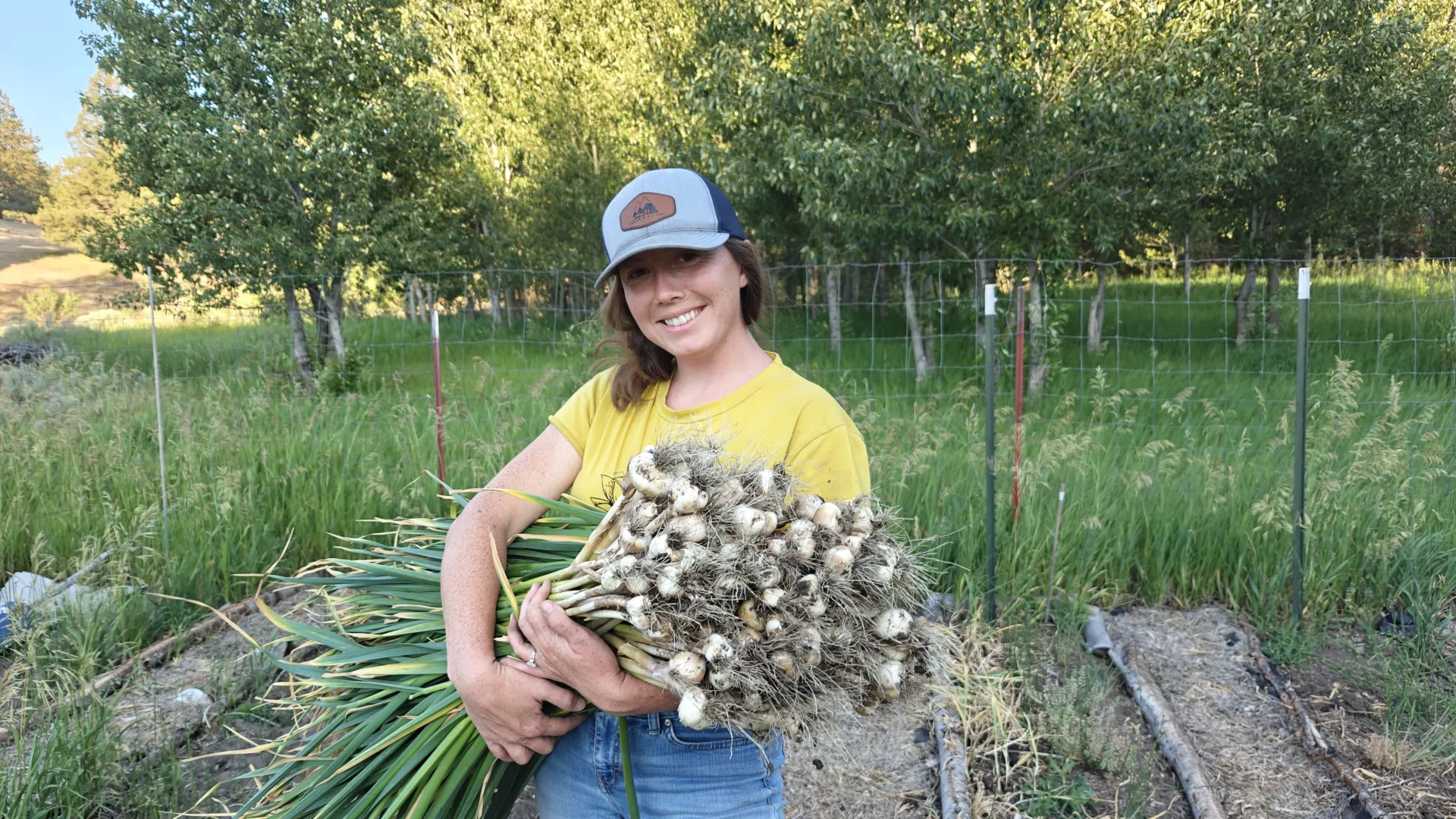
Inspired by the experience and the skills they acquired, a mother-daughter duo is planning to add a commercial kitchen to their farm so they can make freeze-dried meals for camping/backpacking or emergency preparedness. Snell also mentioned a woman who, after participating in a UC Master Food Preserver class on flavored salts, started selling an Italian seasoning blend and garlic salt made with the garlic she grew.
Recently, Snell and Wayne helped connect Modoc County producers with a local pharmacy that had moved into a former Rite Aid store – and now the previously empty freezers are filled with meats and other products from the community.
“Laura and Lio, they’re just really ‘present’ here and you see them everywhere,” Larsen said. “At anything to do with ag, they’re there; we just got really lucky with those two.”
Praising Lio Wayne as an indispensable mentor in the ag and food space, West cited the UCCE duo as another example of how women are leaders in the community.
“Women are running farms and ranches, yes, but they’re also leading the ag commissioner’s office; they’re leading the [University of California Cooperative] Extension office; they’re providing ag education and managing the farmers markets – both my farmers market managers are women,” West said. “When I have a question, the person that I need to call is always a woman.”