
Article and photo credit by Michele Rugo, UC Master Gardener of Nevada County
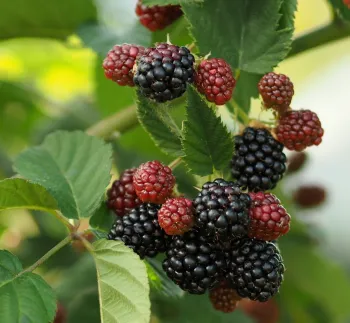
Invasive plants cost the state of California at least $82 million yearly in control and management, with the Himalayan blackberry (Rubus armeniacus) being a major player choking out native habitat, increasing fire risk, and reducing agricultural productivity. One of four non-native blackberries in our state, it also acts as a host for Xylella fastidiosa, the pathogen behind Pierce’s Disease that can stress and decimate commercial grapevines. Himalayan blackberries can also push through asphalt and destroy entire buildings. Reproducing both sexually and asexually, it can clone itself. It is nearly impossible to kill. Whether you burn, drown, hack it down or apply poison, it will in time regenerate, often emerging stronger!
Like many other invasive species, I assumed this (ob)noxious woody vine was somehow brought to California by early settlers and immigrants. It was, however, introduced to the Northwest in the 1880s by Luther Burbank, a California botanist. By all accounts a bright but reserved child, Luther Burbank tinkered with inventions and took pleasure in observing the natural world around him. On a visit to his local library as a schoolboy, he chanced upon a copy of Charles Darwin’s newly published works. From Darwin’s research, Burbank speculated further that one might speed up as well as guide the process of natural selection.
Investing his limited resources in a plot of land in Sebastopol as a young man, Luther Burbank founded a nursery and experimental garden. Over the next fifty years, he developed over 800 new plant varieties including the Santa Rosa plum, the Shasta daisy, the Russet Burbank potato and elephant garlic. Obtaining seeds of what he considered an exceptionally vigorous and high yielding, thornless blackberry from an acquaintance in India, Burbank planted them in his test plots. Soon the plants were being marketed to growers throughout the Northwest whose native berries were too small and soft to hold up in shipping to satisfy emerging East Coast markets. Even the USDA recommended the “Himalaya Giant” and distributed 200 plants nationwide in 1905. Berry growers celebrated the new variety featured in Burbank catalogs with so much fervor that for several years, the plant could not be propagated fast enough to meet demand, a thought to make many a modern day gardener and property owner wince.
From that first notorious seed packet, the blackberry virtually escaped everywhere. Today the plants can be found on every continent except Antarctica. In California, the berries especially thrive throughout the Coast Ranges, the Central Valley, and the Sierra Nevada foothills. But before we lay all the blame on Burbank, consider that current research shows the “Himalaya Giant” is well documented as the European blackberry cultivar, “Theodore Reimers,” named for a German gardener from Hamburg. Recall also that in the latter half of the 19th century, the California Gold Rush brought many people from Europe and elsewhere to our shores. Burbank may be ignominiously credited with the berry’s introduction to America, but it is likely that another enterprising individual would have eventually done the same.
(Michele Rugo has worked at keeping the Himalayan blackberry in check on family properties in Calaveras and Nevada Counties for nearly 30 years. Although she appreciates the delicious berries in pies and cobblers, she would gladly trade her grandmother’s treasured recipes and the occasional county fair blue ribbon to see this plant forever disappear from our local habitat!)
References:
Griessman, Leah. How the Mistakenly Named ‘Himalayan’ Blackberry Became a California Summer Tradition. July 7, 2020. baynature.org.
https://baynature.org/2020/07/07/latest-stories/essays/how-the-mistakenly-named-himalayan-blackberry-became-a-california-summer-tradition/
Oneto, S.R. and DiTomaso, J.M. Pest Notes: Wild Blackberries. UC ANR Publication 7434. Updated 10/2022. ipm.ucanr.edu.
https://ipm.ucanr.edu/home-and-landscape/wild-blackberries/#gsc.tab=0
Patterson, Celina. The Nature of the Beast, On the origin of blackberries. April 24, 2023. oregonhumanities.org.
https://www.oregonhumanities.org/rll/magazine/joy-and-pain-spring-2023/the-nature-of-the-beast/