
Table of Contents
- Greetings from UC ANR
- What is the Forest Legacy Program?
- Compatible vs Non-Compatible Uses
- Q&A with Forest Landowner, Forest Stewardship Participant and Forest Legacy Participant Dale Silva
- Community Forest Legacy Program
- Monitoring the Forest Legacy Project into the future
Greetings from UC ANR
It would come as no surprise to our Forest Stewardship participants, that 93% of them agree or strongly agree with the statement, "I want my wooded land to stay wooded', and 88% agree or strongly agree that 'my wooded land provides benefits to my community'. Sixty-nine percent disagree or strongly disagree with the statement 'I would sell my land if I was offered a reasonable price'.
According to the USDA Forest Service Forest Inventory and Analysis (FIA) 2019 report for California, 179,446 acres of forestland convert to non-forest use (such as subdivisions for residential or commercial development) annually. While that may seem like a relatively small number compared to the 31+ million acres of forestland overall in California, it means a great deal if that land is next to yours. With increasing population demands, fragmentation of landholdings, financial barriers and constraints, and an aging landholder base, sometimes one's best intentions to 'keep my wooded land wooded', may not be an option... and really, you have to do what is best for you and your family.
This issue of the Forest Stewardship Newsletter is about one option for families to protect forestland from conversion and provide for a way to keep your land in your family: the Forest Legacy Program. This voluntary program, adminstered through the USDA Forest Service and CAL FIRE, might just be the thing you've been looking for. Along with this newsletter, we will also be hosting an evening learning session on the Forest Legacy Program on Thursday, May 18th. See below for more details!
Cheers, Kim Ingram, Forest Stewardship Coordinator
What is the Forest Legacy Program?
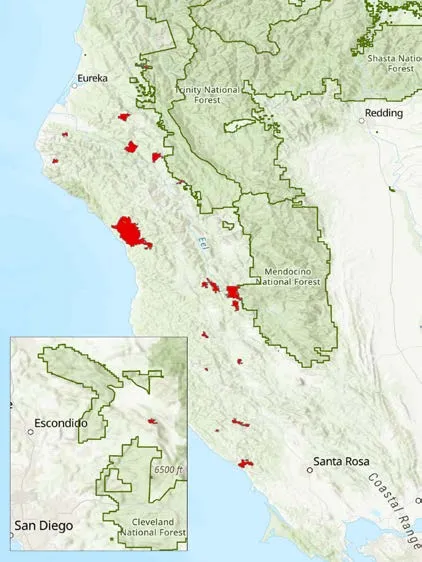
The inset map shows the one Forest Legacy project in southern California. Map courtesy of USDA Forest Service.
The goals of the Forestry Legacy Program (FLP) are to protect environmentally important forestland threatened with conversion; and preserve public resource values such as water, air, wildlife habitat and recreation. Desired outcomes include the protection of important scenic, cultural, fish, wildlife, and recreational resources, riparian areas, and other ecological values. Traditional forest uses, including timber management, as well as hunting, fishing, hiking, and similar recreational uses are consistent with purposes of the FLP. In California, the legacy program is comprised of two separate but complementary programs: the Federal Forest Legacy Program and the California Forest Legacy Program.
These programs are implemented through conservation easements, usually held by a non-profit such as a conservancy or land trust, or in the case of the Federal Forest Legacy Program, held by the state. Landowners may voluntarily sell or transfer certain rights restricting certain activities (development, public access, etc.), while retaining ownership of the property and the ability to manage the forests, so long as those activities are consistent and compatible with the terms of the easement and the landowners goals (for example, timber harvesting, trail building, grazing, etc.).
Properties eligible for participation in the FLP arethose with working forest and rangelands, where the property is managed for the production of forest products and traditional forest uses are maintained. The land title must be free of encumbrances that allow uses incompatible with the FLP, such as mineral reservations; right of ways; contracts; leases; or any other instrument that creates a thirdparty interest inconsistent with the purposes of the FLP. Having a potential third-party encumbrance does not necessarily mean a landowner won't qualify to participate, but other steps will need to be taken.
Project costs covered by the Forest Legacy Program grants include purchase of interests in lands, appraisals, land surveys, closing costs, establishing baseline information, title work, purchase of title insurance, conservation easement drafting and other real estate transaction expenses.
All projects are evaluated on four main characteristics:
- Importance – Does the land provide important economic, habitat, watershed, water supply, recreational, scenic, historical/cultural benefits?
- Strategic Value – How does the property relate strategically to other properties adjacent or in close proximity to it?
- Threat – How is the property threatened by development or conversion to other uses?
- Readiness – To what degree has due diligence been completed?
Projects are selected for funding through a competitive process, first at the State level and then at the national level. The process of applying, being selected, receiving funding, and conducting due diligence (appraisal and appraisal review, title review, survey, etc.) on a project can take several years. It requires a high degree of commitment from landowners and partners.
Roles and Responsibilities
Landowners with completed FLP conservation easements on their property(s) have the long-term responsibility for managing their land in a manner consistent with the purposes of the FLP and the terms specified in the conservation easement and Multi-Resource Management Plan. Landowners who purchase or inherit properties with FLP conservation easements also assume these long-term roles.
In California, CAL FIRE is responsible for overseeing the program administration and other federal or state agencies (such as the NRCS) and local government may participate through an agreement. CAL FIRE works with landowners to complete the application and submits them to the Joint Forestry Committee for ranking. Once ranked, projects are submitted to the USFS Washington Office, where they will compete for funding with other projects across the US.
State Forest Stewardship Coordinating Committees are established in each State for the purpose of reviewing and recommending project proposals at the State level. In California, this role is filled by the Joint Forestry Committee.
Nonprofits can also work on behalf of CAL FIRE to help facilitate project development, due diligence, and monitoring. Qualified nonprofit organizations can hold the conservation easements for fully donated tracts enrolled in the FLP.
Compatible vs Non-Compatible Uses
Before initiating first steps towards a Forest Legacy Project, landowners should have a clear idea on what activities are considered 'compatible' or not.
Compatible Uses
Traditional and other forest-based uses are integral to a FLP. Examples of compatible uses include: hiking; fishing; hunting; grazing; timber harvest; mushrooms, and other forest products; camping; and bird-watching. Many activities and improvements which support or enhance these activities, while minimally impacting other forest values and benefits, may also be compatible. Uses that are commercial in nature, and not contrary to the provisions of the conservation easement, may also be acceptable.
Non-compatible Uses
Uses that are known to, or could, substantially and negatively impact the forest values and benefits are considered non-compatible activities, and should be addressed by either excluding the use or activity through the conservation easement; or removing the non-compatible use areas from the FLP project area. Examples of non-compatible uses include: multi-unit residential subdivisions; parking lots; sports fields; and commercial signage. For more detailed examples of compatible and non-compatible uses, see Appendix E – Examples of Forest and Non-forest Uses in the Forest Legacy Program Implementation Guidelines.
Interested in pursuing the Forest Legacy Program? Here's what you need to do first.
The first step is to reach out to California State FLP Director, John Ramaley (John.Ramaley@fire.ca.gov) or Kevin Kiniery, FLP Coordinator (Kevin.Kiniery@fire.ca.gov) to discuss the program in general and statespecific requirements.
Click here for more information on the history of the Forest Legacy Program in California.
Q&A with Forest Landowner, Forest Stewardship Participant and Forest Legacy Participant Dale Silva
Q: What led you to pursue a conservation easement through the Forest Legacy Program?
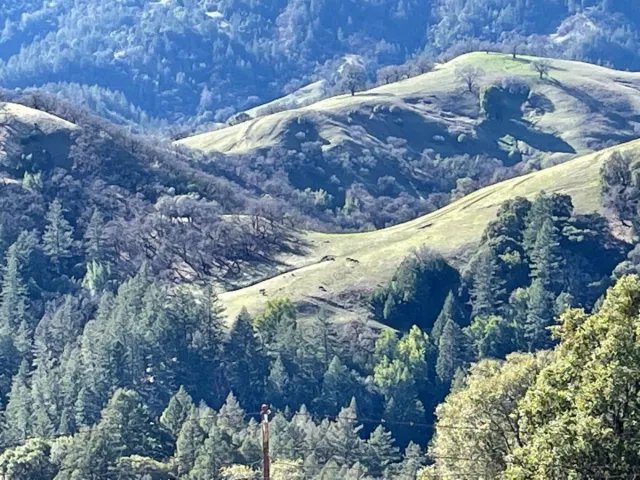
A: We sought to keep the ranch from ever being sold to developers. We want to keep it as it is forever—forest land, grazing, oak forest, and beautiful creeks. We want to make sure that heirs down the line don’t seek to cash out and loose this remarkable family place. Also, with the conservation easement comes revenue to enable us to invest in the ranch to make the operation sustainable. The Forest Legacy program was absolutely wonderful in helping us achieve all this. Their goal of preserving forests and preserving open space is the same as ours.
Q: What were some of your first steps in this process?
A: Our first step was finding an advisor experienced in crafting a conservation easements and in finding funding for them. The advisor will work with others to guide the process. Our advisor was the Western Rivers Conservancy (WRC) based in Portland which contacted the Forest Legacy program for help and closely guided the process every step of the way thereafter. The WRC was joined later by the California Rangeland Trust (CRT) in Sacramento which sought additional funding for us, provided guidance and administration, and now holds the easement. Soon after, we signed on with a conservation easement attorney to help advance our family’s interests with our partners.
Q: What activities are you able to conduct under the terms of the easement that meet your management goals?
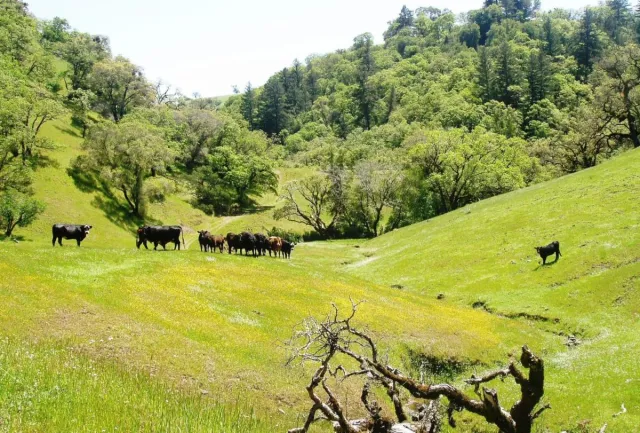
A: Under the terms of our easement we can continue to graze cattle, harvest timber, hunt, maybe plant a vineyard someday, maybe build two or three houses someday and pretty much operate as we always have. We of course can’t subdivide, which is a good thing. Forest Legacy likes working ranches and working forests. Not all easements are designed for working ranches and working forests though. There are groups in addition to Forest Legacy that offer funding, but they are more restrictive. Forest Legacy is generally okay with more restrictions and will work with additional funders. Those restrictions may be fine for some folks and make it easier to get funding in addition to Forest Legacy funding.
Q: How does the holder of your easement engage with you now and in the future?
A: The easement holder, the California Rangeland Trust, will visit the ranch to make sure that we are not violating any of the terms of the easement. There are some things for which we need their approval and other things we need to advise them that we’re doing. Neither is burdensome at all. Their advice is welcomed.
Q: It can be a long process in terms of time finalizing an easement through the Forest Legacy Program. What tips would you give others who are thinking of pursuing this?
A: Please do engage all family members in this, especially immediate heirs. They will have a vision for the future that needs to be honored. From these discussions come decisions about what rights you want to keep and what rights are okay to give up. Secondly, ensure that your advisors seek funding from sources in addition to Forest Legacy. Funding groups are very collaborative and Forest Legacy was very happy to work with them in our case. We found Forest Legacy to be “for you” not “against you” and seeks to make sure your reasonable goals are realized and that your land is preserved. Are you happy with the end result? We could not possibly be happier. The ranch is preserved forever. Forest Legacy could not have been a better partner.
Community Forest Legacy Program
The CAL FIRE Forest Legacy Program facilitates applications to the United States Forest Service (USFS) for the Community Forest and Open Space Conservation Program (Community Forest Program) on an annual basis.
The Community Forest Legacy Program offers a unique opportunity for communities to acquire and conserve forests that provide public access and recreational opportunities, protect vital water supplies and wildlife habitat, serve as demonstration sites for private Monitoring the Forest Legacy Project into the future Long-term stewardship of FLPfunded projects, including monitoring and enforcement of violations, is ultimately the responsibility of the State Lead Agency (CAL FIRE) or the assigned entity. At a minimum, monitoring FLP conservation easements must occur at least once a year, and consists of a visual inspection appropriate to the size and restrictions of the property, documented by a written report to catalog the condition of the conservation values on the property at time of inspection. The holder of the conservation easement should immediately forest landowners, and provide economic benefits from timber and non-timber products.
Program specifics include:
- Full fee title acquisition is required.
- Conservation easements are not eligible.
- Community Forests can be owned by local governments, tribal governments, and qualified nonprofit entities.
- The program pays up to 50% of the project costs and requires a 50% nonfederal match.
- Public access is required for Community Forest Program projects.
- Lands acquired through the program are actively managed in accordance with a community forest plan to provide community benefit.
Monitoring the Forest Legacy Project into the future
Long-term stewardship of FLP-funded projects, including monitoring and enforcement of violations, is ultimately the responsibility of the State Lead Agency (CAL FIRE) or the assigned entity.
At a minimum, monitoring FLP conservation easements must occur at least once a year, and consists of a visual inspection appropriate to the size and restrictions of the property, documented by a written report to catalog the condition of the conservation values on the property at time of inspection.
The holder of the conservation easement should immediately address any violation(s) with the landowner, and the landowner should have the opportunity to correct the breach within a reasonable amount of time.
Other terms to know...
- Affirmative obligation – Specified actions the landowner must fulfill to be in compliance with the terms of a conservation easement or rights granted to the easement holder to access the property or make improvements.
- Baseline Documentation Report (BDR) – A report establishing the initial conditions of an FLP conservation easement tract necessary to monitor and enforce the conservation easement.
- Due diligence – Activities conducted to ensure that no financial harm occurs to the buyer during the acquisition of a tract of land or as a result of purchasing the land.
- Reversion provision – A statement placed in a conservation easement that requires financial reimbursements if the legal protections are removed or the use of the property changes. This is now called an extinguishment or disposal provision.
Find the printable version of this newsletter below. Note that the pdf is for print purposes ONLY.
