
It’s almost tomato harvest season. Time to pick the bright red fruit off the vine and savor the first luscious bite that sends juice dribbling down your chin. Perhaps your tomatoes are blemished, or your vines are showing unwelcome scars, pests, or diseases? Here are a few of the most common disorders that affect our homegrown tomatoes.
Poor tomato fruit set.
Don’t be alarmed if the first blossoms fall off. It is normal for blossoms to drop if they are not pollinated. Temperature is the main cause of poor pollination. In early spring, night temperatures are too low. As nights warm and temperatures stay above 55°F, fruit set improves. When day temperatures range above 100° F, fruit set also decreases. A sudden hot spell will interfere with fruit set for 7-10 days after temperatures return to normal. Failure to set fruit also may be caused by lack of moisture or too much moisture, poor soil fertility or too much fertilizer, or too much shade. Lightly fertilize with a low-nitrogen fertilizer or tomato fertilizer. 1) at the time of planting, 2) when fruit set is well on its way, and 3) after picking the first tomato. Irrigate on a regular schedule.
Blossom end rot.
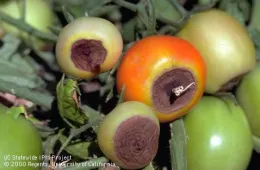
This physiological disorder is related to calcium nutrition and is brought on by poor watering practices. A tan discoloration appears at the blossom end of the green fruit. The discoloration enlarges, darkens, and becomes sunken and leathery. The remainder of the fruit ripens and can be used if there is no other decay. Because water stress in the plant causes the problem, check the soil moisture. In most cases, the cure is more thorough and regular irrigation. Water deeply about twice a week early in the season (tomatoes are deep-rooted), but keep foliage dry to prevent disease. Reduce water by as much as 50% as fruit ripens to reduce cracking and intensify flavor. To check moisture, insert your finger 3” – 4” into the soil – your finger should be moist, not wet or dry. If dry, it’s time to water. 3-4 inches of mulch will help retain moisture.
Splitting Fruit.
Too much or inconsistent water, or fruit exposed to too much sun. Maintain a regular irrigation schedule to keep soil moist (not wet). To check moisture, insert your finger 3”–4” into the soil; your finger should be moist, not wet or dry. If dry, it’s time to water. Provide sun relief for plants. Avoid over-pruning.
Curling of tomato leaves.
Curling of mature tomato leaves is very common and more prevalent in some varieties. It is most noticeable when plants are about 1 foot in height. The leaves on the sunny side of staked plants often may curl while those on the shady side do not. It is not an indication that anything is seriously wrong with the plant. Avoid over-pruning. Provide some sun relief for plants such as a staked umbrella or shade cloth.
Wilt diseases - Verticillium and Fusarium.
Older leaves turn slightly yellow and die (verticillium wilt), OR older leaves turn bright yellow and die (fusarium wilt). When purchasing tomato seed or plants, choose ones that bear VF on the label, as these will be resistant to the two main wilt diseases, verticillium and fusarium. These fungi are so prevalent that plant breeders established resistance to these diseases many years ago. In both diseases, the fungi infect the plant through the roots, then enter and plug the water-conducting elements in the stem. This eventually leads to wilting symptoms. Remove infected plants from the garden and plant tomatoes in a different location next year.
Tomato russet mites.
Tomato mites are too small to be seen and therefore are seldom detected until serious damage has occurred. Lower leaves are killed, causing many dried leaves at the base of the plants. Some leaves are bronzed; others may have a glazed appearance. New growth at tips of branches appears normal. Stems are a greasy, bronzed color and the surface is glazed as if it were shellacked. To control mites, dust the plants thoroughly with dusting wettable sulfur monthly, starting in June when daytime temperatures are below 90°.
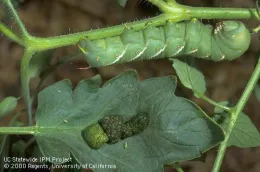
Tomato and tobacco hornworms.
Hornworms are large, green worms with diagonal white stripes on the sides and a sharp spine (horn) at the tail. Because they feed heavily on the upper leaves, the damage is obvious, as are their large black droppings. But because of their protective coloration, the worms are very difficult to find. You can control a few hornworms by hand-picking them from the plants. Other foliage and fruit worms are armyworms, corn earworms, and pinworms. If worms are a big problem, then spray plants with Bacillus thuringiensis (BT).
Stink bugs.
Light-colored cloudy spots with pithy or corky areas in the tissue of the fruit just below the skin are caused by the feeding punctures of the stink bug. Stink bugs are green or brownish grey, shield-shaped, and just under ½ inch in length. It is usually sufficient to hand-pick the bugs and destroy them. No effective insecticides are available for the home gardener.
Whiteflies.
Small white flies that scatter when disturbed. Whiteflies cause leaves to yellow and curl when feeding and can cause fruit to ripen unevenly. Use silver- or aluminum-coated mulches. Spray with insecticidal soap. Put out yellow sticky traps at the first sign of infestation.
Storing tomatoes.
Whether store-bought or home-grown, tomatoes ripen best at temperatures between 55-65° F. If you refrigerate your tomatoes, you prevent them from ripening and actually ruin their tomato flavor. When frost is expected, you can pick any tomatoes that have turned lighter green or pinkish and ripen them indoors.
Eat tomatoes.
Tomatoes are naturally low in sodium, and an excellent source of Vitamins C and A. Tomatoes also contain the antioxidant lycopene, which is related to beta carotene. A study conducted in Italy showed that consuming seven or more servings of tomatoes a week reduced the risk of developing colon, rectal, and stomach cancer by sixty percent!