
Have you ever thought about creating your own native habitat garden? Have you heard the term native habitat garden and wondered what exactly it is and how you could create one? If so, you’ve come to the right place!
A native habitat garden is a landscaped area that utilizes native plants to create a functional ecosystem that supports local wildlife. What wildlife, you might ask? A native habitat garden is likely to support birds, bees, butterflies, and more by providing food, water, shelter, and nesting sites. When building your own native habitat garden, something to keep in mind is that the most successful habitat gardens are built around a keystone species. Today, the keystone that I want to propose to you is the Valley Oak, or Quercus lobata.
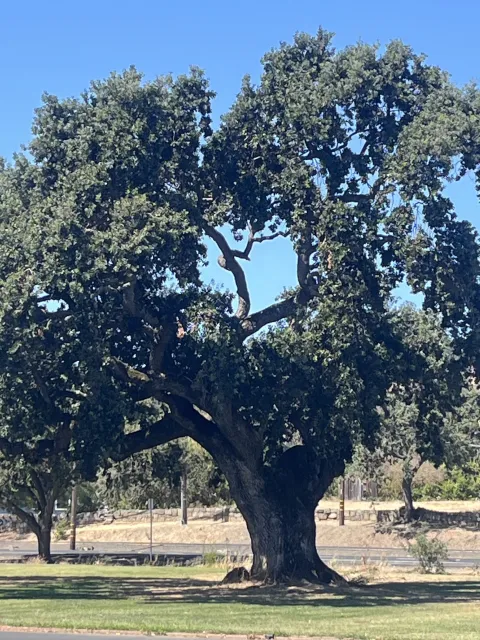
The Valley Oak is the largest of the California native oaks and is endemic to the interior valleys and foothills of the state. It can be found growing in these regions from Siskiyou to San Diego County. Unlike the Blue Oak, which I’ve written about previously, the Valley Oak requires groundwater year-round to sustain itself. When growing within its ideal conditions, the Valley Oak can live to be up to six hundred years old!
As stated earlier in this article, the Valley Oak is a keystone species. But you may be wondering what exactly a keystone species is. A keystone species is a species that is critical for various types of wildlife for either food or cover. A variety of birds and mammals utilize the acorns of the Valley Oak as a food source, such as the California Scrub Jay and the California Ground Squirrel. But this vital food source is also susceptible to attack by bruchid beetles. The large acorns can survive moderate levels of infestation, however. The indigenous wasp Andricus quercuscalifornicus, or the California Gall Wasp, is another species which frequently utilizes the Valley Oak. It induces oak apple galls on the twigs of mature specimens to house its larval stage.
The Valley Oak is a beautiful and long-lived deciduous oak with a distinctive ridged bark that resembles an alligator’s hide. Coupled with deeply lobed leaves which turn a yellow to light orange color in autumn and a distinctively irregular, spreading and arching branch pattern, the Valley Oak is very easily identifiable. It is important to remember, however, that this is the largest of the native oaks and can surpass 30 meters (98 ft) in height, with a sturdy trunk exceeding 3 meters (10 ft) in diameter. If provided with sufficient water, it is possible for the Valley Oak to grow at a rate of over four feet per year. And if these notes alone don’t do enough to catch your attention, you should know that when a fresh leaf from this species is broken or rubbed, an aromatic scent is exuded, which often evokes what most would refer to as the odor of the forest!
So, do you think that you’ll want to plant your own Valley Oak to start your native habitat garden? There’s no better time to start one than the present. Provided that you have the proper space to accommodate the largest of the native oaks and the ability to provide it with sufficient water to thrive, this tree could be a breathtaking centerpiece for your native habitat garden. But no matter whether you decide to start your native habitat garden now or simply continue to cultivate the garden you already have, good luck and happy growing!
Be sure to read more on Valley Oak Companion Plants by Pam Muick