Wherever we travel, I always keep an eye out for plants. First, I appreciate the beauty of the natural environment around me. Some destinations also have official botanical gardens to visit. Other times I marvel at plantings in neighborhoods or even shopping complexes. You just never know what is going to catch your eye.
A recent trip to Catalina Island was no exception. My husband and I hiked up to the Wrigley Memorial and Botanic Garden. We enjoyed the rugged plants that were showcased there. Some were endemic to Catalina and others were plants that thrived in the dry Mediterranean climate. Catalina is in USDA Climate Zone 10b and Sunset Western Garden Zone 24. Catalina is a dry area with an average annual rainfall of 11 inches.
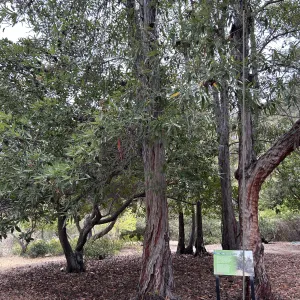
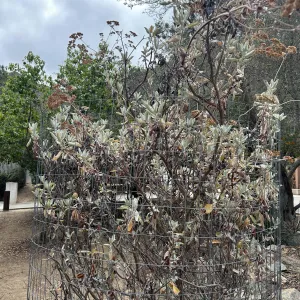
Catalina Ironwood, Lyonothamnus floribundus ssp floribundus, is found only on Catalina. The dramatic bark was quite impressive. Please check out the following link for a quick article about this tree. https://ucanr.edu/blog/uc-master-gardeners-diggin-it-slo/article/caralina-ironwood. Another endemic shrub was St. Catherine’s Lace, Eriogonum giganteum ssp giganteum. The roots and leaves of this plant were used by Native Americans medicinally in a tea. This was one of several endemic plants wrapped in metal wire cages to protect them from the nonnative mule deer that threaten them.
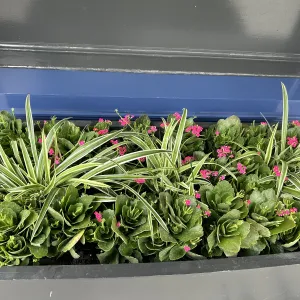
Walking by a hotel near the downtown area, I spotted a lovely planter box. Beautiful pink Kalanchoe was combined with Spider Plant, Chlorophytum comosum ‘Variegata’. Using just two kinds of plants, the display illustrated how striking low-water, low-maintenance plants can be.
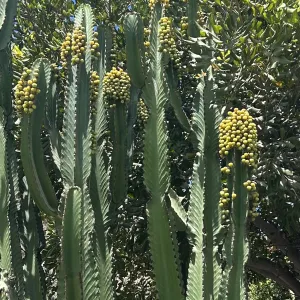
On a longer walk in a business/industrial area, we found a towering plant that stopped us in our tracks. Even my non-gardening husband wanted to know what it was. I think of these kinds of plants as "Wow Plants". The tall linear stems were such a nice contrast with the round, berry-shaped fruit. My plant ID app confirmed it was in the Euphorbia genus. However, further research did not help me confirm a species. Apparently, distinguishing between some Euphorbias can be quite difficult, especially using a photograph. E. abyssinica, E. ingens, and E. ammak are all possibilities. But whatever it is, it is magnificent.