
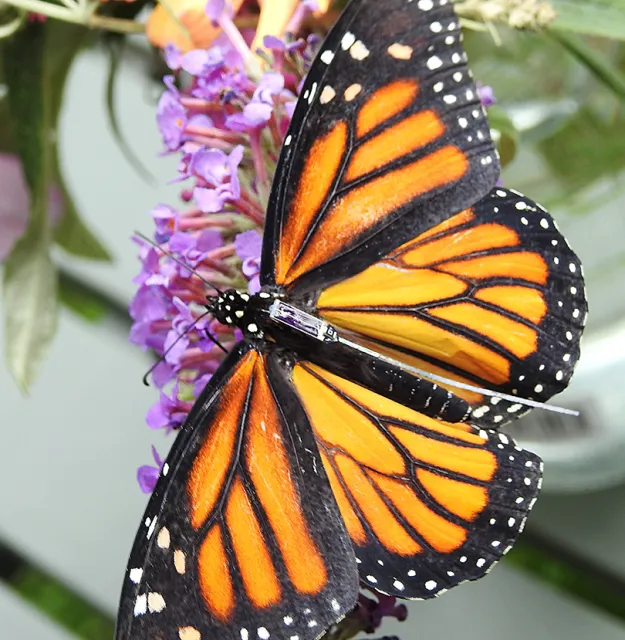
Yes, there are images!
Washington State University professor/entomologist David James shared some of his photographs after radio-tagging or "e-tagging" 22 adopted monarch butterflies on Sept. 17 in Phoenix, Ore.
As part of his Adopt-a-Monarch research program, he e-tagged a total of 200 migratory monarchs in Idaho and Oregon and is now tracking their movements.
Some 50 monarch advocates watched as James released the monarchs at a Phoenix park. He discussed the project and answered their questions.
Phoenix, located in Jackson County, is a small city (population 4,475, per the 2020 U.S. census). It's about three miles southeast of Medford and eight miles north of Ashland.
One of the e-tagged monarchs is our family's adoptee: Butterfly Garvey, or "WR124 Garvey." (See Sept. 18th Bug Squad blog)
Two minutes after she was tagged and released, she nectared on a butterfly bush, Buddleja davidii.
However, as of 6:30 tonight, the mobile app showed 1617 detections ("pings") and no kilometers.
Butterfly Garvey may be in trouble. She has not left the release site.
"Currently, only 4 of the 22 released at Phoenix are still at the release park (including Garvey)," James wrote in an email tonight.
However, the good news: "More than half of the 32 butterflies I released in Phoenix and Ashland are now in California... Mona Lisa, released at Phoenix same time as Garvey, is now near Red Bluff."
"Sadly, not all e-tagged monarchs make the journey," James noted. "At this point. I am not sure if Garvey is hanging around for a while, and will head south soon or whether something bad has happened to her. If she is dead with the e-tag exposed to the sun, pings will continue occurring if cell phones are around and we have seen before that the pings and lines end up making no sense (the system apparently can't cope with lots of detections for an immobile butterfly)."
"WingsRising (thanks to a generous donation from a Portland Monarch Facebook group) has just purchased a piece of equipment that will allow us to investigate a 'pinging' monarch like Garvey, find it and retrieve the e-tag. However, we won't get this e-tag finder for another few months."
James said he experienced a similar disappointment. "I purchased 4 tags named in honor of my wife and 3 daughters. None of them have moved from the release site in Idaho after more than 2 weeks. They are not even pinging!"
"However, the data being gained on the migration in Idaho and Orego makes up for the disappointments. Our understanding will be significantly advanced by this year's e-tagging. One ID-released butterfly is just 80 miles from Arizona, and if it makes it to AZ, it will be the first record of a PNW butterfly migrating to AZ! My hypothesis is that some ID monarchs migrate to Mexico. "
"If a bird swallows an e-tag it won't ping because of no solar radiation inside a bird... It is more likely that a bird would dismember a monarch to eat it so the tag would be dropped. If it lands solar panel up. it could keep pinging..."
"For now, I will keep my fingers crossed that Garvey finds her way out of Phoenix...
Fingers crossed.
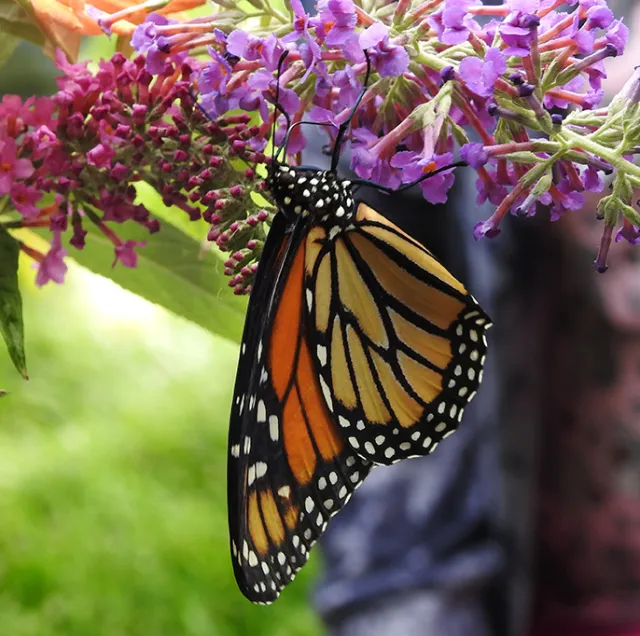
As James explained Sept. 6 on his Facebook page, "Monarch Butterflies in the Pacific Northwest," https://www.facebook.com/MonarchButterfliesInThePacificNorthwest: "Each carries an electronic tag which ‘pings’ when someone with a cell phone is within 100 yards or so. The pings are transmitted to ‘Project Monarch' and show up on the app and over time provide a detailed record of that particular monarch’s migration route."
"This extraordinary number of monarchs e-tagged in the Pacific Northwest was made possible by 200 citizen scientists, monarch advocates and conservation organizations adopting monarchs through our Adopt-a-Monarch website https://adoptamonarch.org/," he related. "This site is well worth a visit if you want to learn more about our program including the locations of all the releases we make this season. The site also contains a tutorial on how to get and use the Project Monarch app. With this app installed on your phone you can join in the fun of tracking individual butterflies released in Idaho and Oregon! You will see data being collected in real time along with the scientists! Will Idaho monarchs end up in Arizona or even Mexico? You (along with many others) will be the first to know."
How It All Began
For us, it all began when a migrating monarch from the David James' research program at WSU (my alma mater) fluttered into our garden in Vacaville, Calif., on Sept. 5, 2016 from Ashland, Ore. Citizen scientist Steven Johnson had tagged and released it on Aug. 28. The tag read “Monarch@wsu.edu A6093.” James firgured it "flew 285 miles in 7 days or about 40.7 miles per day. Pretty amazing."
Meanwhile, Western monarchs are heading for their overwintering spots in coastal California, including Santa Cruz and Pacific Grove. Others will overwinter elsewhere. Some won't make it.
Habitat Loss, Pesticies, Climate Change
Due to habitat loss, pesticides and climate change, Western monarchs are in trouble. "After surveys by hundreds of volunteers and partners, results from the 29th annual Western Monarch Count led by the Xerces Society for Invertebrate Conservation reveal another historically low population," according to the Xerces' website. "Approximately 12,260 monarchs were recorded across 249 sites during the typical peak overwintering period from late November through early December 2025, when monarchs cluster together in groves of trees along California’s coast."
"This is the third-lowest tally since the count began in 1997, following low numbers last winter and a weak summer breeding season," Xerces points out. "The three lowest counts in the program’s history have all occurred in recent years: 1,901 individual monarchs in 2020, 9,119 in 2024, and 12,260 in 2025. Western monarchs numbered in the low millions regularly in the 1980s. The increasing frequency of record-low years heightens ongoing concerns about the health and stability of the western monarch migration.
Meanwhile, you can track monarchs through the Adopt-a-Monarch research project (and yes, James plans to continue the project next year).
Wings up!