

For years gardening magazines have been extolling the virtues of “vertical” gardening as a way of saving space in the vegetable garden, thus allowing more crops to be planted in confined areas. This year I finally decided to give it a try.
The Bean Tower
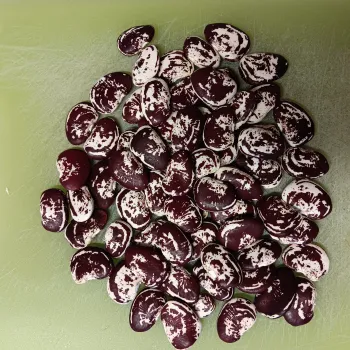
I had saved seeds of climbing lima beans, “Christmas,” an heirloom variety with large beans that are white and heavily splashed with maroon markings. They are good to eat, too! I also have a commercial “bean tower,” which comprises a hollow metal stake driven into the ground, with a couple of heavy-gauge circular wires with radiating spokes attached to it—a large one at ground level and a smaller-diameter one fitting into the top. To set it up, one passes strings from top to bottom and back again all around the circumference to give the climbing plants something to cling to.
Planting the Limas
Lima beans are tender, so I waited until the weather had warmed and sowed them in Bishop on May 2. I planted eight of them in a small 3 × 3-foot raised bed on the north side of the vegetable plot, which has a north-to-south orientation, so that they would not shade out any of my regular vegetables. I used a circle of 1/4-inch irrigation tubing with emitters at 1-foot intervals attached to the base wire of the tower.
To further my adventure in vertical gardening, I erected a new melon tunnel on the east side of the beans so that all of my tall-growing things were together.
Growth and a Leaning Tower
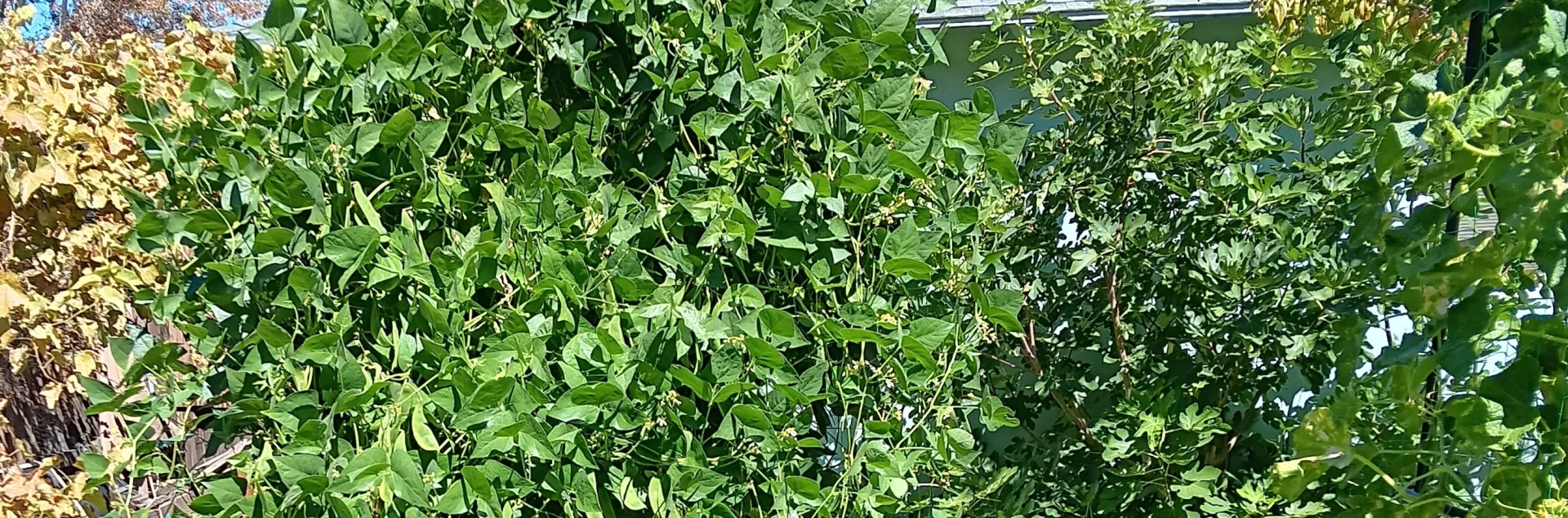
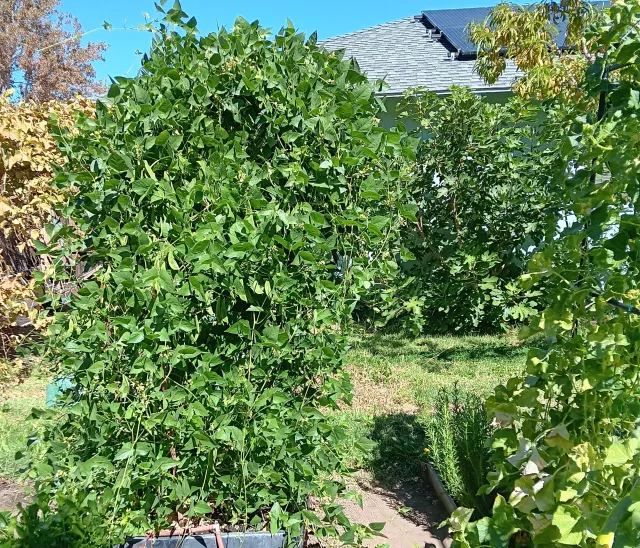
The beans were very slow to get going, but eventually they germinated, and the seedling stems waved about until they found a string. By this time, we were experiencing very hot daytime temperatures, but the beans thrived in the heat, and as soon as the shoots found one of the strings, they romped away. By late summer there was a 6-foot thicket of dense, healthy foliage and small white flowers. I only saw domestic honey bees on the flowers—no native pollinators were in evidence. Then a problem occurred. Obviously, the central stake was not sufficiently deep in the ground to support the wind resistance of the wall of foliage, so the structure began to lean at an alarming angle. I fought my way through the greenery and managed to get a thin rope around the upright and tie it to a stake hammered into the ground. I then placed fruit tree props under the upper string support. However, since this support is only placed in the hollow stake without any fixing, the risk is that these props will push it out of the top if I am too aggressive.
There are a great many thick green pods containing two seeds each all over the plant, but since these look rather coarse, I have not attempted to eat any at this stage. Instead, I will wait until the end of the season and harvest them as dried pods. Even in October, the plants are still sending out new shoots, which I prune off because the lower ones are a tripping hazard.
The Melon Tunnel
Meanwhile, the melon tunnel functioned as planned, although the melons and cucumbers needed constant guidance to find the netting at first, and many stems evaded my efforts and grew along the ground. I had a good crop of cucumbers, but although I had quite a few melons, they never reached the top of the structure to fulfill my dreams of lush foliage with melons hanging in abundance from the top!
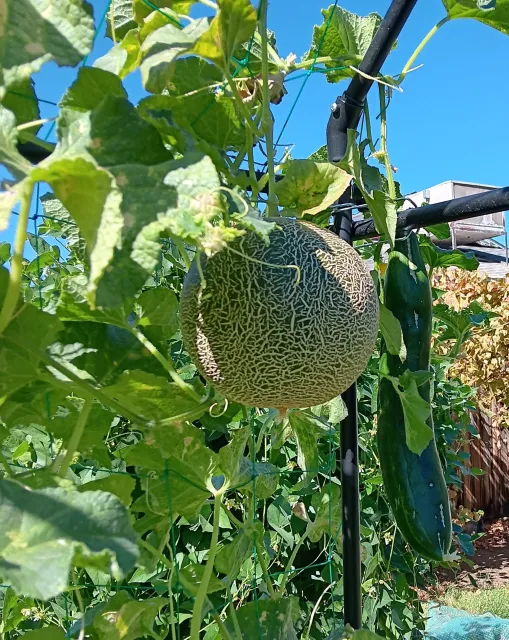
The downside to the vertical gardening plan was that the melon tunnel shaded the bean tower plants from the morning sun, and the beans shaded the melons from the warm afternoon sun, which delayed the ripening of those fruits. I must make sure that they have a bit more space between them in the future. Two plants, a luffa and a Kuri squash, were planted late and were shaded out at the base of the tunnel, so they did not really begin to grow until early September—too late to produce any kind of crop.
The upside is that squash bugs hardly touched the cucurbits that were not growing on the ground, and produce is easier to harvest. I had planted tomatoes on the east side of the tunnel so that they were protected from the very hot afternoon sun. That worked, and they were very productive, while some that I planted in a more open, exposed area looked thoroughly miserable throughout the growing season.
Lessons Learned
In the past, I have tried growing climbing plants up my own structures created from natural sources—poles, twiggy branches, and the like—but I have to say that the commercial, easier-to-erect varieties are a lot simpler to deal with. It is obvious that care needs to be taken in deciding where to place these structures in order to get the best results.