
Authors: Ana M. Pastrana (UCCE Imperial, Riverside and San Diego), Charlotte Acharya and Richard Michelmore Genome Center, UC Davis)
Downy mildew is one of the toughest diseases lettuce growers face in the Imperial Valley, especially in cool, foggy winters with heavy dew. With a strong El Niño expected this winter, we may see more of it than usual. Here is what we learned about the downy mildew in our area this past season, and what it means for your fields.
WHY A RESISTANT VARIETY CAN STILL GET DOWNY MILDEW
Most lettuce varieties carry resistance genes that allow the plant to recognize downy mildew and prevent infection. The problem is that the downy mildew pathogen keeps changing. When a new strain appears that the plant can no longer recognize, it can infect varieties that used to be resistant.
These different strains are called races. In the U.S., races are given official names like 9US or 10US, with the most recent named in 2025. A strain only gets an official name after it appears repeatedly across many fields over several seasons. Until then, new strains are simply called "novel."
The more acres we plant with the same resistance genes, the faster the pathogen adapts, much like weeds or fungi become resistant when we spray the same product over and over. The good news is that the variety's resistance does not wear out. It still works against the races it was bred for; it's the pathogen that changes.
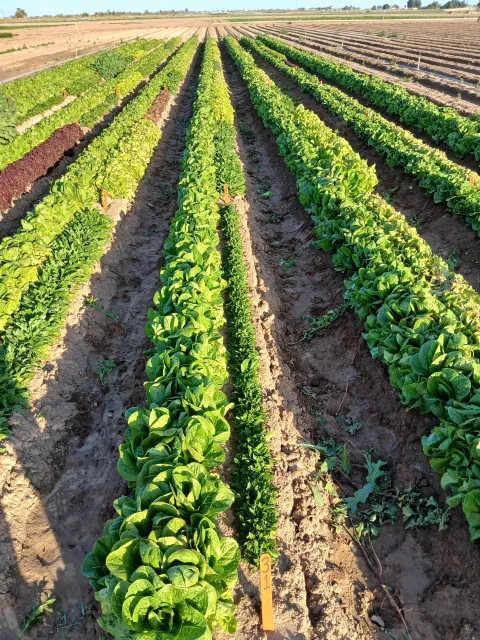
What is a trap nursery? A trap nursery is a field planting of many lettuce lines side by side, each carrying different resistance genes. Our trap nursery includes 60 lines: commercial varieties, breeding lines and wild relatives of lettuce (Figure 1). We let downy mildew infect the plants naturally, without spraying, and then look at which lines get sick and which stay clean. Because each line resists a different set of strains, the pattern of infection tells us which downy mildew strains are present in the Imperial Valley. We also collect samples from infected plants for race and fungicide testing in the lab.
We planted our second trap nursery last winter, and 13 lettuce lines became infected. Seven of the characterized 2026 samples came from it; the other three came from fields near Holtville. We are repeating the trap nursery this winter to track how the pathogen changes from year to year and to keep growers and seed companies up to date.
WHAT WE FOUND IN THE IMPERIAL VALLEY
In January 2026, we collected 10 downy mildew samples in the Imperial Valley. The Michelmore Lab at UC Davis obtained an isolate (a culture of the pathogen grown on a susceptible variety) from each sample, identified which resistance genes it overcame, and tested the efficacy of common fungicides against it.
Most of our downy mildew were strains. Only 3 of the 10 isolates were a known race (9US). The other 7 were novel strains that don't match any officially named race.
How the isolates responded to fungicides. We tested the isolates growing on seedlings in the lab against three common fungicides.
Table 1. Response of 7 Imperial Valley downy mildew isolates to three fungicides. Numbers show how many of the 7 isolates fell into each group.
| Fungicide (active ingredient) | Effective | Partly effective | Not effective |
| Ridomil (mefenoxam) (FRAC 4) | 2 | 3 | 2 |
| Orondis (oxathiapiprolin) (FRAC 49) | 7 | 0 | 0 |
| Revus (mandipropamid) (FRAC 40) | 3 | 4 | 0 |
Orondis controlled all the isolates. Ridomil still worked, fully or partially, on 5 of the 7 isolates, but not on the other 2, so it's best used alongside other products rather than on its own. Some isolates were slightly less sensitive to Revus. That doesn't mean it will fail in the field, but it's a good reason to rotate products and keep an eye on it.
WHAT DOES THIS MEAN FOR YOUR FIELDS?
If you see a lot of downy mildew in a resistant variety, it's most likely one of these novel strains, not a problem with your seed. Resistant varieties are still worth planting because they keep the known races and many but not all novel strains under control. But with so many new strains around, resistance alone is not enough. Here's what we recommend:
- Plant varieties with broad resistance (races 7US–10US) and, if you can, mix varieties with different resistance genes across your fields.
- Rotate fungicides with different modes of action (FRAC groups). Tank-mix or rotate it with products that work differently. In our tests, oxathiapiprolin (FRAC 49) and mandipropamid (FRAC 40) performed better, but they also need to be rotated and used within label limits to keep them working.
- Spray before the weather turns, not after. Start protecting your fields when cool, wet, or foggy weather is in the forecast.
- Keep leaves dry when you can. Manage sprinkler irrigation, avoid overcrowded plantings, and scout early in the morning, when the white downy growth under the leaves is easiest to see.
Help us track downy mildew. If you find downy mildew in your lettuce this winter, especially in a resistant variety, let us know, and we'll collect a sample for testing. Every sample helps us and the seed companies know how the pathogen is changing.
Have a disease question? Whether it's downy mildew or anything else going on in your fields, please reach out. I'm happy to visit your field or look at a sample. You can contact me at ampastranaleon@ucanr.edu or (442) 977-5391.