


Persimmons come in a variety of shapes, sizes and colors, with different characteristics depending on the variety. Learn more about persimmon characteristics, varieties and tree care from UC ANR's South Coast Research and Extension Center.
About Persimmons
Scientific classification: Family Ebenaceae; Genus Diospyros
A persimmon, known to the ancient Greeks as "the fruit of the gods," is the edible fruit of a number of species of trees of the genus Diospyros in the ebony wood family (Ebenaceae).
The word persimmon is derived from putchamin, pasiminan, or pessamin, from Powhatan, an Algonquian language (related to Blackfoot, Cree and Mohican) of the eastern United States, meaning "a dry fruit."
Persimmons are generally light yellow-orange to dark red-orange in color and, depending on the species, vary in size from 1.5–9 cm (0.5–4 inches) in diameter. They may be spherical, acorn-shaped or pumpkin-shaped.
The calyx often remains attached to the fruit after harvesting but becomes easier to remove as it ripens. Persimmons are high in glucose, have a balanced protein profile and possess various medicinal and chemical uses.
While the persimmon fruit is not considered a "common berry," it is, in fact, a "true berry" by definition.
Source: Wikipedia, as cited in the original publication.
Persimmon Varieties
The following varieties are featured in Persimmons of Southern California, produced by UC ANR's South Coast Research and Extension Center.
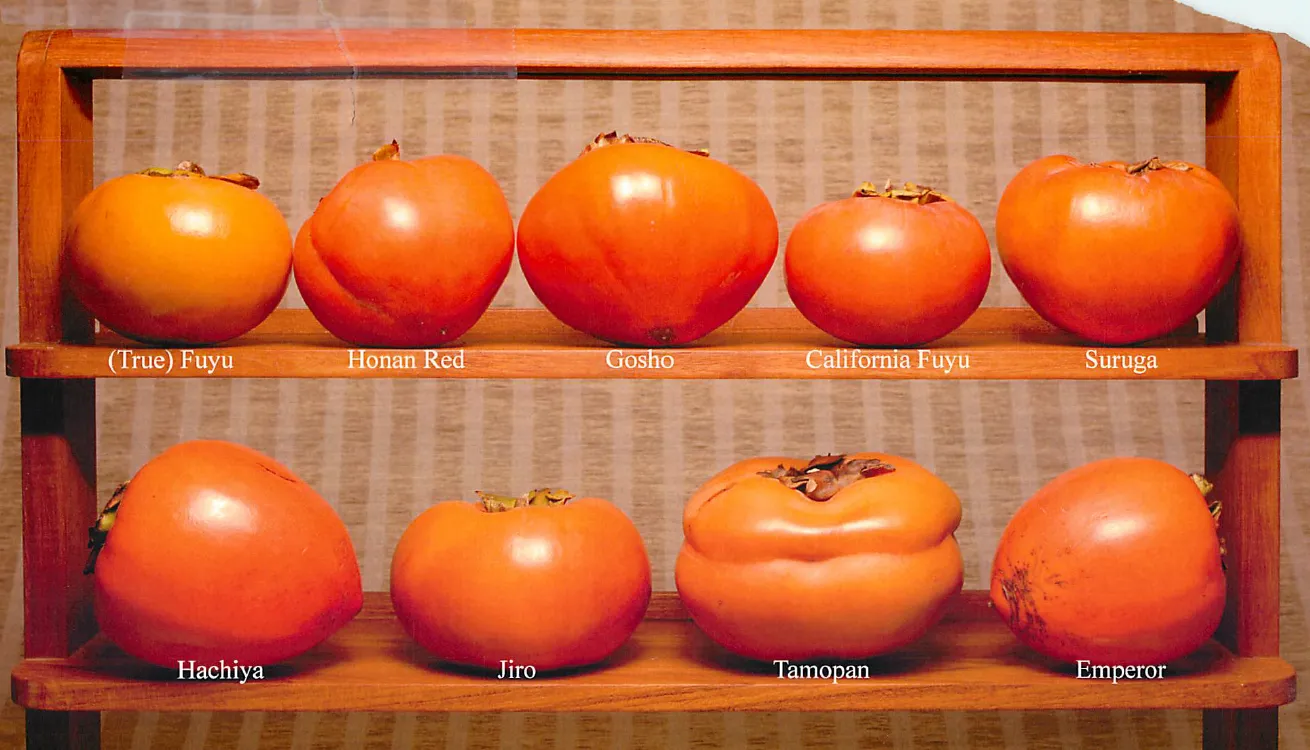
Tamopan
Large, somewhat four-sided fruit, broad-oblate and indented around the middle. Skin thick, orange-red. Flesh light orange, sweet and rich when fully ripe.
Ripens midseason in California.
Jiro
Fruit large. Resembles Fuyu, but more truncated and squarish in cross-section. Skin orange-red. Flavor and quality excellent.
Ripens late October and early November at SCREC; ships well. Often sold as Fuyu.
Tree slightly upright. Most popular nonastringent variety in California.
Saijo
Large squarish fruit. Skin orange-red. Flesh dense, very sweet, excellent quality. Difficult to soften on tree (fruit becomes spongy rather than soft). Ripens in November/December at SCREC; keeps well. Tree almost free from alternate bearing.
Recommended for warmer climates.
Virginiana
Diospyros virginiana
Native North American persimmon.
Hachiya
Large, oblong-conical fruit. Skin glossy, deep orange. Flesh dark yellow. Sweet and rich. Good for drying.
Ripens midseason to late. Tree vigorous, upright-spreading. Prolific in California.
True Fuyu or Fuyugaki
Medium-large oblate fruit, fairly four-sided. Skin deep orange. Flesh light orange, sweet and mild. Ripens late. Keeps well and is an excellent packer and shipper.
Tree vigorous, spreading, productive. Most popular nonastringent cultivar in Japan.
Hyakume
Fruit large, roundish oblong to roundish oblate. Skin buff-yellow to light orange, marked with rings and veins near the apex. Flesh dark cinnamon when seeded, juicy, of fine texture, non-melting.
Flavor spicy, very good. Nonastringent even while the fruit is still hard. Ripens in midseason; stores and ships well.
Honan Red
Small, roundish oblate fruit with thin skin. Skin and flesh ripen to a distinct orange-red. Very sweet and rich. Excellent for fresh eating and drying.
Ripens midseason to late. Tall, upright, moderately vigorous tree. Bears good crop.
Gosho or Giant Fuyu
Large, roundish-oblate fruit. Skin reddish orange, attractive. When fully ripe has one of the deepest red colors of any persimmon.
Flesh quality good, sweeter than Fuyu. Ripens in late October/November at SCREC. Tree somewhat dwarf. Bears regularly but sets a light crop in some seasons and is prone to premature shedding of fruit.
Russian Beauty
Cross of Asian and American persimmon. Heavy bearer of large, mostly seedless, sweet persimmons. A naturally dwarf tree and hardy to -30 degrees.
Nikita's Gift
Naturally dwarf tree loaded with delicious 2–3-inch bright reddish-orange persimmons. From Ukraine, Nikita's Gift is a hybrid of Asian and American persimmons with exceptionally sweet flavor when ripe (you'll know when they fall off the tree).
Bold red leaf color in the fall is an added bonus. Zones 6–9.
Additional Varieties Featured
The original publication also includes photographs identifying the following persimmon varieties:
- Wasa Jisha
- California Fuyu
- Suruga
- Emperor
These varieties are pictured in the original publication without additional descriptive information.
Persimmon Tree Care
Soil
Persimmon trees grow well in a wide range of soils.
They tolerate more clay than other fruit trees and do best in well-drained soil with a pH of 6.0–6.5.
Pruning
Normally only the top two or three buds at the end of the current season's growth contain flower buds.
If a tree is pruned heavily, it will result in a reduced crop and promote excessive vegetative growth.
Moderate pruning is recommended to promote an annual renewal of fruiting branches and to keep the trees in good shape. Don't let the branches get so long that the tree will need to be staked.
Thinning
On a young tree there should be 15–18 leaves per fruit compared with 20–25 leaves per fruit on a mature tree.
In order to have good-sized fruit there should be one fruit per bearing shoot.
Thinning is also important for pest control and a consistent, even fruit color.
The best time to thin is at flowering; then one month later, thin the small fruit.
Feeding
- First application: June or July, about one month after flowering
- Second application: September–October
Pests
Common pests listed in the publication include:
- Mealybugs
- Scale
- Tree borers
Diseases
- Anthracnose: Often called leaf, twig or shoot blight, and caused by several fungi
- Bacterial Blast: Causes leaf spotting and a blackening of the leaf petiole
- Botrytis Bunch Rot: Causes brown patches on leaves
Credits
South Coast Research and Extension Center (SCREC)
Persimmon Germplasm Collection
University of California Agriculture and Natural Resources
- Isabel Barkman – Master Gardener and persimmon expertise
- California Rare Fruit Growers (CRFG) – Persimmon notes
- Lani Colver – Recipes and cooking (unless otherwise noted)
- Gregory Rager – Photographs, design, printing and omissions/errors