
Table of Contents
- Greetings from UC ANR
- Bears in the age of mega-fires
- Trees as tasty meals for black bears
- Some bear facts
- Q&A with Meghan Murphy, Director of the North Bay Bear Collaborative & NBBC information
Greetings from UC ANR
When my son was 5, he and I were in a serious car accident. The responding firefighters gave him a teddy bear in a tee shirt with a heart on it. He held onto that bear for days. It became a fixture on his bed, then his bookshelf, and eventually it wound up in his closet. He is 29 years old now and his room has become my home office. Recently, when cleaning out the closet, I came across the bear. I jokingly asked him if he wanted the bear in his apartment, which was a NO, but he did ask if I could just keep it in a box with other items I have saved from his childhood. Obviously, even after all these years, that bear means something to him.
Bears, and wildlife in general, mean something to forest landowners. Of the 388 Forest Stewardship participants who have answered our survey question on "How important are the following reasons for why you currently own your wooded land in California?", 91% feel it is important or very important to protect or improve wildlife habitat, and 93% feel it is important or very important to protect nature or biological diversity. These are the #2 and #3 reasons you all own your forests, just edged out by 'to enjoy beauty or scenery'.
The topic of wildlife is huge! There are many subject matter experts within UC ANR and our partners who spend a great deal of time thinking about wildlife and forests. Consider this issue on bears as the tip of the iceberg. I hope you will join us for our March 21st webinar focusing on bears (more info below). Also, I want to thank our Community Education Specialist Heather Hill for taking on some of the pieces in this newsletter. Heather LOVES bears :)
Cheers,
Kim Ingram, Forest Stewardship Education Coordinator
Bears in the age of mega-fires
Forests across the United States have undergone significant changes due to timber harvesting and a century-long fire suppression policy. As a result, a heavy fuel load is present throughout the country. Additionally, unprecedented climate conditions, including higher temperatures, drier winters, and tree mortality, have created a new norm where severe wildfires and “mega-fires” are more common than ever before.
Regrettably, in 1927, the United States Forest Service adopted fire control practices for all publicly owned forest lands, which led to a detrimental outcome characterized by the overgrowth of coniferous trees, a reduction in biodiversity, and a decline in the quality of habitats for numerous wildlife species (Stratman and Pelton,1999).
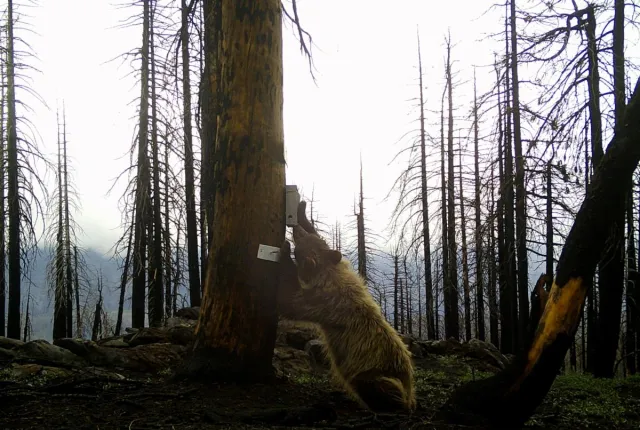
Land managers are actively working on restoration techniques to mediate and correct years of fire suppression and tree crowding. Even though restoration benefits biodiversity, prescribed burns, thinning, and other restoration treatments can impact the habitat conditions for black bears (Ursus americanus), at least in the short term. The availability of forage and horizontal cover used for dining will be impacted though the disturbances will be less significant than severe fire conditions. Additionally, seasonal shifts in forage consumption may increase interactions between black bears and hunters or other wildlife. Studies have shown that these changes can affect the behavior of black bears, leading to increased interactions with humans.
Wildlife corridors are crucial links that provide additional suitable habitat and allow animals such as bears and mountain lions to transition between different landscapes. These corridors are continuously being expanded to accommodate the needs of animals in search of new range and forage opportunities. They become even more crucial in post-fire environments, where animals must move to safer areas. These corridors have been effective in helping to slowly repopulate the North Bay bear population as black bears have expanded from Napa, Sonoma, and, most recently, parts of Marin. Wildfires and forest restoration treatments can reduce the availability of essential food sources for black bears. However, prescribed burning every three years can help promote the growth of soft mast foods such as blackberries, wild grapes, and huckleberries, commonly found in habitats that undergo a short burning cycle (Stratman and Pelton 1999). While these foods may not be a bear's primary source of nutrition, bears can benefit from their seasonal abundance to meet their nutritional needs when other preferred foods are unavailable. Research has also shown that some plants that produce fruit important to black bears require approximately five years following a fire to produce significant yields. Hard-mast production foods such as acorns are the primary sources of fall food for bears.
On March 21st, we will host a webinar on Bear and Predator Conflict and Mitigation in a Changing Landscape. One of the topics that will be discussed is the impact of the Dixie Fire on the black bear population in Lassen Volcanic National Park. The data collected before and after the fire will be compared to investigate the effects of such mega-fires on black bears in mountainous regions of California. These findings will help inform future management strategies for black bear populations in these areas and hopefully throughout California.
Trees as tasty meals for black bears
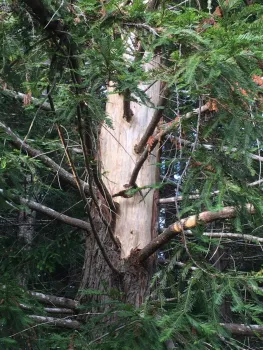
Emerging from winter hibernation, black bears are on the lookout for a quick, fuel-loaded meal. For female bears with cubs, locating that food source is also a teaching opportunity. In early spring, foraging options can be more limited than in later months, so bears often turn to trees as their next meal. The cambium layer of trees is what bears are after. Vascular cambium is a thin layer of stem cells that will transform into phloem or xylem (sapwood). These components of a tree's circulation system distribute the water and sugars (sap) produced by the tree's needles or leaves. Bears access these nutrients and sugars by stripping away the bark and scraping the cambium into their mouths with their incisors. This dining experience can leave trees partially or completely girdled at the tree base. Depending on the tree species and amount of damage, this can leave a tree with minimal damage (where the tree will recover quite nicely), up to complete mortality (from complete girdling; from pests or diseases entering the wounded area; or increased probability of wind-throw). For redwoods, they will often resprout below the damaged area which leads to an increase in stems per acre.
Just like humans with food preferences, bears also have preferences as to which trees they will feed on. In a report by O'Hara, Narayan and Leonard (2019), bears seem to prefer redwood trees that are small (10-60 cm dbh), more easily accessible, and vigorous, meaning they have a high sugar content in their cambium. They will however also feed on Douglas-fir, Sitka spruce and western hemlock. According to a report by Witmer and Pipas (2020), a single bear feeding on western larch, can peel and feed on 50-70 trees in single day.
Where a tree happens to be growing also seems to have some effect on whether it becomes breakfast. Fulgham and Hosack (2016) reported that more bear-damaged redwoods were found along roads and trails than were statistically suspected in the stands they studied. O'Hara et al (2019) also found in stands that had been thinned, more damage occurred in the first four years after thinning, with bears preferentially feeding on the remaining larger trees. Those released trees might be on the larger end of the snacksize preference, but they may be responding more vigorously to an increase in available resources and less competition, which means fewer snack options for the bears.
What Can a Landowner Do? It Depends!
Landowners who have invested resources into thinning stands, reforestation efforts, or simply connecting with particular trees, have limited options to date in discouraging bears from doing what bears do. The first step is to identify your tolerance level. Bears are part of the forested ecosystem and you might be ok with them sampling the buffet you offer, no matter where that may occur in your forest. Whitmer and Pipas note that it is unclear whether all bears cause feeding damage or merely a subset of those present in a given area. So, the density of bears in your area is not an indicator of the scope of potential damage.
If you would like to encourage bears to dine elsewhere, Witmer and Pipas (2020) tested the efficacy of three repellents marketed to reduce spring/summer damage by bears - Hot Sauce (an animal repellent made by Miller Chemical and Fertilizer Corp.), Tree Guard (a repellent marketed primarily for use as a dear repellent, made by Nortech Forest Products, Inc.) and grizzly bear feces (collected from captive animals at Washington State University. Note that as we do not have grizzly bears in California, this may not have the desired effect). These products applied directly on a tree work through taste or odor deterrence. Repellents for this use must show long term efficacy, maintaining their effectiveness for months. They must also not wash away with the first rain or change under freezing conditions. They note that Capsaicin, which is a concentrated red pepper spray, has been tested and is only effective when used in direct encounters with bears. Analysis of their work suggests that the three repellents may provide greater protection than no treatment. Preexisting damage on some of the treated trees does not appear to prevent subsequent feedings. Application of the two name branded products was conducted by spray, while feces was applied by hand. A landowner interested in this method needs to consider the resources and time needed for correct use. It may be worthwhile for that 'special tree(s)', but application on a larger scale may not pencil out.
Some bear facts
According to the California Department of Fish & Wildlife:
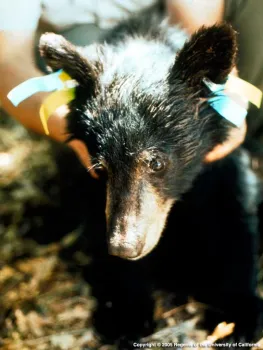
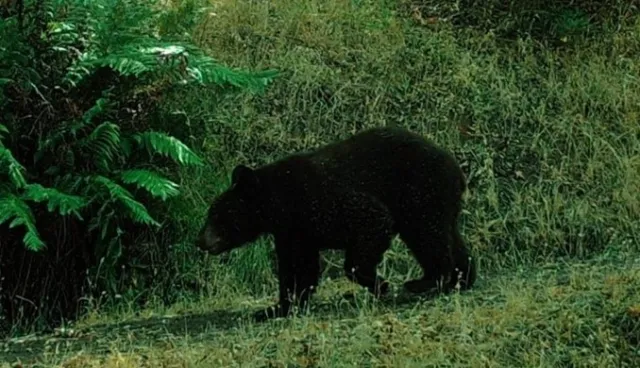
- The black bear (Ursus americanus) is the only bear species living in California today. Black bears occur in a diversity of habitats, including natural, rural, and residential areas. In California, they can be found in the North Coast Ranges, Cascades, Sierra Nevadas, parts of the South Coast Ranges, and in the San Gabriel and San Bernardino Mountains.
- Black bears are sometimes mistaken for grizzlies due to their wide range of fur color ranging from blonde or cinnamon to black.
- Bear cubs are born in winter dens in hollow bases of trees, snags or stumps, in hollow logs, rock caves, or in holes dug in ground. Dens are usually found in dense, mature vegetation on sheltered slopes.
- Black bears provide many ecosystem benefits by serving as seed dispersers, scavengers, and predators. They are omnivores and will consume nearly anything, including seeds, plants, berries, other animals, pet food, human food, and trash.
- Bears require large trees and various cavities and hollows in trees, snags, stumps, logs, uprooted trees, talus slopes, or in the earth for denning.
- Black bears may cause concern due to property damage, loss of small livestock or pets, or public safety as they search for food, as they can become habituated to and lose their fear of humans.
North Bay Bear Collaborative
As the population of black bears in the North Bay area continues to grow, there may be challenges in managing their interactions with humans. A group called the North Bay Bear Collaborative (NBBC) has been formed to address these challenges proactively. This working group comprises public agencies, non-profit conservation groups, landowners, and individuals committed to keeping human and bear populations safe.
The NBBC's mission includes educating the public on how to coexist with bears and reducing negative interactions when bears are attracted to garbage cans and other food sources in residential areas. The group also aims to teach people how to be better stewards of natural spaces and create resilient habitats supporting diverse wildlife.
To achieve its goals, NBBC is taking a multi-faceted approach. The group is mapping the range of black bears in the North Bay area to understand their dispersal patterns better. In addition, the group is working to improve the infrastructure of regional and state parks by installing bear-proof trash cans and food storage containers in campgrounds and backcountry sites. In the future, they hope to collect DNA samples to study the genetic relationships between individual bears.
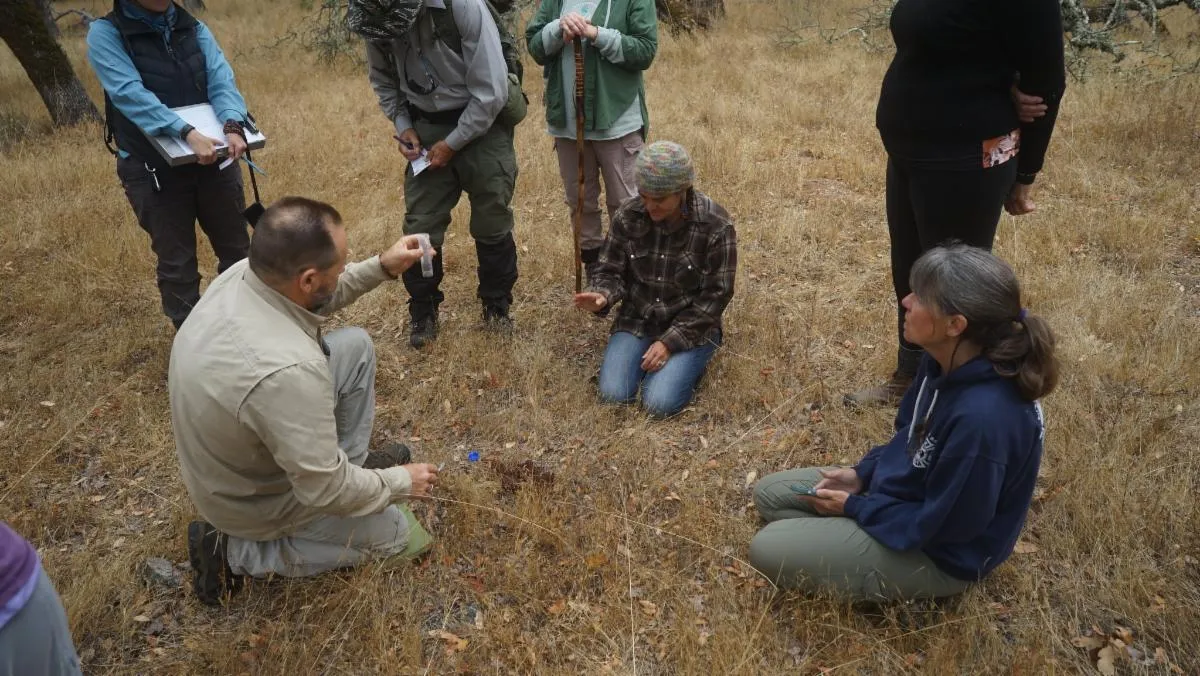
Finally, NBBC is offering internships to teenagers interested in wildlife conservation, monitoring, and historical ecology to increase awareness and ensure the longevity of this initiative. By working together, NBBC and its partners hope to create a safer and more sustainable future for humans and bears in the North Bay area. Volunteers collecting bear scat. Photo by North Bay Bear Collaborative.
Q&A with Meghan Murphy, Director of the North Bay Bear Collaborative
Q. What is one of the NBBC success stories?
A: I feel that NBBC is most successful and proud of our overall engagement within the collaborative and in our community. We try to honor many different perspectives and ensure that these different perspectives inform how we can be better neighbors with the bears. We also have over 50 volunteers who help us with the myriad of projects we have going. Having many different perspectives and people involved feels successful.
Q: What is a significant or ongoing barrier that NBBC faces?
A: One of our most significant challenges is how to get the word out. From an organizational perspective, NBBC is a true collaborative, where all the individual organizations give extra time on behalf of the bears and their habitat. This is no one‘s full-time commitment. So, limited capacity often challenges us, especially with social media and marketing. From a bear human relationship perspective, one of the greatest challenges is how to best educate on how to coexist with bears. The more people who understand waste management and bear behavior, the better off we will all be.
Q: What research are you currently conducting involving black bears?
A: Currently, we have a mapping project to help us understand the range of black bears within the North Bay. We also have an ongoing bear scat DNA project. These projects help us understand bear behavior, movement, and areas where we can prioritize our energies.
Q: What agencies are involved in your organization?
A: We work with state and local agencies such as California Fish and Wildlife, California State Parks, Marin Water, Napa Land Trust, Sonoma Land Trust, Kashia Band of Pomo Indians, and various non-profits and individuals throughout the North Bay.
Find the printable version of this newsletter below. Note that the pdf is for print purposes ONLY.
