
Table of Contents
- Greetings from UC ANR
- Best practices for using wildlife cameras
- Wildlife camera equipment
- What forest landowners might see...
- Q&A with Big Chico Creek Ecological Reserve (BCCER) staff: Gary Day (Administrative and Outcomes Manager), Daisy Cruz Martinez (Land Steward 2), and Robert (Bobby) Banta-Green (Land Steward 1)
- Other research projects using wildlife cameras
- Rare animal or human trespassing images- what are your obligations?
Greetings from UC ANR
Surveys of our Forest Stewardship participants over the last 6 years show that 91% rate protecting or improving wildlife habitat as important or very important. A worthy goal! But, do you actually know all of the wildlife that resides on, or passes through, your forestland?
For those looking to develop a forest management plan, there are specific sections requiring information on wildlife, fish and aquatic species, and threatened or endangered species in your forest, and the general habitat they are using. Which species can you list?
This newsletter provides information on the use of wildlife cameras, the various equipment to use, how and where to place cameras, and what to do with the images - besides keeping a file for your plan! We encourage you to consider this foundational knowledge and then join us for a webinar on Tuesday, June 9th where we will hear from a landowner and resource professionals on how they use wildlife cameras in their day-to-day work. (See below for registration information)
Cheers,
Jannike Allen, Forest Stewardship Community Education Specialist
Kim Ingram, Forest Stewardship Education Coordinator
Best practices for using wildlife cameras
Wildlife cameras can be useful for observing large species of interest, whether you are just curious what is there or have specific questions. Biologists use them to understand what species are present, hunters may use them to observe what is in the area, and landowners may even monitor for trespassers using wildlife cameras.
Where should I install wildlife cameras?
Notice where animals seem to frequently be on your land in order to position your camera near points of interest. There may be scat, scratches on trees, or game trails that you can use as clues. Water sources are frequently good locations for cameras, whether they are riparian areas or guzzlers (water tanks dug into the ground) installed to benefit wildlife. You may even be able to steward an area to create improved habitat for target species and then monitor with a camera. According to Greco et. al. (2025), for those aiming to detect different habitat uses, having a mix of on-trail and off-trail cameras can be helpful.
Camera placement/ settings:
Cameras do not detect all movement equally, so placement and camera settings can make a big difference in what you capture. If you are targeting a game trail, try aiming the camera at a 45 degree angle across the trail. Rocky or sparsely vegetated areas can be good to aim your camera at to minimize false triggers (for example, when sunwarmed moving vegetation causes a photo to be captured when no animals are visible). When photographing in a larger viewshed, you can test the motion trigger at various distances from the camera. Reducing the trigger distance can also help if frequently moving vegetation is present further from the camera.
Photo management:
You may obtain large number of photos, either transmitted directly to you, or stored on an SD card to unload manually. Transfer photos from your camera's SD card by offloading them to your computer; do not view them by putting the SD card in a point-and-shoot camera. If you are overwhelmed by the number of photos you are obtaining, you can adjust the camera settings to take videos instead of photos (a few videos generally will take up the same amount of storage space as many photos), or you may be able to adjust the time between photos captured to fine-tune how many photos you end up with.
Should I bait the camera trap?
Most wildlife camera users should not bait their camera traps. California has regulations against feeding big game mammals to protect them. Scientists need proper permits to bait their camera traps, and only do so for specific purposes. Baited sites can bias what wildlife activity occurs, and can also become ambush sites where prey are vulnerable. Installing cameras while wearing gloves can minimize human scent left on them and help reduce influence on wildlife.
Can I help scientists and land managers using wildlife cameras?
Some researchers and land managers welcome help from volunteers who may be able to assist with specific data collection efforts by either retrieving photos stored on cameras, or helping look through the photos to determine what species were observed.
Thanks to Big Chico Creek Ecological Reserve's staff and the Trail Cam Pro website for sharing recommendations.
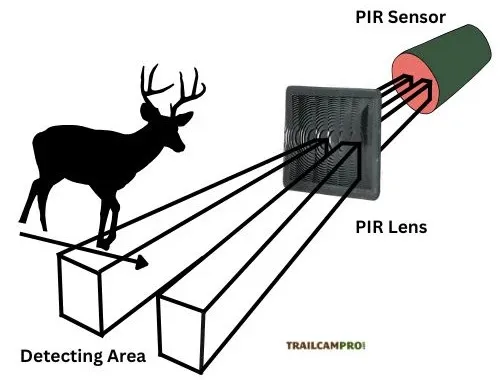
Wildlife cameras using Passive Infra-Red (PIR) detection circuits have a detection area in front of the sensor. Best detection occurs when animals are moving perpendicular to the sensor. Image source: Trail Camera Anatomy: Trail Cam Pro
Wildlife camera equipment
Wildlife cameras are installed in stationary locations and capture photos of wildlife when they are detected in their field of view. Wildlife cameras are triggered using a combination of motion and thermal detection, noticing a difference in temperature between the ambient air and animal(s).
Before purchasing a wildlife camera, consider how you would like to use it and any site constraints. Wildlife cameras have a variety of applications, including short or long deployments and research or anecdotal image collection. For many, it is important to balance cost constraints with risks, such as the potential for the camera to be damaged.
The camera's output can vary based on:
- Video/photo settings
- Programmability/ time lapse
- Image quality/ memory
- Focal length options
- Flash/ low glow/ covert flash
Cameras often use a flash to illuminate the animals/environment they are photographing, to varying outcomes. "Red glow" cameras produce a detectable red glow, but often capture brighter night pictures than "no glow" infrared cameras, which are invisible to humans at night. "Low glow" cameras are an option between no glow and red glow.
Advertised image quality of specific camera models can be misleading because many wildlife cameras advertising >4-5 megapixels are achieving that through interpolation. This adds additional pixels by guessing what color they should be (based on neighboring pixels), so it does not necessarily improve the image quality. Check sample photos to assess image quality of cameras you are considering purchasing.
What triggers the camera can depend on it's:
- Detections distance
- Detection zone versus field of view
- Trigger speed/ recover time
- Sensitivity settings
Some cameras have adjustable sensitivity settings to help you fine tune for your situation. High sensitivity can detect small movements, but may br prone to false triggering.
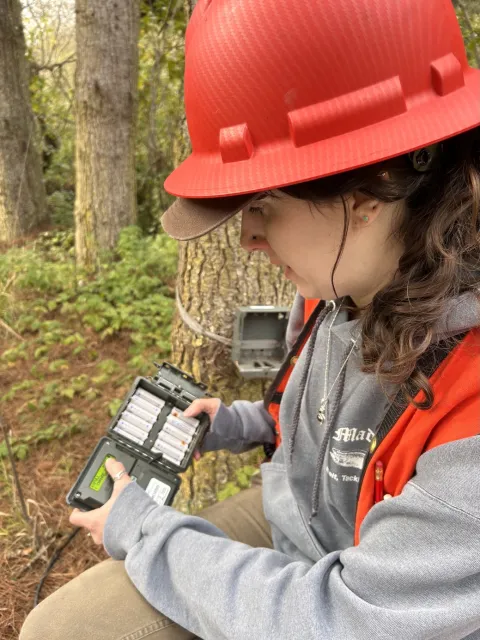
Your site may make it important to consider:
- Cellular/ WiFi functions
- Security boxes/ locks
- Animal damage
- Theft potential
- Durability
- Battery life/ external power/ solar power
In addition, you may also want to consider:
- Cost
- Repairability
- Seller/product warranty
- Foreign/ domestic origin
Thanks to Robert Douglas of the Jackson Demonstration State Forest for sharing these wildlife camera considerations!
What forest landowners might see...
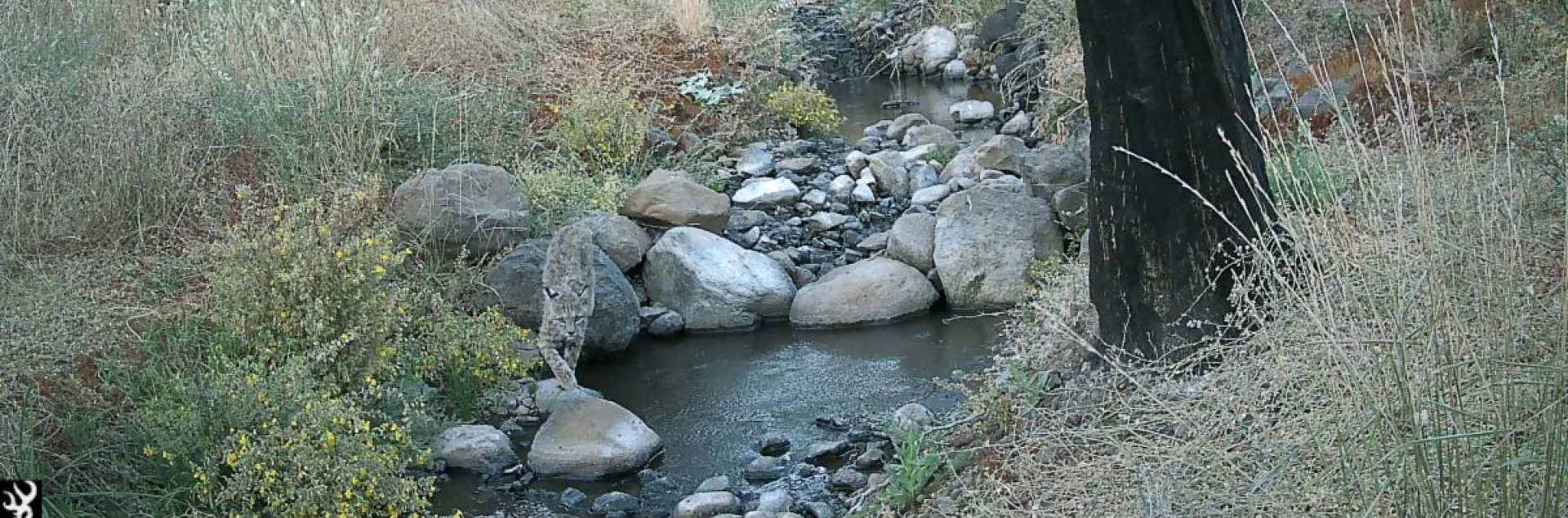
Several Forest Stewardship Workshop participants have delved into monitoring wildlife on their land using wildlife cameras. Chris Horton has captured photos of mountain lions, cows, coyote, bears, foxes, deer, fisher, and bobcat.
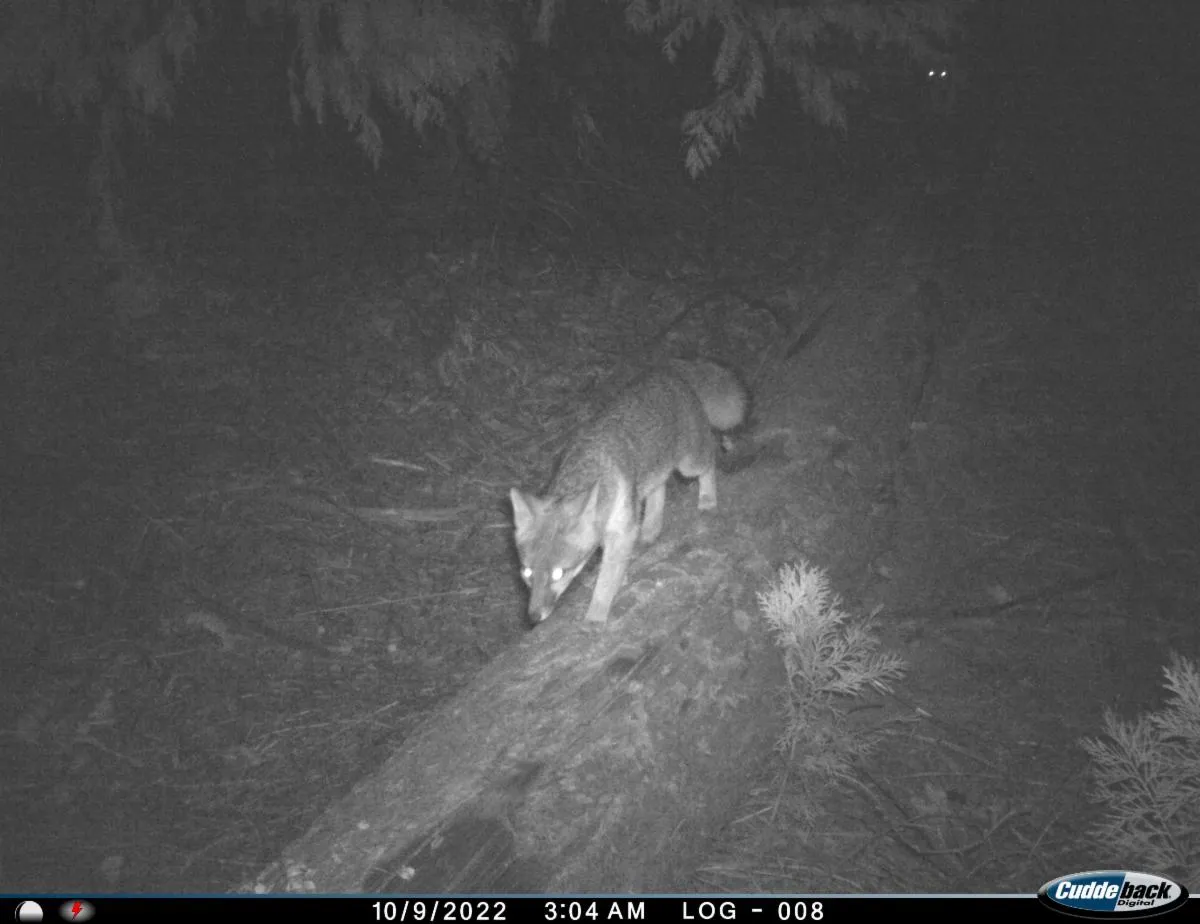
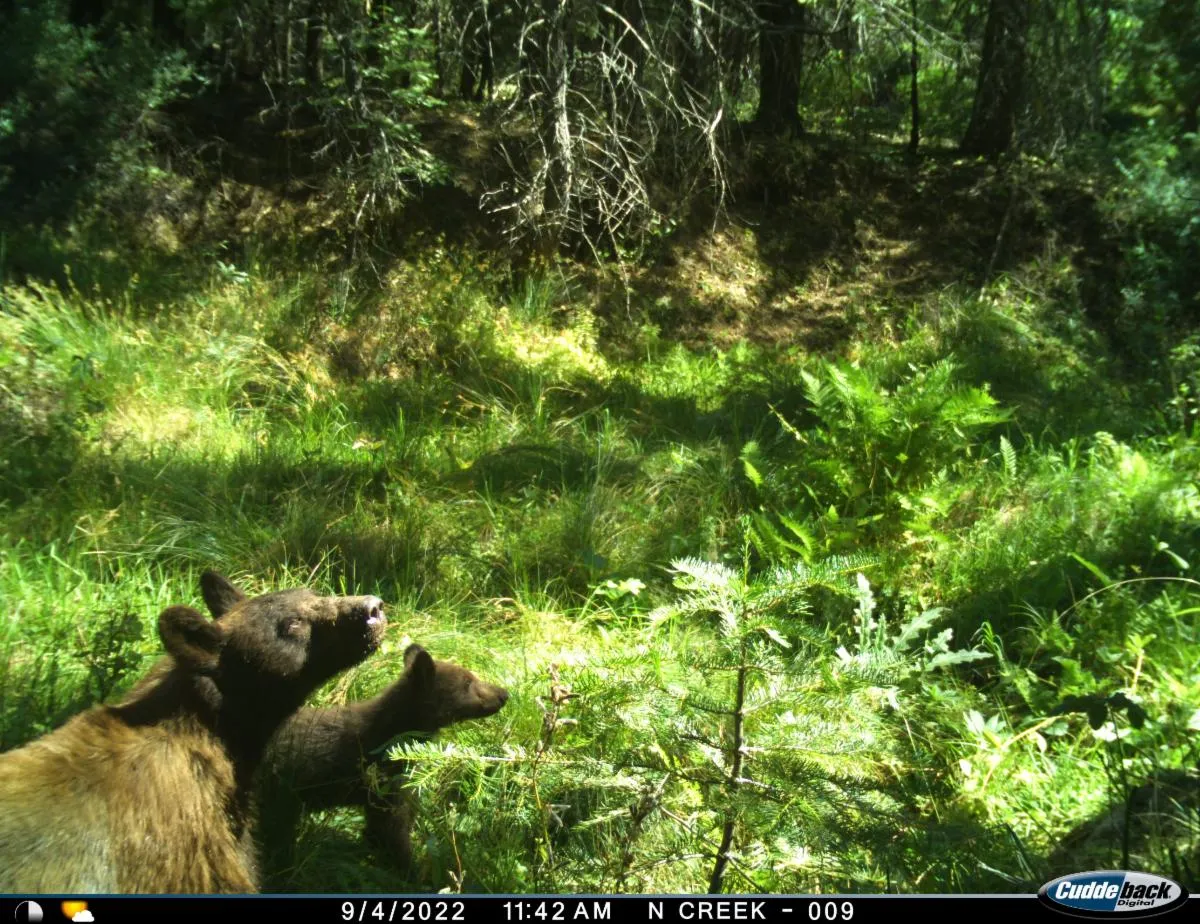
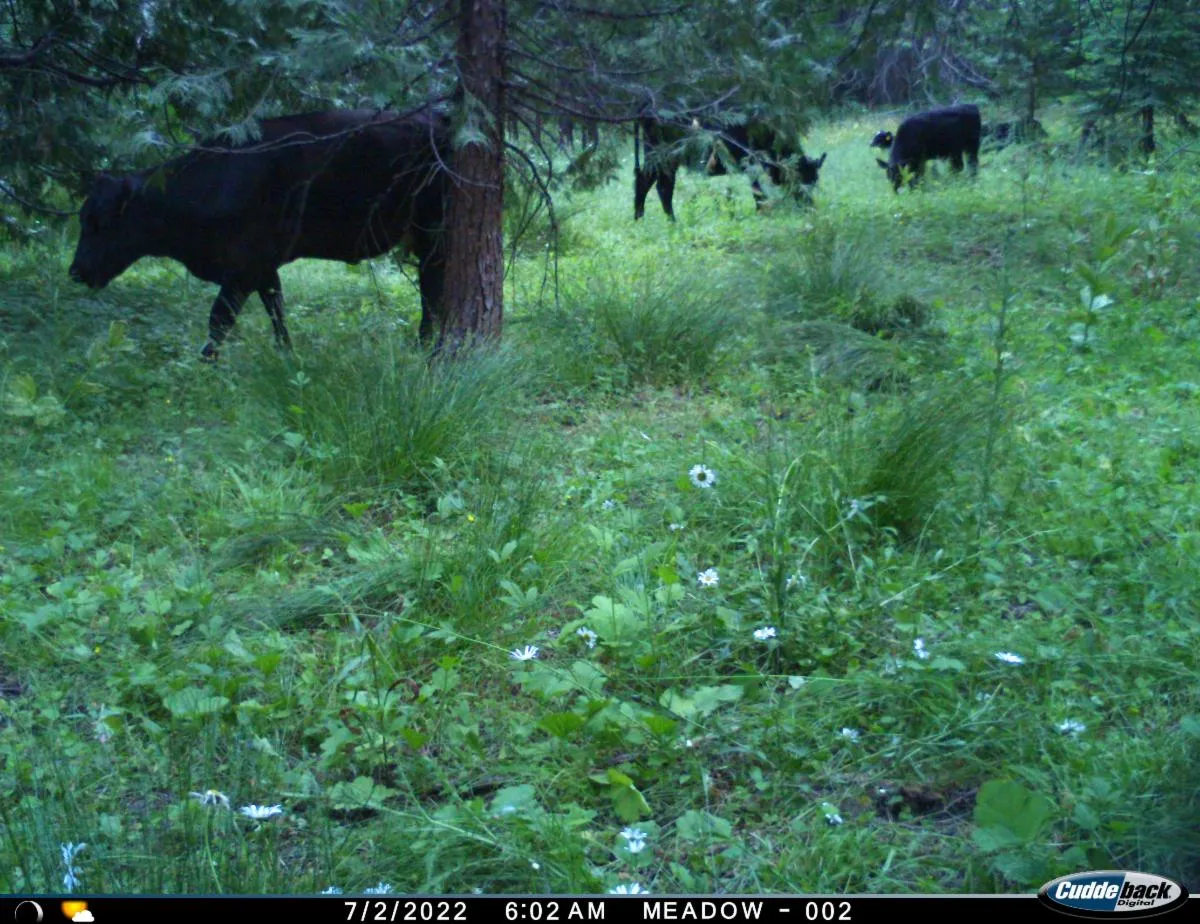
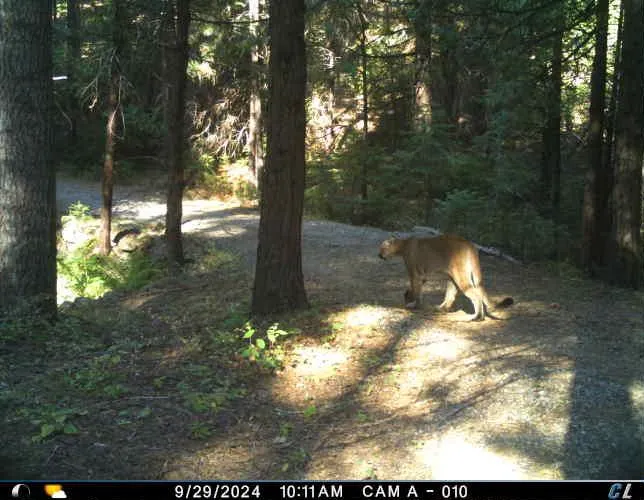
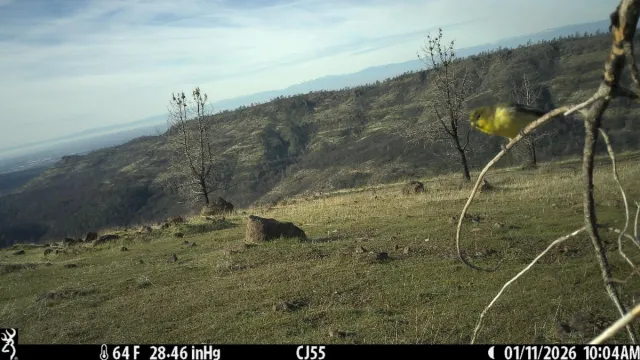
Photos by Chris Horton (2021-2025)
Q&A with Big Chico Creek Ecological Reserve (BCCER) staff: Gary Day (Administrative and Outcomes Manager), Daisy Cruz Martinez (Land Steward 2), and Robert (Bobby) Banta-Green (Land Steward 1)
Jannike Allen and Grace Dean spoke with the team behind the wildlife
cameras at CSU Chico's Big Chico Creek Ecological Reserve (BCCER), to hear about how their programs are supporting research, restoration, and more.
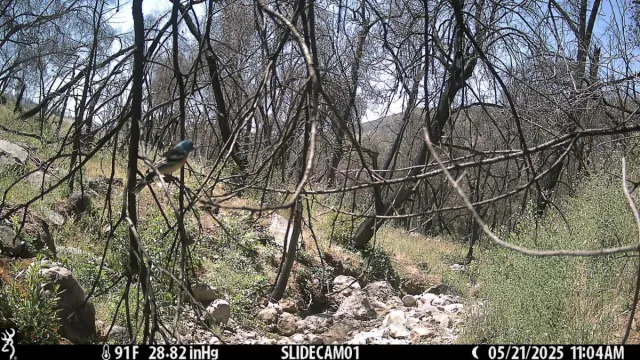
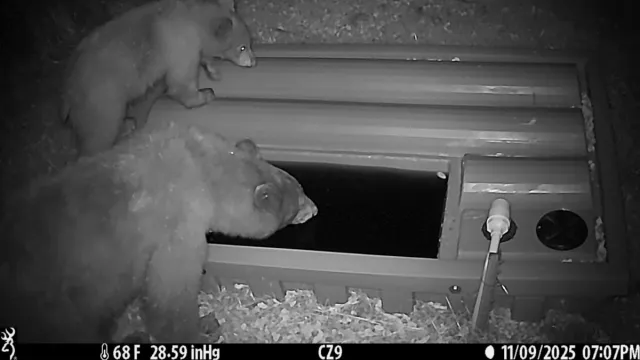
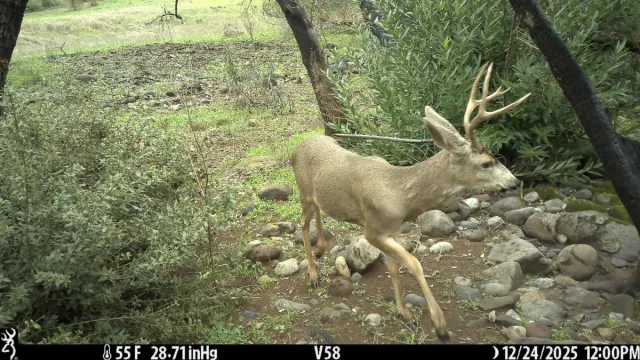
Q: Can you introduce yourselves and share your experience with using wildlife cameras?
Gary: As the Administrative and Outcomes Manager, I support BCCER programs including field trips, research, and the Adopt an Acre program which connects donors with the reserve so they can support professional development, habitat restoration, fire mitigation, or other efforts de
pending on the donor's interests. I also coordinate Chico State's Interdisciplinary Wildland Management master's program.
Bobby: I work on the Adopt an Acre camera team, installing and maintaining cameras, and processing photos. We help get pictures for donors, but we're also doing monitoring, especially after fire. I am also working towards a master's degree in the Wildland Management program, looking at black bears at the reserve.
Daisy: I work with wildlife cameras gathering monitoring data on the reserve as part of a Wildlife Conservation Board (WCB) grant. The project is to understand baseline conditions as well as opportunities and effects of different management actions. I got my degree at Cal Poly Humboldt, studying Wildlife Biology and I used wildlife cameras as a student there as well.
Q: What led you to use wildlife cameras? What questions were you trying to answer?
Daisy: For the WCB project we are monitoring to see what is migrating through the area. One species we're looking for is pacific fisher, which is known to live at higher elevation. A neighbor did a reintroduction and expected the fisher to go up north, but the fisher stayed in the nearby area. We're wondering why the fisher is here, instead of going to cooler climates. We also are thinking about what can be done to improve the habitat for them if needed.
Bobby: I install and maintain cameras to monitor specific acres, for the Adopt an Acre program. A lot of these acres have pre-fire data, which we can compare with. We're able to see a ton of diversity and I focus a lot on bear monitoring. I've seen a mom with a cub in November. Sometimes they don't hibernate if they have enough food, and it's kind of like when you have a little kid, and it doesn't care what time of day it is, or what time of night it is, it's up. You can't really control it. So, yearlings will sometimes not go into hibernation. I've also learned to be careful about camera placement because a camera that is too low might get broken by a bear.
Q: What animals have you seen using wildlife cameras?
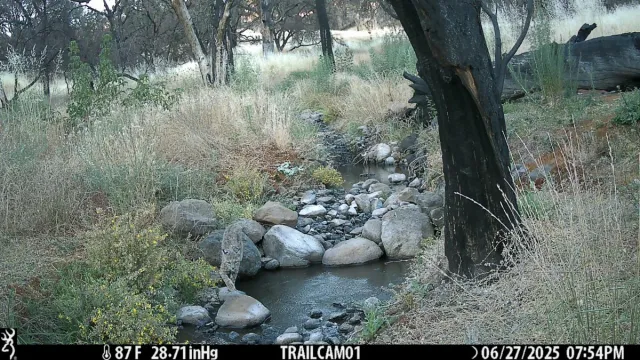
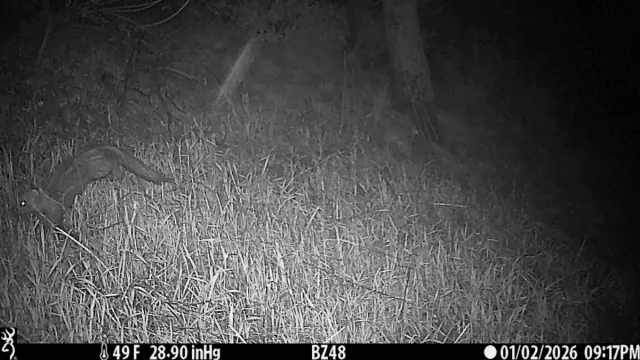
Daisy: In the area we're monitoring through the WCB program we've seen migratory birds (including lazuli bunting), Bullock's oriole (which are fire loving birds), bobcats, grey foxes, coyotes (including a really big one that almost looked like a wolf), bears, and hopefully one day a fisher.
Bobby: Two weeks ago the first coyote in the valley/canyon part of the reserve was seen on camera. We've also seen bear cubs after the fire, which was shocking because past research says that bear cubs don’t happen that quickly post-fire. We also see a lot of grey foxes, which are pretty widely distributed in the canyon of the reserve. A cougar walked from the neighboring park into the reserve. We’ve seen a bear cub climb up to a camera 7 ft up. We’ve also seen skunks, and have captured one photo of a fisher post-fire.
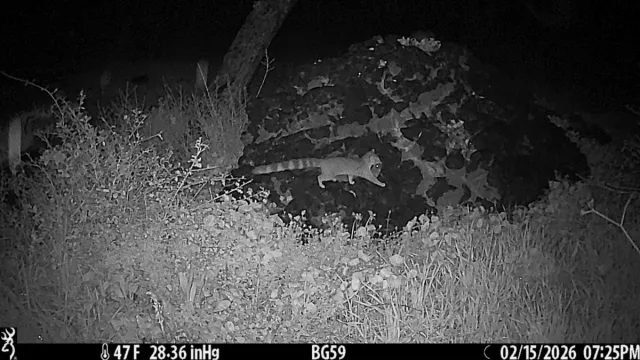
Q: Is there any other technology or equipment you use to monitor wildlife in addition to the wildlife cameras?
Gary: Mapping is used, and we record the coordinates of camera locations on the Avenza app in order to find the cameras again. We use gloves to minimize human scent on cameras (delicious smelling cameras will be destroyed). UTVs and 4WD trucks are how staff get around the reserve, and Garmin are carried to call for help if there's an emergency. Our team also sits at computers to go through the photos.
Bobby: Slideshow mode is really helpful for looking through the photos.
Besides the cameras, there are a lot of in-person clues you can see, including scratch marks on trees, paw prints, hoof prints (especially in sandy areas i.e. down by a creek), and scat. You can learn to tell apart canine, coyote, fox, or feline scat. We also worked with CDFW to collar black bears during my master's project. Having the tracking collars helps us find out how the bears are interacting with the reserve after the fire. We were able to ask: are they crossing Highway 32? Male home ranges are expected to be larger than female home ranges, and the collars helped confirm this, as well as showed us where the female hibernated.
Daisy: An upcoming project is being prepared to survey rodents, which
are hard to capture on camera. Instead of cameras, the survey will use traps to detect presence or absence of rodents, to provide a broad idea of what is present on the reserve. There is also a saw-whet owl banding station to help understand how saw-whet owls travel, how far they go, what their patterns are, and how many are coming back. Nets are set up to catch saw-whet owls as well as other nocturnal birds and bats. Handling is done by people with handling permits. Swim surveys and insect transects are also done on the reserve to observe species present.
Q: Did anything surprise you from starting this job until now?
Daisy: I've worked here for about 2 years, and did come in with some experience, such as from the Wildlife Techniques class I took in college. I now have a better understanding of how different entities use cameras and what questions they are looking into. BCCER is a great place to grow. Working with the cameras, it's essentially like a story that you're trying to piece together of what you normally don't see, after dark, or when you have to go home at a certain time. It's a whole other species' life that you're trying to understand, and trying to see what, as humans, you can improve on.
Bobby: I started working here in September 2024, and came in having taken a 4 day wildlife research techniques course, and joined the camera team with minimal experience. I've learned about reading the land, and previously couldn’t tell where a game trail was or what kind of animal prints are there. Being out there is a helpful way to learn the land. I also like teaching people about it, and the photos are a great tool for sharing.
Q: Do you want to share any upcoming plans or ways people can get involved?
Gary: We've always been collaborative with CDFW, but Bobby’s graduate thesis brought in an active partnership with CDFW that we want to continue, and support more animal research. There's always new opportunities, new animals, or more continued research on animals as the next undergrad or next grad student comes through the door here. We aim to be a place where they can get experience, and become well rounded candidates for future jobs. We've had the Adopt an Acre program since 2019 and are always looking for more donors. Funds go to a variety of areas such as: facilitating opportunities for students and young professionals to gain experience, help with habitat restoration, protecting animals, installing more water guzzlers for wildlife to drink from, and fire mitigation and fuels reduction, which is especially important given our neighboring communities. Donors receive photos from "their" acre on the reserve, and at certain donation tiers, supporters receive tours of the reserve, first dibs on events, and other recognition.
Learn more about Big Chico Creek Ecological Reserve's Adopt an Acre Program here.
Explore student research using wildlife cameras at the Big Chico Creek Ecological Reserve below.
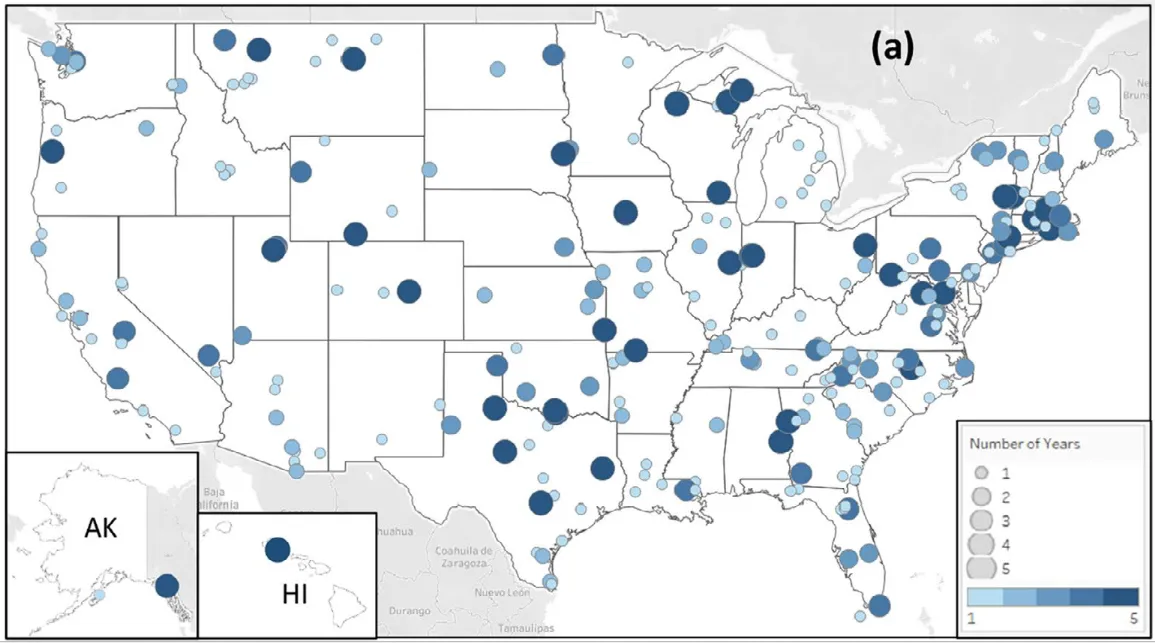
"FIGURE 2 | (a) Map of the United States showing all 263 SNAPSHOT USA 2019–2023 camera trap arrays, with their colour and size representing the number of years the array was surveyed." (Rooney et al. 2025)
Other research projects using wildlife cameras
As we've heard from Big Chico Creek Ecological Reserve staff, wildlife cameras can be a great tool for research, especially when studying large mammals. Below we highlight some examples of additional research that makes use of wildlife cameras, while acknowledging that in some situations they are not the best fit.
Academic institutions and other organizations collaborate across the US to collect mammal data nationwide as part of the SNAPSHOT USA project. Each year participants capture photos of wildlife September through October using standardized camera trap survey methods and identifying the observed species. This dataset is made available for research, management, and education and can help improve our understanding of "species densities and mammal biomass across space and time" (Rooney et al. 2025). Valerie Elder and her students at College of the Redwoods (CR) participate in the project, adding data collected near Eureka, CA. The Introduction to Wildlife Ecology and Management class helped deploy and manage camera traps, collecting data on local Northern California mammalian species. CR Forestry student Kevin Golden’s favorite part of the camera trap project was “seeing all the pictures we collected at the end of the semester. The hands on part of the project was enjoyable and each time we went out it built anticipation to see the final project. The project showed me that following standard procedures is important for having accurate results.”
The SNAPSHOT USA project is recruiting more collaborators, so consider telling organizations you are involved in about this project!
Sometimes wildlife camera research covers a smaller geographic scope, with implications that can be applied across similar areas. Emily Matthews used wildlife cameras in riparian areas and GIS to research how mammals use riparian habitat differently depending on how close to recreation infrastructure they are. Observations of mammals varied between East Bay parks with high, moderate, and low development levels since some species are more urban adapted than others. Mule deer and bobcats were seen less frequently at busy park areas, and in those park areas, mule deer were seen more frequently at night. Urban adapted species such as coyotes were observed more in busy park areas than other species. These differences in habitat use can encourage park managers to refrain from expanding trail systems into refuges of undeveloped area, recognizing the value of lower trail densities to many mammals. Read more about Emily Matthews's findings in her 2024 thesis: The Impacts of Recreational Infrastructure on Mammal Use of Riparian Zones in Northern California Regional Parks.
Rare animal or human trespassing images - what are your obligations?
You've captured an image of a Sierra Nevada red fox, how cool is that! You've also just viewed images of uninvited people who are on your property sitting around a campfire, not so cool. As a landowner who knowingly set up a wildlife camera, what are you expected to do with such images, if anything?
Legally, landowners have the right to set up cameras on their private property. Know however, that cameras will not distinguish between humans and wildlife, when taking photos as programmed. Data processing technologies are advancing that will help with this, but are not practical at this time for forest landowners. Cameras that capture images from public areas, such as the ball park across your street, are subject to rules and codes of conduct, and depending on the situation, there maybe social or legal consequences if you use any of the unauthorized images. Individual privacy, freedom of movement and personal autonomy are protected under local, state, and national laws.
To avoid privacy concerns of neighbors, do not set up cameras that will capture images of your neighbors private areas (aimed at windows, hot tubs, etc.). It is permissible to capture limited images of your neighbor's forest, but try to limit the scope. Think if the situation were reversed, what would you be ok with your neighbor snapping a picture of, and what would not be ok?
What to do with photos of people? Because of privacy laws, you should never post photos you have captured of people on social media or share with others. The exception to this is if you capture people causing damage or harm to your property. While it is important to respect individual privacy rights, there is a also a public duty to report illegal activity. Check in with your local law enforcement agency to see how they would like these images handled. If you capture people trespassing on your property but not causing damage or harm, then it is up to you if you want to report it to your local law
enforcement agency or not. Know that sharing 'real time' images of people misbehaving to local law enforcement may result in them responding to the incident more quickly than if you share photos hours or days after they were taken.
Certain rare animal sightings should be reported to the CA Dept. of Fish and Wildlife (CDFW) for their use in species monitoring and habitat conservation programs. If you observe a species of concern, you can help protect it by consulting with your region's CDFW Unit Biologist. Use official websites
only, never posting about the sensitive sighting and location on social media.
Report sightings of a Sierra Nevada red fox at the following website: https://wildlife.ca.gov/Conservation/Mammals/Sierra-Nevada-RedFox/Sighting-Report
Other wildlife sightings important to CDFW work can be reported at the following website: https://wildlife.ca.gov/Sightings, and you can consult with
CDFW staff by submitting a wildlife incident report at https://apps.wildlife.ca.gov/wir.
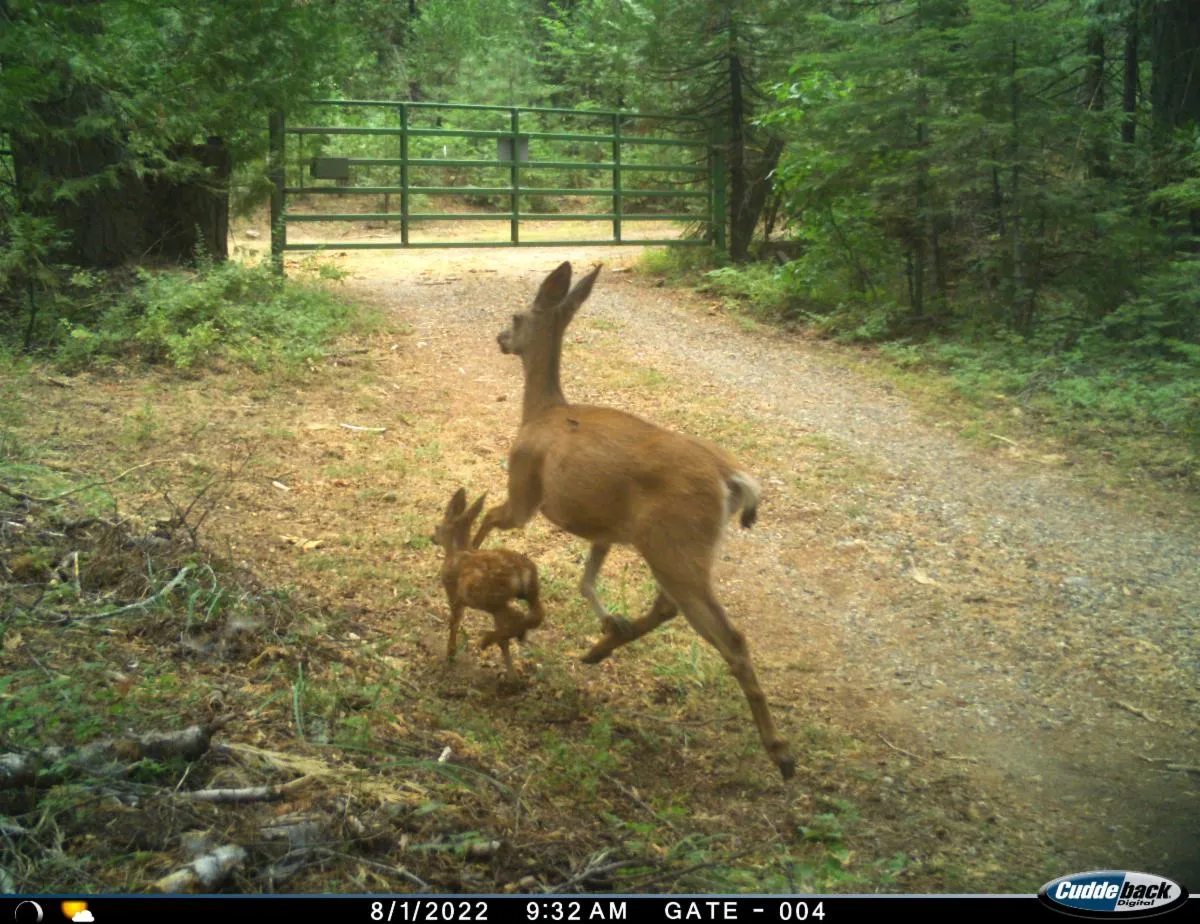
Find the printable version of this newsletter below. Note that the pdf is for print purposes ONLY.
