
What is Fire Severity?
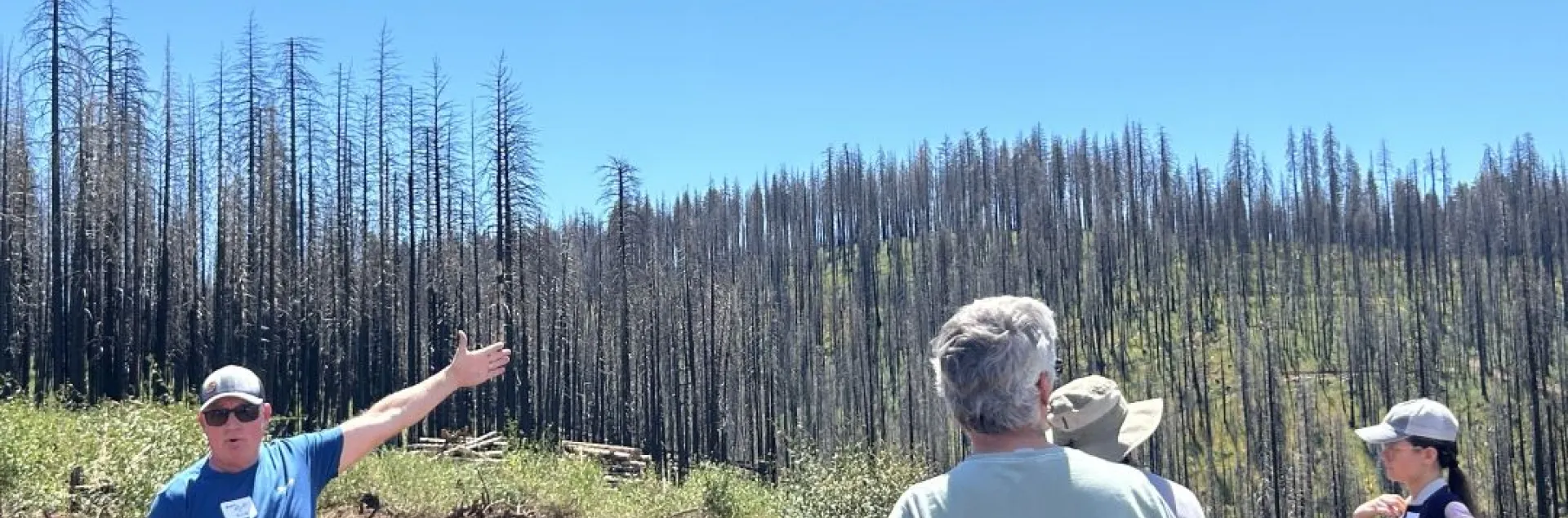
Fire severity refers to the degree of vegetation change caused by a fire, measured in forested ecosystems by the mortality of overstory trees. Low severity fire burns mostly on the forest floor and causes little to no overstory tree mortality. Moderate severity fire kills more individual trees but leaves many alive. High severity fire kills most or all trees over a large area or in large patches (Figure 1). Fire severity is assessed using the survival of individual trees at the stand or landscape scale and may vary across a property. The severity classes above only describe effects on vegetation. Fires have additional ecological impacts along with other impacts on landowners, including safety risks from dead standing trees and the loss of a home, aesthetics and/or timber value.
Why is it important to assess fire severity?
Assessing the severity of fire effects is important for understanding the short- and long-term changes to the forest caused by the fire. Immediate and longer-term management strategies will be based on an understanding of these changes, along with management objectives. The need for forest management after fire is generally concentrated where fire severity is the greatest and trees are adapted to low severity fire.
Trees are adapted to frequent low severity fire: Most conifer species in California are adapted to frequent low severity fire, with high severity fire effects historically limited to smaller patches (Agee 1993, Safford and Stevens, 2017). As a result, forest regeneration relies on germination of new seeds from nearby live trees. Since cones and seeds can be destroyed by high severity fire, it is often necessary to plant seedlings if a forest is to persist. Examples include the mixed conifer species ponderosa pine, sugar pine, white fir, Douglas-fir and incense cedar.
Trees adapted to high severity fire: Some California tree species are serotinous meaning they require heat for their cones to open and release seed. Though the mature trees die, new seedlings are numerous and proliferate after high severity fire. For these species, planting is often unnecessary, unless the trees are killed before they are capable of producing cones. Examples include Baker cypress and knobcone pine.
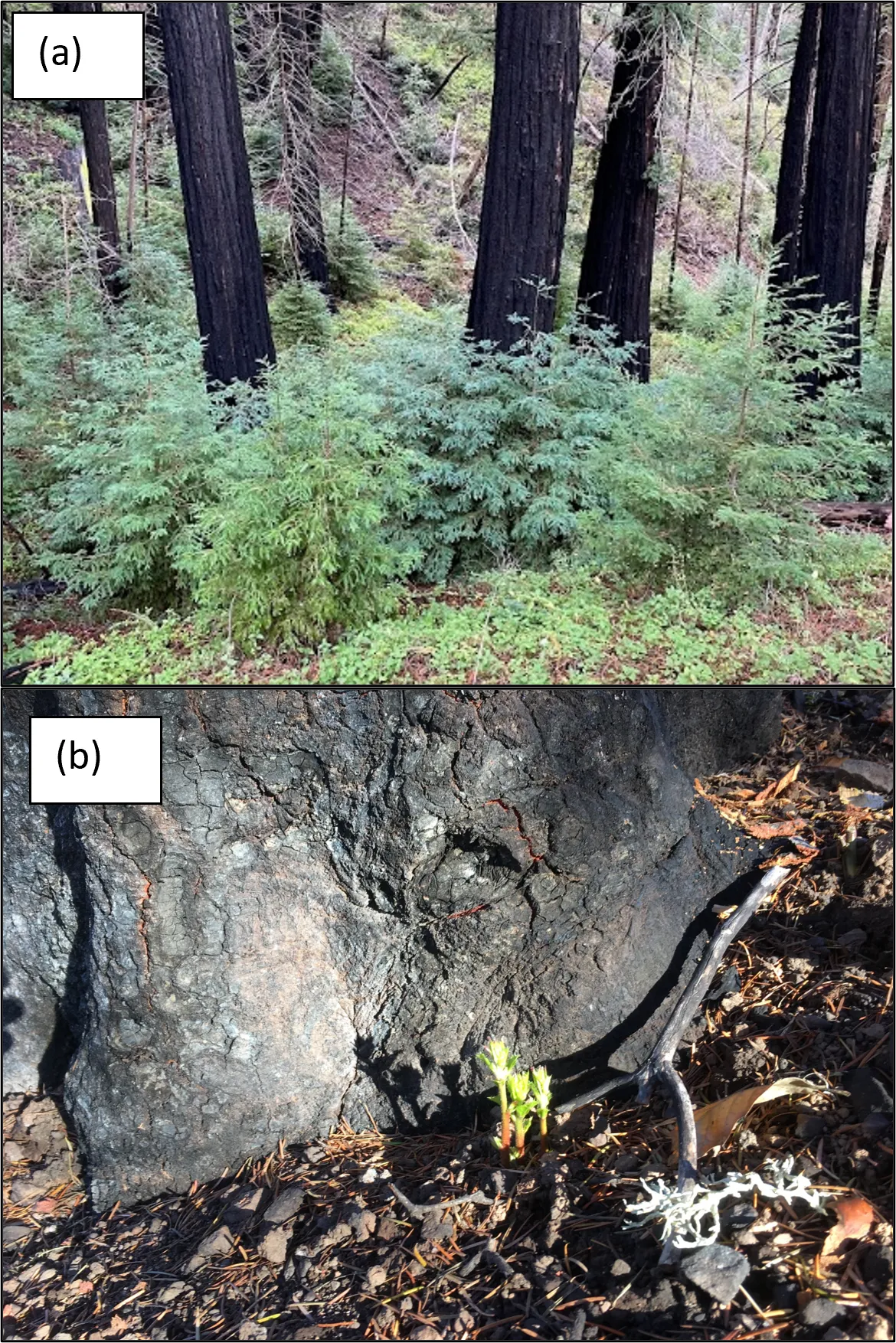
Resprouting trees: Some tree species are ‘top-killed’ by high severity fire, meaning that the above ground part of the tree dies while the roots survive. These trees can resprout from the roots and regrow to tree form. For these species, thinning vigorous resprouts can help regrow individuals to tree form. Examples include hardwoods such as maples and oaks, and coast redwood (Figure 2).
In all these vegetation types, it is important to remove dead trees before planting to reduce future fire risk from accumulating fuels (Coppoletta et al. 2016). To ensure the success of planted or naturally occurring seedlings, as well as desired resprouts, it is often necessary to manage competing vegetation (Plamboeck et al. 2008).
Determining if individual trees will survive
Trees may be killed directly by a fire or be weakened and die in the next several years due to stressors including insect attack and drought. Assessing fire severity on your land starts with understanding which trees have died and which are likely to die. Whether or not an individual tree will survive the effects of wildfire depends primarily upon the degree of damage to the tree’s foliage and cambium.
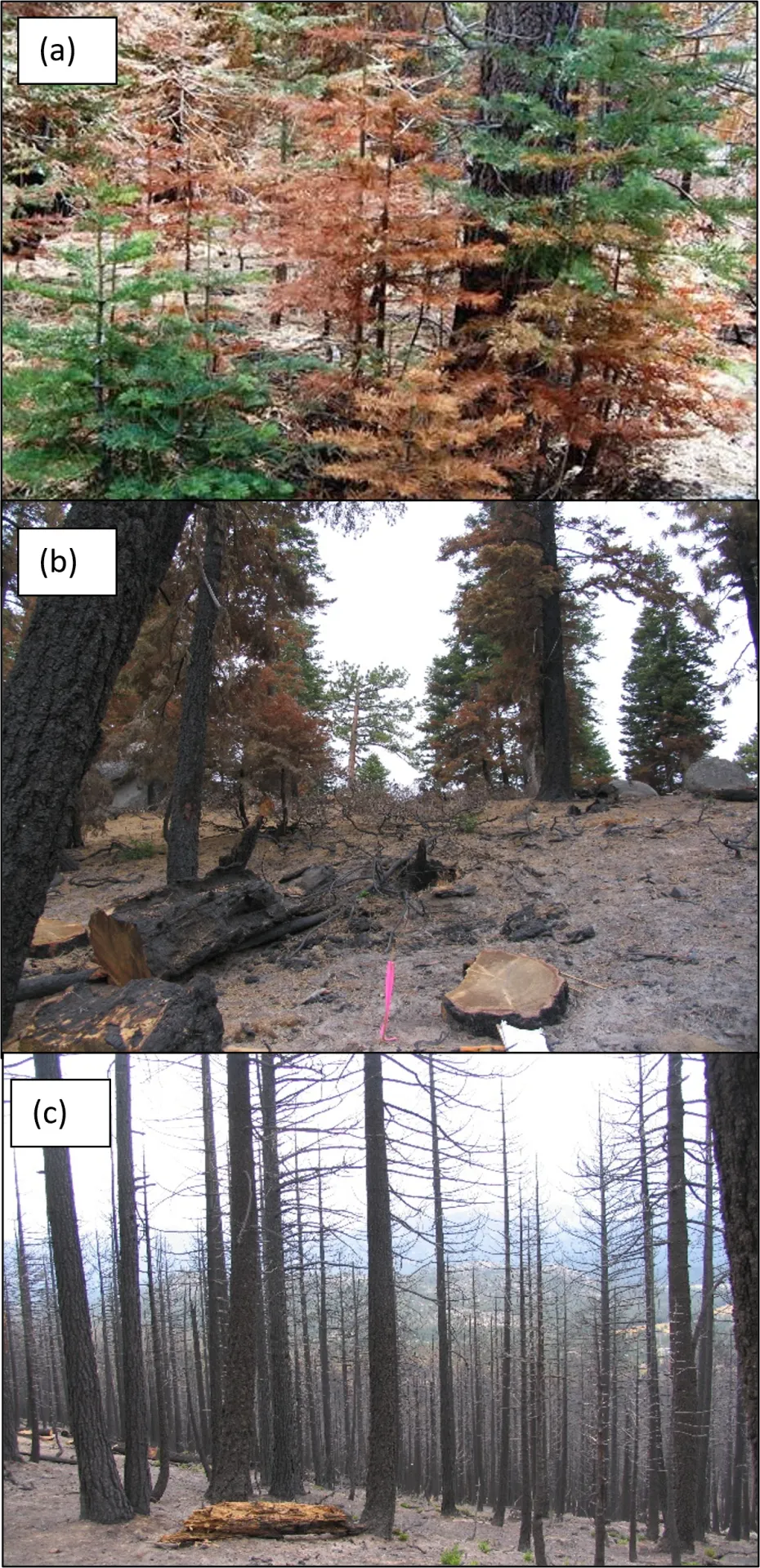
Except for redwoods (see Post-Fire Redwood Response and Survival), conifers will not survive when needles are completely consumed (torched) or brown and dead (scorched), or when there is significant damage to the cambium, the layer of live tissue under the bark that transports water and nutrients. The likelihood of mortality in trees that appear alive can be assessed by the percent of foliage killed by the fire, the portion of the tree’s circumference with dead cambium, evidence of insect attack, species, and diameter (See Survival of Fire-injured Conifers in California).
Oak trees may survive and produce new leaves despite a completely dead crown as long as the cambium is not charred around a tree’s entire circumference. When oaks are “top-killed” due to cambium damage all the way around the trunk, they often resprout from the roots (See Burned Oaks: Which Ones Will Survive).
Assessing fire severity across a property
Using guidelines for assessing individual tree survival or mortality, landowners can identify areas where many trees have died or are likely to die (high severity) and where some or all are likely to survive (low to moderate severity). Identifying the species of trees affected is also important as serotinous conifers can be expected to regenerate new seedlings even when dead, and hardwoods can be expected to resprout.
When fire effects vary across a property, a landowner can identify areas of greatest priority for treatment by mapping patches of high, moderate and low severity fire effects. Patches can be mapped using a handheld Global Positioning System (GPS) device or a smartphone with a mapping application such Avenza Maps. Alternatively, a paper map and compass can be used to navigate across the landscape and to identify areas of varying severity using existing landmarks as reference points, though some experience with navigation is needed to record locations with accuracy. See Mapping Forest Features.
Planning short and long-term management
Fire severity and tree species type across a forested property are the primary drivers of early post-fire management decisions, while safety concerns, economics, and land use objectives will play an important role as well. Each landowner must make management decisions that best suit their needs, objectives and abilities, considering both short and long-term goals. Consulting a registered professional forester (RPF) is often an important step in planning and implementing post-fire forest restoration work. In large patches of high severity fire, removing dead trees and planting and nurturing new seedlings is often needed to maintain forests where trees are adapted to low-severity fire. See the Post-Fire Management Decision Framework Factsheet further guidance.
Further Reading and ResourcesOwen, DR., DR Cluck,& SL Smith (2015). Survival of Fire-injured Conifers in California.California Department of Forestry and Fire Protection. Macreary, D. & G. Nader. 2011. Burned Oaks: Which Ones Will Survive? UCANR Publication 8445. Satomi, R, C Eggleton & V Butsic. 2024. Mapping Forest Features. UCANR Publication 8734 Shive, K and S Kocher. 2017. Recovering from Wildfire: A Guide for California’s Forest Landowners. UCANR Publication 8386 Making Forest Management Decisions after Wildfire. UCANR Forest Fact Sheet |
Find the printable version of this fact sheet below. Note that the pdf is for print purposes ONLY.
