
Resiliency in California Forests
It’s often necessary to plant trees to restore forests after high severity wildfire. Deciding how many and what kind of trees to plant and in what pattern is a key step in the reforestation process. These decisions can be informed by understanding the resiliency that California forests had historically.
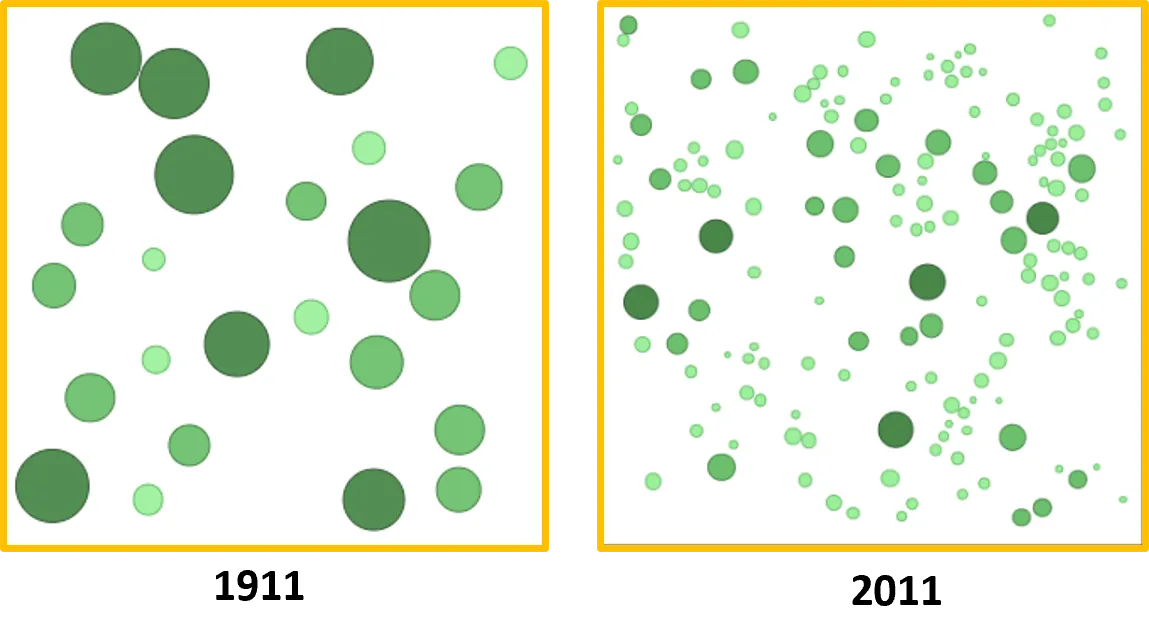
California’s native forests are adapted to survive frequent fires. When fire was more frequent across the landscape, there were fewer, larger trees, and the species that were most common were adapted to survive wildfires. Frequent low-severity fires reduced tree density and created a mosaic of uneven-aged groups of trees with tree clumps, gaps, and openings (see Figure 1).
Fire suppression over the last century has led to forests that are uncharacteristically dense with more trees, many of which are not well adapted to fire. In the absence of fire, many California forests have developed as uniform dense stands of similar-aged trees.
Planting New Resilient Forests
Resilience strategies include a plan for the number, species and arrangement of seedlings to plant. These factors shape competition between trees for the sunlight, moisture and nutrients available on site which affects their survival, growth and maturity. Planning decisions are needed on:
Density: Density is the number of trees planted per acre (TPA). Planting at a low initial density provides seedlings better access to soil moisture, nutrients, and sunlight. Planting fewer trees means less competition between those trees, which encourages them to grow faster and develop fire-resistant characteristics such as thick bark, large crowns and branches high enough off the ground that surface fires cannot reach them. Planting fewer trees reduces the effort needed to thin them out later and the risk from future wildfires. However, planting at low density assumes that most of the seedlings planted will survive. If not, additional planting may be needed later.
Denser plantings, in contrast, are done to ensure that trees capture the site as quickly as possible and are common for producing timber. On harsh sites with high expected mortality, planting more trees provides insurance against failures. However, high seedling survival can create vulnerable stand conditions. Crowded trees create ladder fuels, competition for water, and susceptibility to bark beetles, disease, and death. When fire returns, it typically kills the young stand.
Planting density should be matched to productivity and landscape position (aspect, slope position, and elevation, which affect water availability and growing conditions) while considering future climate conditions (North et al. 2018).
Species: It is important to plant a mix of native species that are adapted to the conditions found on site. For example, drought tolerant trees, such as pines and oaks should be emphasized on south facing slopes. On north facing slopes, which are moister, drought intolerant species such as firs and cedars can be emphasized. All of these species may be planted on each site, but the proportion of each, the species composition, will vary.
Spatial arrangement: Seedlings can be planted in different patterns across the landscape, from uniform grids to clustered patterns.
Grid planting: This approach plants seedlings at uniform spacing to maximize individual tree growth (McDonald and Power 2010). This "pines in lines" method promotes desirable growth form in trees and ensures that the entire site is planted. The predictable structure makes it easier to plan thinning and prescribed fire which can be used to create openings and variability. New trees drop needles and branches, creating an even fuel bed, which can help managers use broadcast burning to maintain it in the future (see figure 2).
Grid planting is currently the standard for reforestation on private lands, both for industrial landowners and small non-industrial owners. Planting contractors are most familiar with this pattern, and it is effective for establishing forests and timber production.
Cluster planting: This method copies natural regeneration by planting trees in groups with gaps between them, attempting to establish historical forest structure from the beginning (See Figure 1). Studies of natural regeneration show that 75% of natural seedlings establish in clumps and often grow faster than isolated individuals despite increased local competition (Fertel et al., 2022).
Cluster planting with high seedling survival creates gaps and openings without the need for later thinning or burning. Shade tolerance of trees should be taken into account when planting in a cluster. Shade-intolerant species such as pine should be planted on cluster edges where the most sunlight is available while shade-tolerant species such as fir can be planted behind them where they will eventually cast shade. If there are live seed trees nearby, the gaps between planted clusters leave space for natural seedings to grow. For some sites, this approach can reduce the need to thin out excess seedlings later with pre-commercial thinning, which can be expensive. Planting in clusters also creates patchy fuels as needles and branches fall in concentrated areas. This can create patchy effects from future wildfires increasing variability in the forest.
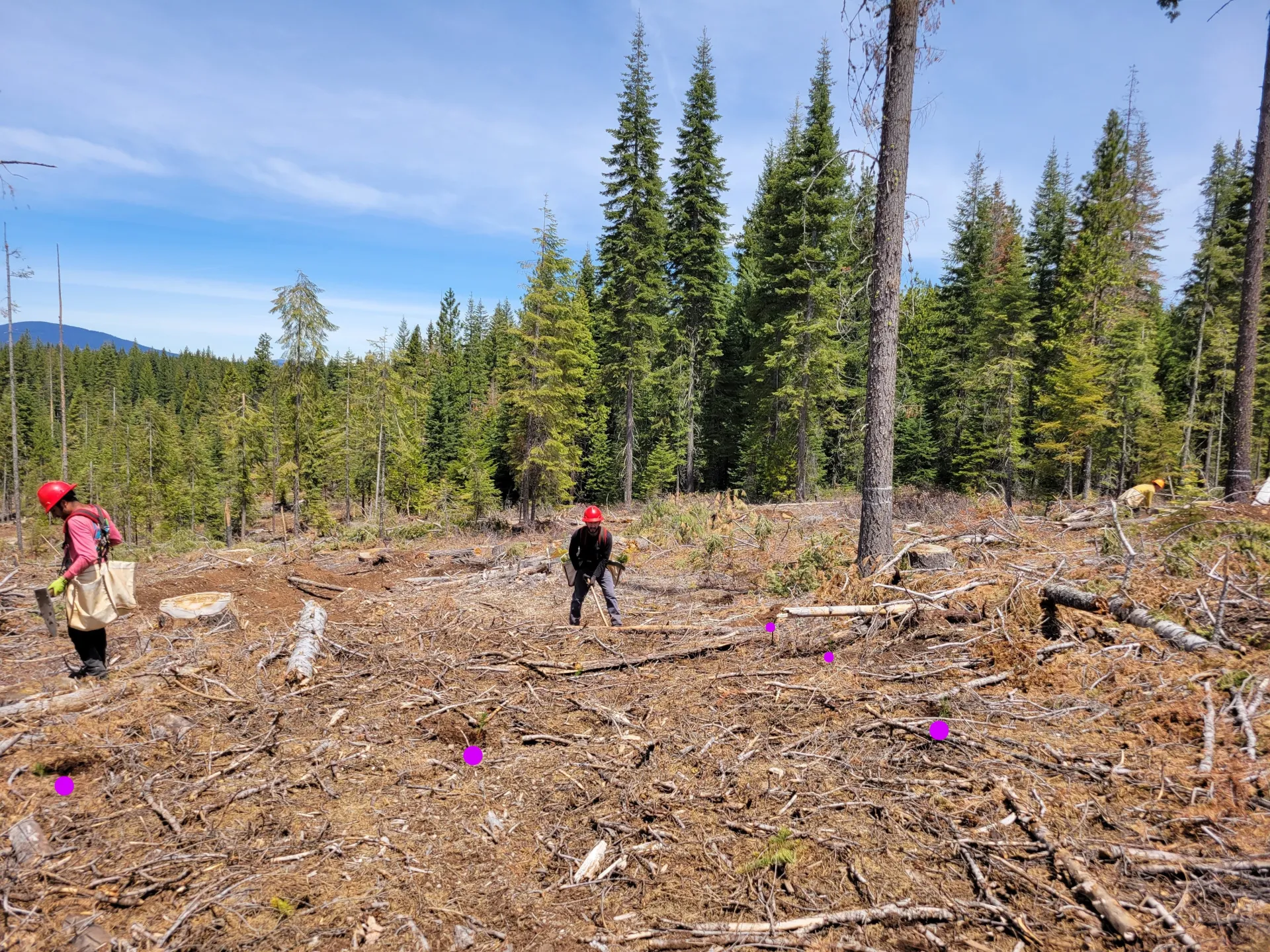
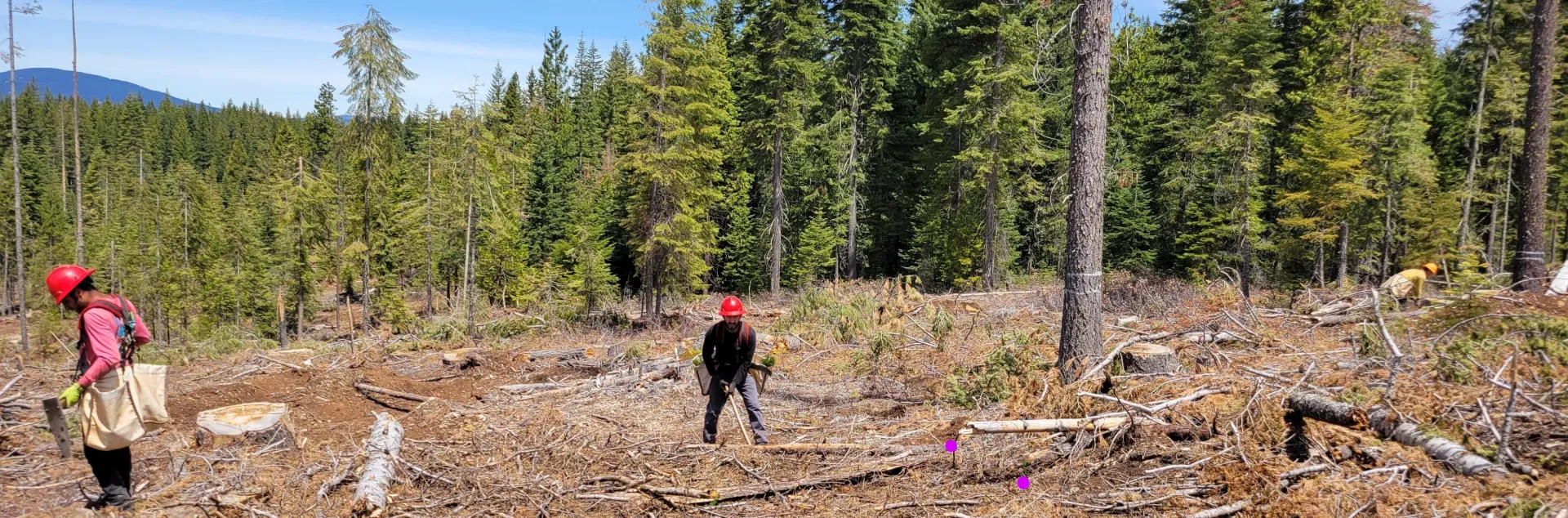
The disadvantages of cluster planting include incomplete site coverage that may miss productive areas and the risk that some clusters may fail entirely, creating larger openings than planned. Cluster planting requires more planning to layout the design and to communicate with contractors who may be less familiar with this strategy than they are with grid planting. The less predictable forest structure makes long-term management planning more uncertain.
Public land managers are the primary managers currently using cluster plantings. Many managers hope this planting design will allow them to start founder stands across larger areas, reduce the need for follow up thinning and be less vulnerable to high severity fire.
Adapting Planting to Specific Sites
A planting design should be customized to the characteristics of the site to be planted (see Table 1). These factors include:
Site quality: Site quality refers to the land's natural ability to support tree growth. High-quality sites with deep soils and reliable moisture can grow tall, vigorous trees quickly and support higher densities. Low-quality sites cannot achieve high growth, even with intensive management. Seedlings may die on harsh sites, meaning it may take a few plantings to re-establish trees there.
When tree density exceeds what the site can support (its "carrying capacity"), trees start to experience stress from competition. This makes them more vulnerable to bark beetles, drought, and fire. On low-productivity sites, competition for moisture can persist for decades until conifer roots grow deep enough to access water below the shrub root zone.
Natural regeneration potential: Burned areas near living seed trees have the potential for natural seedlings to establish. Managers can plant fewer seedlings to reach their goals, though they may want to plant species that are not present nearby. Dense seedlings will eventually require thinning to reduce competition (Sorenson et al. 2025).
Landowner resources: Landowners with the ability and resources to conduct thinning or burning operations in young stands can plant at higher density with the knowledge that they will be able to reduce the number of young trees on site later to improve forest resilience. Those without the capacity to manage the young stand may want to plant at lower density, to reduce wildfire risk before it develops.
Landowner objectives: Those who may want to harvest timber in the future may want to plant more trees in a grid pattern to maximize fiber production (while planning for future thinning). Landowners who want to reestablish a forest but don’t have resources for more management later and do not care whether the site is fully occupied by trees may want to focus on less dense cluster plantings.
Many successful projects combine strategies. This could include using low density grid planting on harsh sites and cluster planting in productive areas with natural regeneration potential. Alternatively, landowners with a timber objective could plant more densely in grids on productive sites and less densely in clusters on harsh rocky slopes or areas more prone to burning sooner.
By matching planting design to site potential and management capacity, managers can focus resources where they will have the greatest effect.
Managing New Forests After Planting
Assuming that tree planting has been successful, additional management actions, such as herbicide application, pre-commercial thinning, and prescribed fire may be needed to reduce tree density and accumulate fuels. This is more urgent when trees have been planted at high density. The goal should be to establish a fire and climate resilient forest structure as soon as possible.
Table 1: Comparison of grid and cluster planting arrangements
Factor | Grid | Cluster |
| Pattern | Roughly uniform spacing (15×15 feet or 16×16 feet) with flexibility for microsites | Groups of 3 to 5 trees, 20 to 25 feet between clusters, ~1,000 square foot openings |
| Structure | Uniform initially; thinning and Rx fire used to create variability over time | Variable from the start; mimics historical mosaic |
| Extent | Complete—no productive areas missed | Partial—leaves room for natural regeneration |
| Fuels | Even distribution; supports predictable Rx fire behavior | Varied; supports patchy fire behavior |
| Shrub Control | Post-planting shrub treatment across site | Shrub treatment focused on openings between clusters |
| Implementation | Straightforward; crews experienced | More layout time; 30-40% fewer seedlings |
| Best for | Capturing site, timber objectives, capacity for treatments | Natural regeneration potential; resilience objectives |
Find the printable version of this fact sheet below. Note that the pdf is for print purposes ONLY.
