
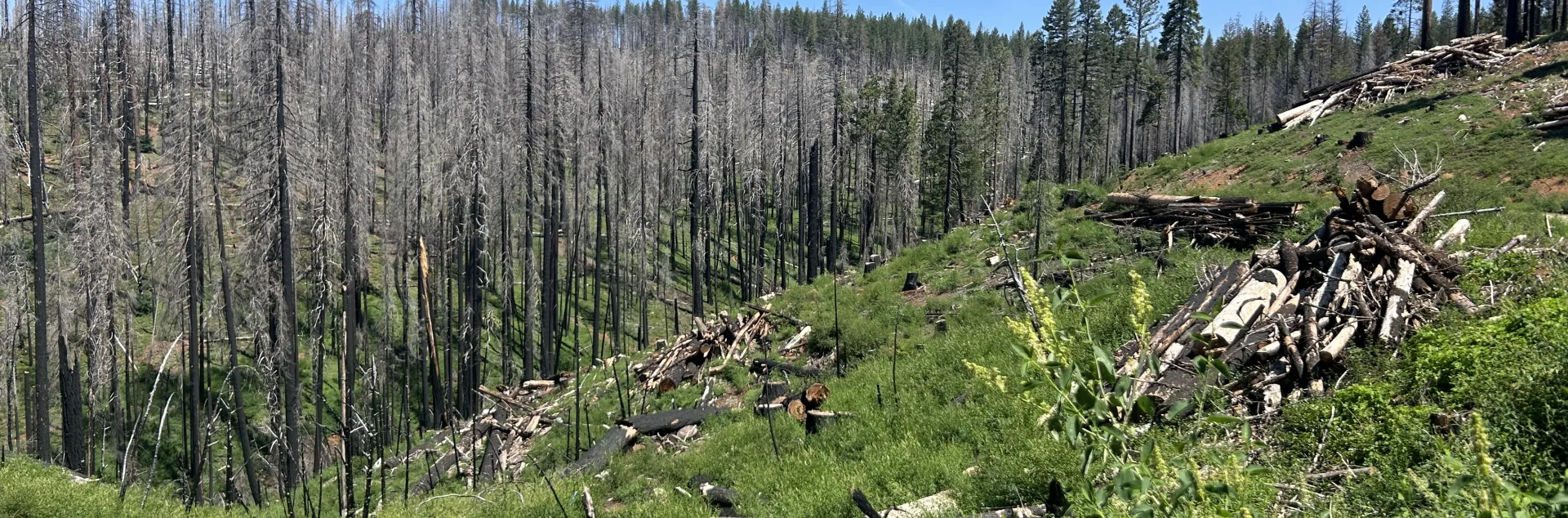
As the magnitude and prevalence of large, high-severity fires in California’s forests increases, so does the urgency to promote the re-establishment of forests on burned lands.
Prior to European colonization, most California conifer forests burned frequently with low to moderate severity surface fires via indigenous burning and lightning ignited fires (Stevens et al. 2017). In the Sierra Nevada, these frequent fires minimized competition between trees and shrubs, limiting shrub cover to less than 30% (Knapp et al. 2013), and enabling the growth of large and vigorous trees at a lower density (North et al. 2022). Following a wildfire mature trees persisted and provided a seed source for new trees to establish. Infrequent, small patches of high-severity fire, usually less than 10 acres (Williams et al. 2023), created openings for seedlings to establish.
Policies during the 20th century, including the removal of indigenous communities, fire suppression, and land management practices shifted forest structure. The absence of frequent low-severity fire and historical timber harvesting that removed large fire tolerant trees created an overly dense forest with high fuel loads, increasing modern forests’ vulnerability to drought mortality and high-severity wildfires (Hagmann et al. 2022). As a result, contemporary fires are increasing in frequency and severity with extensive patches of high-mortality (1,000 to 30,000 acres in size), leaving not enough live mature trees to contribute seeds for regeneration (Williams et al. 2023). With these changes in fire patterns, natural forest recovery is no longer certain.
The establishment, survival, and growth of conifer seedlings is dependent on a variety of factors, including proximity to seed trees, cone crop volume, soil conditions, climate, and competing vegetation. Following high-severity fire, the re-establishment of conifers is challenged by a lack of sufficient tree seed sources, warmer climates, and early colonization of grasses and shrubs that compete for soil moisture (Davis et al. 2019).
Planting tree seedlings is an effective practice to ensure forest establishment and augment any seedlings that may naturally establish, called natural regeneration. Although an increasingly warm climate may be challenging for young trees, they can survive and thrive if they are planted quickly post-fire, and competing vegetation is sufficiently reduced to allow seedlings to capture the moisture, nutrients, and sunlight available on site.
Ecology of post-fire vegetation
After a wildfire, plant communities recover through different pathways known as ecological succession. In California forests, the combination of plant species prevalent on site immediately the fire determines what the forest will look like decades later, although which species dominates varies over time. Shrubs start growing immediately after a fire and can grow quickly to dominate the site. Tree seedlings may naturally sprout in the spring after the fire if trees nearby are mature and their cones and seeds survived the fire. If conifer seedlings don’t sprout, shrubs and grasses rather than trees will dominate the site. Once shrubs dominate a site for several years, successfully establishing trees through planting becomes increasingly difficult and expensive.
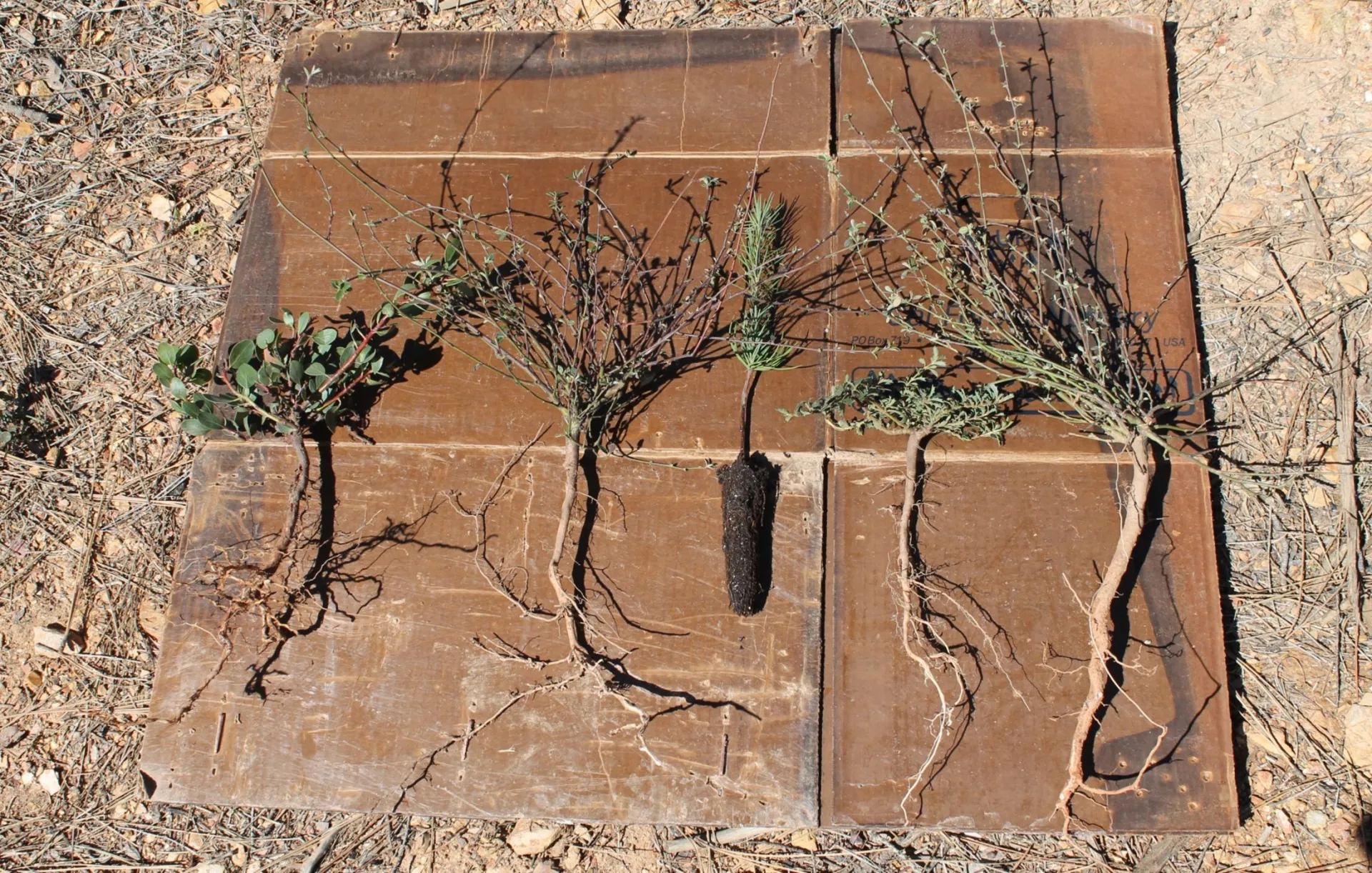
Even when planted early, tree seedlings must compete with rapidly establishing grasses, forbs, and shrubs for both growing space and resources. In California's Mediterranean climate, water becomes the most limiting resource, with dry summers intensifying competition between planted seedlings and other vegetation. Managing this competing vegetation often determines whether reforestation efforts succeed or fail. As the climate warms, it is even more important.
Management Considerations
The main goal of managing vegetation after wildfire is to maximize the growth of seedlings into mature trees by reducing competition for water and solar resources. An additional goal is to reduce the fire hazard in planted forests because shrubs and grasses are also live fuel that carries fire. Wildfire risk is decreased by limiting the density and size of shrubs and herbaceous vegetation, which reduces fuel loads and minimizes fire intensity. Reducing competition can help tree seedlings grow more vigorously, helping them grow taller and wider, faster. This helps them survive wildfires by having thicker bark and branches higher off the ground and above low intensity wildfires.
Burned areas left with standing dead trees and high shrub cover contribute to a higher fuel load, therefore risking a future high-severity reburn (Coppoletta et al. 2016) and conversion from forest to non-forested landscape (Coop et al. 2020). .
To reduce the vegetation competing with planted tree seedlings:
Plant early: Plant soon after the fire and after the site has been prepared by removal of woody debris to expose bare mineral soil.
Control competition: Free upgrowing space and resources to planted seedlings by removing competing vegetation.
There are a variety of methods available for forest managers to control competing vegetation, using herbicide, animals, prescribed fire, and mechanical and manual methods. Each has its own cost, considerations, and efficacy (See Table Below). A combination or repeated use of the same method may be necessary for successful control. Using the right sequence and timing of treatments can be as important as the choice of the method itself. For example, early mechanical treatments may prepare sites for planting, while follow-up herbicide or manual treatments maintain seedling advantage during critical establishment years. Choosing not to manage competing vegetation includes its own impacts and costs including replanting failure (See Image 2).
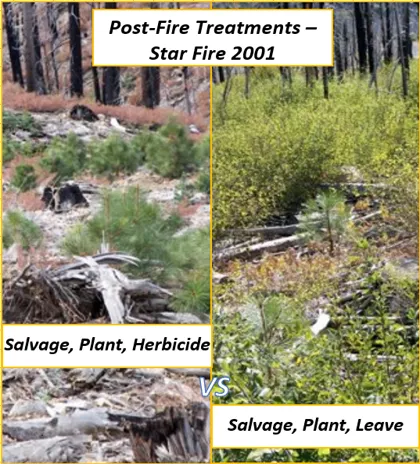
Table: Competing Vegetation Management Treatment Toolbox
Treatments | Cost/Acre | Considerations | Effective Duration | Timeline |
No Action | $0 | - Seedling survival threatened - No control over shrub resurgence - High fuel load, potential for reburn | Not Effective | Could result in increased costs, and/or reduced effectiveness of long-term forest reestablishment |
Chemical (Herbicide) | $-$$ | - Safe & reliably effective shrub suppressant - Low soil disturbance - Weather/ seasonally dependent - High knowledge need | 3-5 years | Dependent on herbicide type, can be applied prior to or after planting and other treatments |
Mechanical | $$+ | - Only used prior to planting - Not feasible on steep slopes - Potential soil disturbance | 1-2 years | Accomplished prior to planting |
Manual (hand-grubbing) | DIY, or $$$ | - Time-consuming and laborious, may be only possible for small acreages - May be useful in riparian areas where other treatments are not allowed | 1-2 years | Optimal 1-3 years post-fire; thereafter largely infeasible |
Targeted Grazing | $$-$$$ | - Requires supervision - unmanaged grazing may cause damage to seedlings - Shrub reduction dependent on species and grazing preference - Reductions are usually short-term due to re-sprouting, inability to impact sprouting root-ball. | 1-3 years | Grazing should be timed to avoid browse damage to seedlings |
Prescribed Fire | $-$$ | - Potentially removes shrubs/herbaceous fuels if targeted - May not be suitable for young seedlings, requires trees to be old enough to withstand fire - Can stimulate the growth of perennial shrubs, and release stored seeds in soil - Can be more successful following herbicide application | 1-6 years, depending on fuel consumption | Either before planting (as site-prep) or once saplings have grown enough to withstand fire (in planted forests, at least a decade) |
Find the printable version of this fact sheet below. Note that the pdf is for print purposes ONLY.
