
About ten years ago, we removed the front lawn and built a three-foot wall across the front of the house to block the sights and sounds of a somewhat busy street. We planted trees and shrubs with little awareness of drought-tolerant gardening. But, to our credit, everything is watered by drip irrigation or low-volume sprayers, and we use the fallen leaves to provide a layer of mulch in our planting beds. Now, the challenge is to decide what to plant after the recent removal of many water-loving plants. In my review of websites and articles on drought-tolerant plants, I found ornamental grasses to be a good addition to my yard.
The term ornamental grass includes not only true grasses but also close relatives such as sedges and rushes. Some sedges have a lawn-like look, are evergreen, and tolerate more shade than grasses. During my research, I found that most rushes are water sponges, so I crossed them off my list. Grasses are adaptable and can grow in a variety of soils and locations, require little effort to maintain, come in many heights, colors, textures, add fall and winter interest with colorful seed heads and foliage, and have many decorative uses indoors and out. But, best of all, many can be used as groundcovers to replace lawns or high-water-use plants.
Ornamental grass replacements for lawns require a lot less water and maintenance than traditional grass lawns. Watering requirements range from no supplemental needs once established to once or twice a week. Drip irrigation systems work well on all grasses. Once a year, almost all of the drought-tolerant grasses need to be cut back. Many grasses go dormant in the winter, retaining their shape, but not necessarily their color. In February or early March, cut the dormant grasses back to 4 to 6 inches to allow new growth to emerge. Almost all grasses require little to no fertilizer. Use a slow-release fertilizer at the beginning of spring growth or after the grasses have been cut back and/or divided. Ornamental grasses are rarely bothered by garden pests.
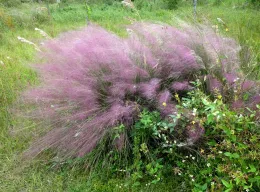
Now, what to plant? If you are looking for grasses that sport beautiful, feathery plumes that wave in the breeze, look for Miscanthus and Pennisetum species. Maiden grass, Muhly grass, and purple fountain grass show lovely pink, purple, or bronze colors and grow over three feet tall, making perfect background plants. Several grass varieties are interesting shades of blue, including blue oat grass and the blue fescues. Blue fescues make great border plants, growing 8 to 12 inches tall. Variegated grasses, such as Japanese sedge and Zebra grass, add interest to any yard. While certain varieties will grow large and stay individually mounded, other varieties will merge together in an undulating swath, such as California meadow sedge or Berkeley sedge. Some grass varieties stay green year-round, while others turn tan, brown, golden, or reddish when dormant. You can mix and match low, large, mounding, merging, and different colors depending on your space and the look you want. I found all of these species in local garden centers and nurseries.
Avoid planting Pampas Grass (Cortaderia selloana), as it is considered an invasive species in California. If you like that look, try planting Giant Wildrye, a native grass, instead.
The popularity of ornamental grasses has grown widely in the last few years, because of their good looks, ease of maintenance, and low water use. I plan to incorporate grasses in my new garden. If you can identify an area of lawn that you don't really need anymore, try ornamental grasses. We can learn and experiment together!