
Many of us have replaced turf (lawn) with low-water-use shrubs and perennials. Whether native to California or elsewhere, the plants were chosen for their ability to require less water and, in other ways, be more "climate-adapted." We now have a patchwork of no-lawn yards in our valley and in many public spaces. Many of these gardens are at least five years old and ready to be evaluated. How well have they lived up to their promise of low water, lower maintenance, and year-round attractiveness?
It is undeniable that some plants have performed better than others. This re-evaluation should not be a cause for alarm. Rather, we should see it as a maturity in our collective gardening knowledge. The old-style turf-and-foundation planting developed over decades. We should anticipate continued refinement of the modern California style and be energized by participating.
One lesson we have learned is that many species that are adapted to high heat and low water behave differently in our Central Valley than they were supposed to."
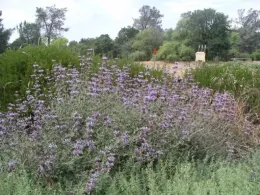
The best-known example of this is Cleveland sage (Salvia clevelandii) and its cultivars, which evolved in coastal southern
California hills and low mountains. In our non-coastal climate, Cleveland sage has become the poster child of problems with relying on the so-called "drought-tolerant" plant species to replace lawns. Poor Cleveland sage: doing its best to stay alive all summer with very little water and high temperatures, and then being criticized as ugly. If we follow typical recommendations and cut it back after it's finished blooming, we have a shrub with brown sticks and sparse curled leaves for two to four months. We have put Cleveland sage front and center in the garden for its fantastic blue flowers in the spring. We know the shrub is alive and will "green up" when cooler weather arrives. We tell ourselves and our skeptical neighbors, "It's supposed to look like that. It's fine."
But is it?
Other plants that are on the "lists" of recommended species that can display this near-total summer dormancy include monkey flower (Diplacus/Mimulus), hummingbird sage (Salvia spathacea), western yarrow (Achillea millefolium), apricot mallow (Sphaeralcea ambigua), silver bush lupin (Lupinus albifrons), blue-eyed grass (Sisyrinchium bellum), chapparal honeysuckle (Lonicera interrupta), buckeye tree (Aesculus californica), and most of the native gooseberry shrubs (Ribes).
There is nothing wrong with these plants, and they are, in most cases, healthy while dormant. We generally don't assume a valley oak tree or rose bush is dead in the winter, even though it is only limbs and no leaves. We understand winter dormancy. Summer dormancy is still foreign to us. This desirability/undesirability trait is a personal preference. If you are already fine with summer stick shrubs and brown plants in July, you don't need a solution to a problem you don't have. But if we want to continue to promote garden schemes that work with the climate, we may need to combine our continued education ("That's how they are supposed to look. The plant is not dead," etc.) with aesthetic solutions.
Solution #1: Don't plant species that have this known tendency if you find it unbearable. Downside: you will miss out on the springtime flowers and the known habitat benefits (bird attraction, pollinator support, etc.)
Solution #2: Consider these plants to be moderate-water-use instead of low-water-use. In other words, water them more throughout the summer. Downside: using more water in the ornamental garden than planned, and with that comes more summer weed management and potentially more pruning. One advantage of summer-dormant species is that they do not generally require any pruning beyond an annual trimming.
Solution #3: Ignore the literature that says plant in full summer sun and instead plant them in partial summer sun, such as on the north or east side of a deciduous tree, where they will be in the shadow of the tree's canopy. Disadvantage: fewer flowers. The exception is hummingbird sage, which blooms early and is less affected by spring and summer shade for flower production.
Solution #4: Design the garden so that you can allow summer-dormant or summer-deciduous plants to be less noticeable in the months when they are less attractive. Plant so that summer-loving plants, both California native and non-native, catch the attention. Some examples are lantana, bulbine, California fuchsia, California or western goldenrod, crape myrtle, and desert marigold (Baileya multiradiata). "Hot Lips" sage and Mexican bush sage may also work for this. A second part of this solution is to prune summer-dormant plants as early as you can after bloom, perhaps as early as June, when they will still be green and perhaps do a second flowering, and then prune again in late fall or early winter.
All plants have a main season and a season of rest or dormancy. For some of them, this is in the summer. Now that you know, you can make the choice that's right for you and help educate others about what it means when a plant looks less than lush in summer. It doesn't mean living in denial about our climate; it means continually learning and adapting, just like our plants.