
Every summer, I take great joy in growing six beautiful tomato plants and sharing the fruit with my neighbors. I usually grow Big Boy, Better Boy, Beefsteak, and a couple of smaller varieties. In my estimation, there is nothing better on a summer day than a sandwich with tomatoes freshly ripened from my garden. I also freeze tomatoes for use in soups in the winter. I hate to say it out loud, but I have had great crops the last few years. I always let my tomatoes ripen fully on the vine for the fullest flavor.
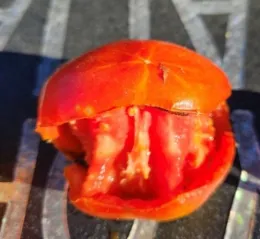
As far as tomato pests go, I usually get whiteflies or other small invaders toward the end of the season. By then, my tomatoes are on their way out, so it's never been a problem. Occasionally, I have had a few bird pecks on the ripe fruit. I can tell that by the beak-like shape of the puncture and the location at the top. I have also sometimes had a small issue with caterpillars or worms. This year, however, (thankfully, toward the end of the season), something was seriously decimating my tomatoes. Some of the tomatoes had only the skin remaining, where it was still attached to the top of the plant! I wasn't at all sure what critter was causing this type of damage.
So, I went on a hunt. I went to my trusty University of California Agricultural and Natural Resources website (UCANR.edu) and started researching various publications, trying to discover my culprit in the Integrated Pest Management Program section for Home and Landscape. Inputting Tomato Pests, I quickly eliminated the disease articles. This was definitely a pest of some kind.
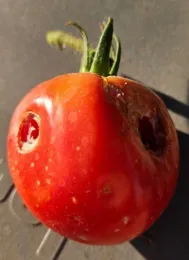
Worm Damage
Reading through Publication 3470, Tomato, I learned a lot about various worms that attack tomatoes.
The Western Yellowstriped Armyworm feeds on foliage and fruit, making irregular holes on the surface of the fruit, but rarely bores deeply into the fruit. That was not the damage I was concerned about.
Cutworms were also listed. They are mainly active at night and eat irregular holes in the surface of the fruit. Again, not the damage I was seeing.
Tomato Fruitworms complete their larval development inside the fruit and can emerge from one fruit and enter another. However, they feed mostly on green tomatoes and rarely on red ones. My green tomatoes were pristine; my issue was all red tomatoes, so forget the Tomato Fruit worm!
The Beet Armyworm will attack foliage and fruit, creating single or closely grouped circular or irregular holes in the fruit. The feeding is often shallow and superficial, and the wounds eventually dry. Once again, not the culprit I was looking for.
Tomato Hornworms can get quite big--3 to 4 inches--and can consume leaves, stems, as well as chew holes in green or red tomatoes. They can completely defoliate a plant. They are usually few in number and therefore can be picked off the plant and disposed of. But again, I had no foliage damage.
All of these worms can be controlled through the use of BT (Bacillus thuringiensis) applied as a spray to target the pests. The worms must ingest it, and then it disrupts their digestive system, causing death within a couple of days. Even though it doesn't kill immediately, the insect stops feeding within hours. A friend once described its actions, saying, "they get a stomachache, so they stop eating." The good thing about BT is that it is safe for humans and other higher animals. A telltale sign that you might have worms in your garden is the presence of black specks of frass—or worm excrement.
The Pest Note article also lists other controls, such as Spinosad, and gives detailed information on when to apply and how. Since I did have some caterpillar damage, I liberally doused my plants with BT. I knew, however, that it wasn't going to take care of my main issue, so I continued to search.
It was in UC ANR Publication 3441, New Citrus Pest Management Guide, that I believe I found the answer to my dilemma. I came across a description of damage done to oranges, avocados, and other fruits, where sometimes a hollow fruit skin is left hanging on the tree or plant. That is exactly what I saw on my tomato bushes. Then I remembered how my neighbor's orange tree would often have hollowed-out oranges hanging from the tree. I remembered talking to my pest guy about it, and he told me the culprit was probably roof rats! So, I did more reading and also talked to my pest guy again. Eureka! and Yuck! all in the same breath! I have roof rats attacking my tomatoes. In one tomato, I could actually see some tooth marks. Again yuck!
I learned that roof rats, who are mainly active at night, live above ground in trees, shrubs, dense vegetation, and may travel up to 300 feet for food, which means they can actually be in someone else's landscape. In my case, my pest guy identified a neighbor's palm tree that hasn't been cleaned of debris in years as the probable housing ground. I also read recommendations like reducing shelter or potential nesting sites, like wood piles. We did have a small wood pile from when we used to use our fireplace. Gone! Also, it is recommended to pick the tomato fruit as soon as a hint of color (besides green) appears. Never leave fully ripened fruit available overnight. Also, remove spoiled or damaged fruit quickly so it doesn't attract more rats. I realized I had been leaving half-eaten fruit sometimes, thinking maybe they would finish eating it and leave my other tomatoes alone. Wrong!
Publication 8513, Roof Rats, O MY!!, talks very specifically about ways to manage these rats, from trapping to bait. One specific trap they mentioned was snap traps. A friend showed me a snap trap he uses. It reminds me of a very wide, fat clothespin but with strong jaws. He said that when he catches a rat in that kind of trap, all he must do is press the ends together over the disposal site, and the rat just drops out. Of course, he always wears gloves as rats carry all kinds of diseases, such as rat bite fever, typhus, leptospirosis, salmonella, and plague, to name a few. Again yuck!
Well, after all this research, I hope your tomato pests are more like caterpillars or worms and not rats. However, now that I have named my culprit and am armed with lots of useful information, I plan to go on with the attack. I think I will also ask my neighbor to trim his palm tree!!
Happy tomato growing and consumption to you all!