
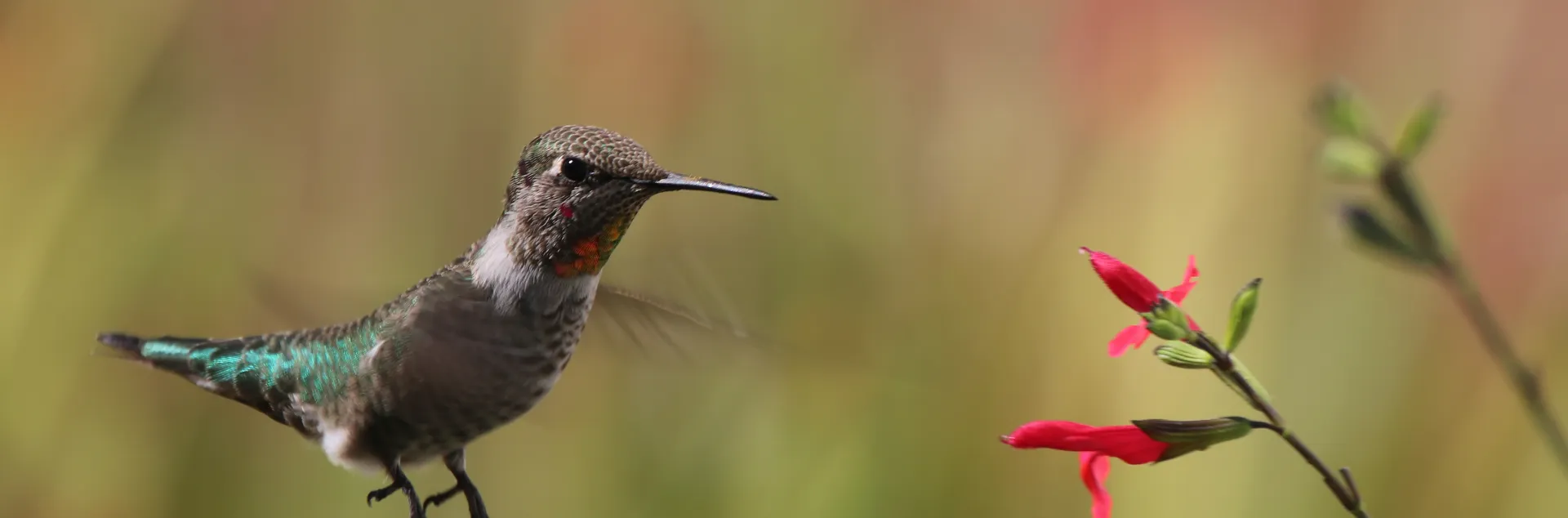
Hummingbirds are magnificent creatures. They perform death-defying feats like thrill-seeking stuntmen, pushing boundaries way beyond that which is humanly possible. Everything about hummingbirds conjures superlatives: the fastest flyers, the smallest size, the biggest eaters, the speediest metabolism. The best part? With a little know-how, you can lure them into your garden to enjoy the show firsthand.
The love life of hummingbirds
When a male hummingbird is pursuing a female, it dive-bombs 50 mph out of the sky in front of her in a U-shaped swoop, screaming first toward the ground at nearly 400 times its body length each second. This is twice as fast as a peregrine falcon, making the hummingbird the fastest moving vertebrate on earth relative to body size.
As it approaches the ground, it spreads its wings and tail and launches into a skyward projectile of 10 g-force, or 10 times the gravitational pull of the Earth. Relative to size, that’s faster than the space shuttle’s re-entry into the atmosphere. To put it in perspective, fighter jet pilots black out or temporarily lose vision above 7-g.
All to get the girl.
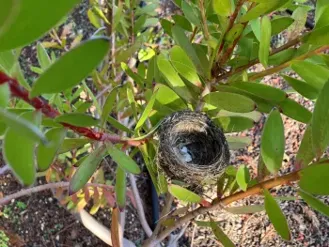
Despite their bravado, these flying machines are the love-’em-and-leave-’em type, always looking for the next tryst. The female, in the meantime, builds a tiny nest of twigs and spider webs high up in a tree where it lays eggs no bigger than jellybeans. Dad takes no responsibility for his hatchlings. Most will die within a year; some will live three years or longer.
Nature’s extremists
As their mating ritual depicts, hummingbirds are extremists. Their behavior, abilities, and physical makeup practically defy reason. They push the extremes of flying, eating, guarding, and even sleeping.
Tiny but powerful
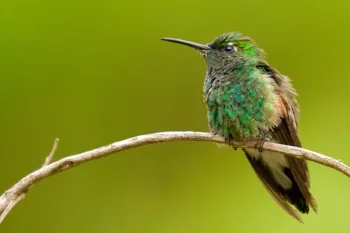
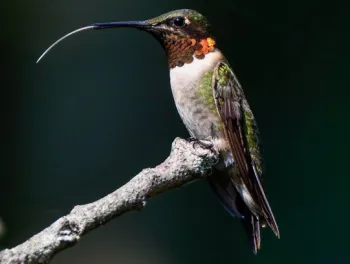
The smallest bird species in North America, hummingbirds only exist in the western hemisphere, from southeast Alaska to Chile. The typical hummingbird is just 3 inches long and weighs less than a nickel, yet it can hover in place, fly forward, upside down, or sideways. It is the only bird that can fly backward. Possessing the fastest metabolism of any animal, the hummingbird’s heart beats up to 1,200 times per minute, and its wings beat up to 200 flaps per second. While at rest, it will take 250 breaths per minute. On an average day, a hummingbird will fly around 25 mph. That’s how fast a ruby-throated hummer flies when migrating across the Gulf of Mexico — for 500 miles, 20 hours, nonstop. And no, it does not hitch a ride on another bird.
Aggressive eaters
To maintain this flurry of intense activity, hummingbirds must eat regularly, heavily, and efficiently. Some flowers have actually coevolved alongside hummingbirds to perfectly accommodate their long, slim beaks: as the birds grab their food, the plant gets pollinated. To stay alive, a hummingbird will eat — must eat — anywhere from half to eight times its body weight every day, which is why it licks the nectar of around 1,000 flowers daily with its forked tongue and gulps down insects for protein. Hummingbirds remember the locations of these nectar sources from years prior and protect favorite food patches like warriors. Despite their wee size, hummingbirds are one of the most aggressive birds. They attack crows and hawks that infringe on their territory and may even try to gouge out a competitor’s eyes.
Playing dead
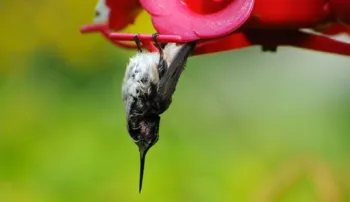
Everything screeches to a halt at night when some hummingbirds go into a state of torpor. Body temperature drops precipitously from 107 to 70 degrees. Heart rate plummets to a human-like 70 beats per minute. Hummingbirds in torpor look dead and are occasionally found hanging upside down.
How to invite hummingbirds into your garden
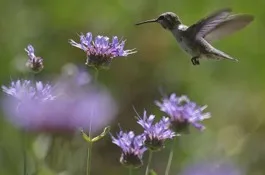
To lure hummingbirds into the garden, you need to provide what they need for survival -- food, water, shelter, and a place to raise their young.
- Food: A hummingbird needs a steady supply of nectar, which means it’s critical to grow the plants they love to visit. Hummingbirds prefer bright red or orange tubular-shaped flowers – the more nectar-rich the better. California native plants are excellent choices, as are other tubular crimson flowers. Check out this list of plants that hummingbirds can’t resist. They also need plenty of insects for protein, so please do NOT use pesticides that may inadvertently kill off an important part of a hummingbird’s diet.
- Water: Hummers need access to clean, fresh water all year long. This does not need to be anything elaborate. A simple bird bath, shallow bowl, mister, or small fountain will do just fine.
- Shelter: Shrubs and vines make good perches for hummingbirds. They prefer sturdy, thin, exposed twigs that give them some protection from the wind. This allows them to keep an eye on their environment and maybe even take a short rest. IMPORTANT: please leave cats indoors. The shelter a hummingbird finds is no match for a cat on the hunt.
- A place to raise their young: Small trees typically make good nesting sites. Hummingbirds use spider silk to create their nests and to attach those nests to branches. So the next time you have an urge to clean up all the spider webs in your garden, please think about the hummingbirds in your neighborhood.
A word about feeders
Growing the plants hummingbirds love is the best way to lure them into your garden. However, if you want to supplement their natural food sources with a hummingbird feeder, it’s important to do it correctly so you don’t end up hurting them. Feeders can be used year-round but must be kept clean and free from ants and bees.
- Recipe: Add one part sugar to three to four parts very hot or boiled tap water. Shake or stir until the sugar is completely dissolved. Fill feeder only with enough to last two days. Store the rest in the refrigerator. Do not add any supplements as this could create problems for the birds.
- Cleaning: Clean the feeder every two to three days, using very hot water, perhaps with a little bleach. Detergent may be used, but do not use detergent and bleach together. Rinse very thoroughly. In warmer weather (above 65 degrees), more frequent cleaning is required as pathogens multiply faster. Refill feeder with a fresh sugar solution.