Irrigated Pastures
Central Sierra: Save Water with Drip Irrigation | El Dorado County
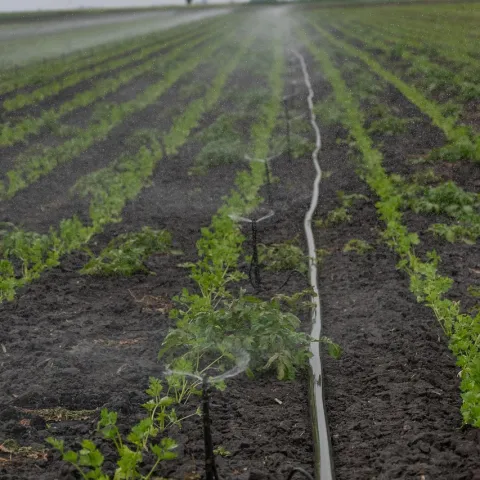
Drip irrigation is well-suited to the El Dorado County landscape.
It is doubtful that anyone living in El Dorado County, or the whole of California for that matter, is not aware of drought conditions impacting everything from household water use, home gardening, commercial agriculture, new home construction, etc. The list is a long one. We all need to do our part to help conserve what water is available, and this article, I hope, will help sway gardeners to switch to drip irrigation for their landscapes.
The history of drip irrigation
Very crude drip systems were used in ancient times, but modern drip irrigation was developed in Israel in 1959, because of the need to grow food crops in their dry, desert country. Drip irrigating expanded through the decades to enable farmers, nurserymen and home gardeners to more efficiently use water to grow everything from crops to ornamentals. This is primarily because drip irrigation technology applies water slowly and directly to the targeted plant’s root zone. Another bonus is that oddly shaped areas or hilly terrains are much better irrigated with drip systems than overhead sprinklers.
Installing and maintaining drip irrigation
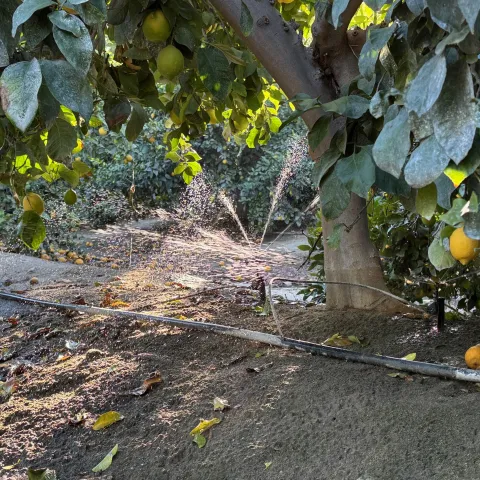
Drip irrigation involves placing tubing with appropriately spaced emitters on the ground alongside the plants, and the emitters slowly drip water into the soil at the root zone. Irrigating using this method has many benefits, including:
- Minimizing diseases due to water not contacting leaves and stems
- Reducing weed growth in dry rows between plants
- Increasing effective watering on uneven ground
- Reducing leaching of water and nutrients below the root zone.
Initially setting up a drip irrigation system is time intensive, but once it is done, the only maintenance necessary is periodically checking to see that emitters are functioning properly and not clogged; many gardeners walk around their landscapes on a weekly basis to see that everything is working properly. Newer tubing is much better than in the past and does not deteriorate as quickly when exposed to sun. It can be covered with mulch if the appearance on top of the ground is not appealing, but one word of caution – it is a good idea to take a picture of a system once it is installed and before covering with mulch. This lessens the chance of cutting into it with a shovel or other garden tool.
In recent years, in-line tubing has become more readily available. This innovation precludes having to punch into lines to insert emitters because they are already installed inside the drip tubing. Manufacturers claim that this type of system does not become clogged with dirt or insects and is much better adapted to being covered with soil or mulch. Spacing of the built-in emitters is usually every nine or twelve inches and can be used in straight rows, as in vegetable beds, or wound around a landscape in various patterns.
Everyone needs to do their part for water conservation and in the garden utilizing drip irrigation is a big step toward helping reduce water use.
This article, by UC Master Gardener of El Dorado County Sue McDavid, originally appeared in the Mountain Democrat in April 2026.
If you have any questions about the best way to irrigate your garden in El Dorado County, please reach out to us and we'll give you research-backed information to help you water most efficiently.