
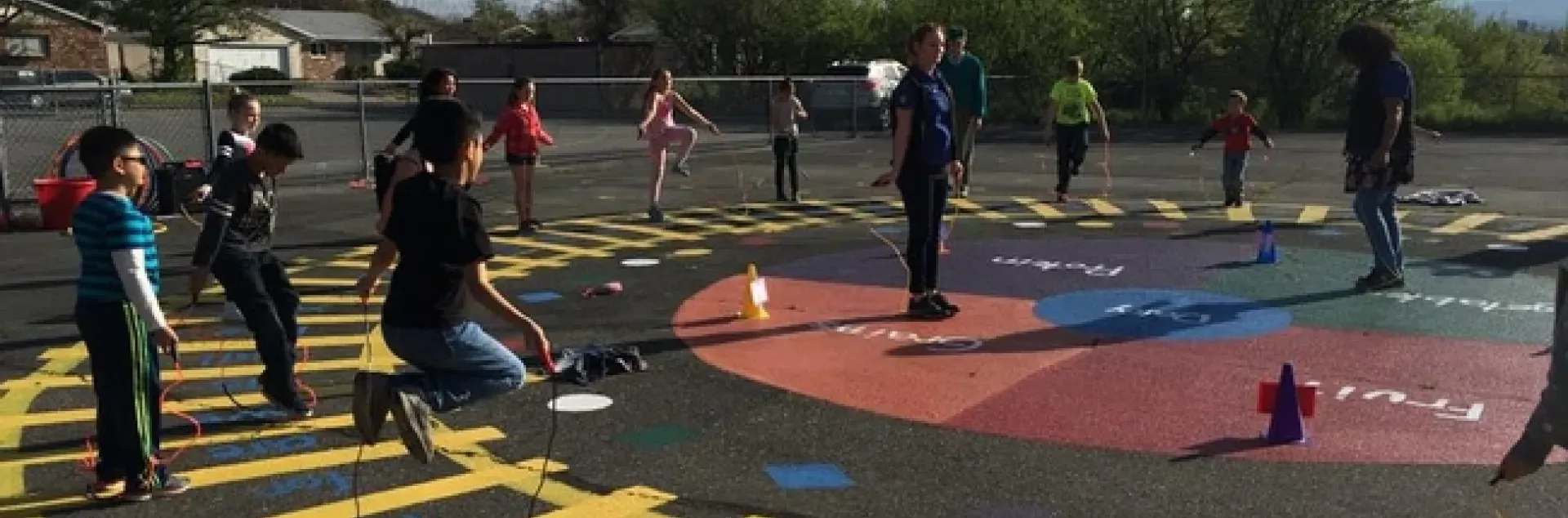
Children need physical activity, not just for the physical benefits, but also for the mental health and social gains. Students who are physically active behave better and have a higher academic performance than students who are more sedentary.
To ensure that children get physical activity and have a mental and social break from sitting in the classroom all day, California law mandates that public elementary and charter schools provide at least 30 minutes of recess time each school day as of school year 2024-25.
However, the law passed without additional funding or accountability measures.
Implementation was required by California Senate Bill 291, also known as Recess for All, which passed in 2023 under the leadership of State Senator Josh Newman. Hannah R. Thompson, Nutrition Policy Institute director and University of California Cooperative Extension specialist with UC Agriculture and Natural Resources, and Rebecca A. London, chair and professor of the UC Santa Cruz Sociology Department, provided essential evidence on the lack of recess time in public schools prior to the law passing.
Thompson, who is also an assistant research professor at the UC Berkeley School of Public Health, and London recently received a grant from the National Institutes of Health to evaluate the implementation of the law.
“This is an important opportunity to contribute evidence on the impact and implementation of a statewide law impacting the health of nearly 3 million California elementary school students,” Thompson said.
“We are hopeful that what we learn from studying Recess for All can help improve recess in California, as well as strengthen similar legislation in other states to increase the impact of these types of laws in the future,” she added.
Thompson and London will specifically examine changes in scheduled recess minutes before and after school year 2024-25 by using schools’ publicly available bell schedules.
The researchers will interview 125 district and school staff to qualitatively determine barriers, facilitators and best practices for implementing the recess law, along with solutions-oriented approaches to improving current and future legislation.
“Understanding how and why schools are, and are not, meeting the mandates of the law is important to make sure that we close the equity gap in access to school-based play and physical activity,” said London.
The two-year project began on Sept. 1, 2026, with Thompson serving as principal investigator and London as an advisor. NPI’s Reka Vasicsek will serve as the project manager, with Davrina Rianda as project scientist, Caroline Nguyen as data analyst, and Miranda Westfall Brown supporting qualitative interviews. NPI is an institute of UC Agriculture and Natural Resources.
This project is supported by the National Heart, Lung, and Blood Institute of the National Institutes of Health under Award Number R03HL185215. The content of this article is solely the responsibility of the authors and does not necessarily represent the official views of the National Institutes of Health.
For more information about the project, see UC Santa Cruz news release “London advises on National Institutes of Health grant to study implementation of California’s Recess for All.”