
By Anne Ryder.
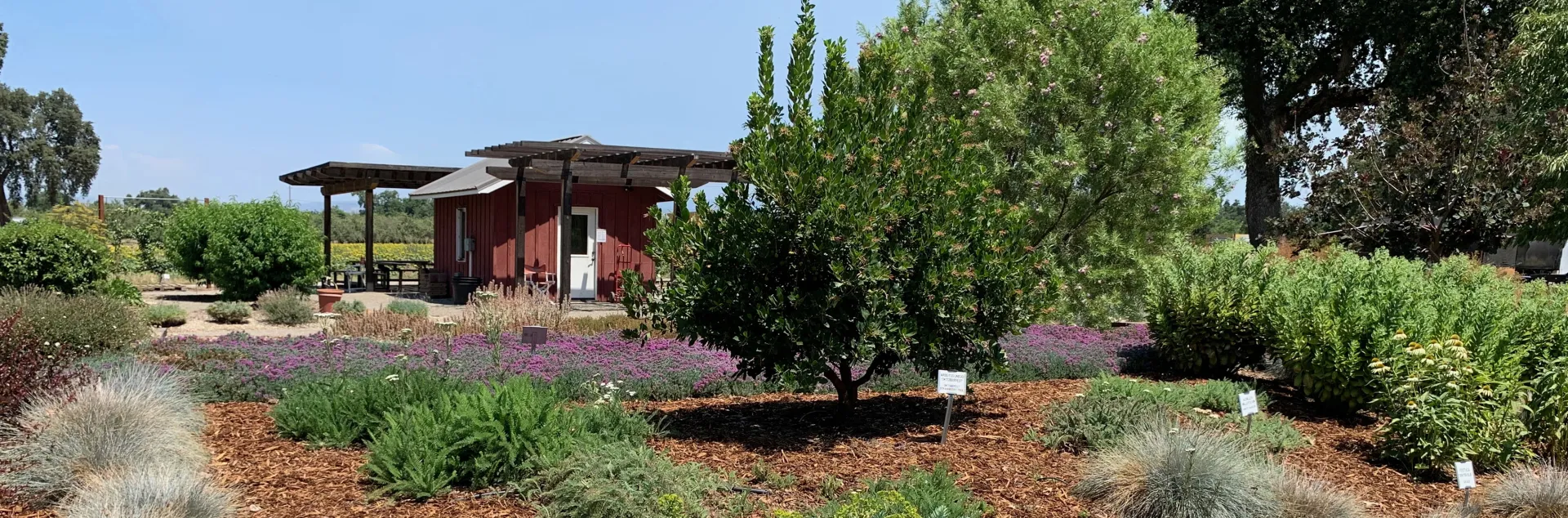
At this time of year, many of us struggle not only with the heat, but with a dispiriting lack of color in our gardens. And, while it’s not a good time to put in new plants that will surely also struggle in the heat, it IS a good time to note spaces in your garden where you’d like to insert those cheery plants come fall, when the temperature cools down. For ideas and inspiration, the Master Gardeners Demonstration Garden is here to help!
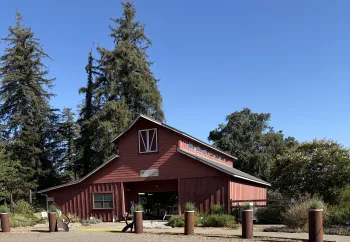
The Demo Garden is located on the property of the Patrick Ranch Museum at 10381 Midway, between Chico and Durham, and is open for visitors on Saturdays and Sundays from 11-3. Drive slowly down the dusty entrance road! You will see that there’s plenty of parking under the towering Valley Oaks. Enter the Gardens through the Red Barn (Visitor Center and Gift Shop). Once in the Demo Garden, locate the Master Gardener Office: there are laminated maps outside the Office to help you explore and navigate the various garden areas.
Think of the Demo Garden as a "test drive" for your own backyard. There are actually fourteen specialized gardens within the larger Demo Garden, and these distinct areas demonstrate how to grow plants that are successful in our local Mediterranean climate. Signs near the plants and trees give their scientific and common names. Take notes and photos so that later on you will be able to find sources for plants you want to integrate into your home landscape.
What is “High Summer” like in the Demo Garden? Compared to spring and fall, there are not nearly as many plants still in bloom. While the “All Star” Garden boasts flowering native plants that grow easily in Chico and environs, the majority of them have hunkered down to withstand the heat, shifting their energy to seed production. Still, there are black-eyed Susans and a very lovely purple ground cover called hardy plumbago (Ceratostigma plumbaginoides) in bloom.
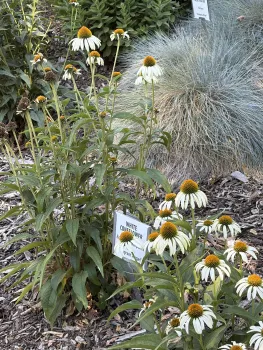
A few heat-loving summer plants and shrubs are flowering, like the red heart rose of Sharon (Hibiscus syriacus) just outside the gate and the white cone flower (Echinacea purpurea) just inside. Both of these thrive in our summer climate, and (bonus!) come in a variety of colors. Close by the cone flower is a striking stand of blue fescue (Siskiyou blue), a drought tolerant grass with leaves of silvery blue. A much larger grass (Stipa gigantea) makes a statement nearby – it’s an excellent option for those who have more room and enjoy the beauty of grasses.
The real mid-summer excitement is in the Espalier Garden and the Edible Garden. Here, the fruit trees, berry bushes, and vegetables are thriving. Near the outdoor classroom, a mini-orchard beckons: the plums have been harvested, but there are apples, peaches, pomegranates, Fuyu persimmons, and figs, all in various stages of development. Warren pears (Pyrus communis) grow along the fence in the Espalier Garden.
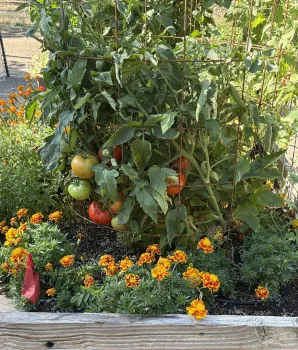
Two magnificent arbors brimming with Himrod grape (Vitis labrusca) lead visitors into the Edible Garden. It is a delight to explore and imagine these fruits and vegetables in one’s garden at home. Bright orange cherry tomatoes are growing up a wire trellis for easy picking, and several other varieties of tomatoes are on display. Colorful marigolds, zinnias, and sunflowers fill out the raised beds (the marigolds assist with insect control).
Green onions, zucchini, and peppers add spice and color. A large stand of blackberries is partially covered with netting, to dissuade the birds. The Edible Garden also provides an excellent opportunity to see a variety of different kinds of raised beds. Some are the traditional wooden raised bed constructions we may be familiar with; others are tall metal troughs; and still others are putting culvert material (high density polyethylene) to good use. In one of the latter, a healthy artichoke is stretching out.
Before you leave the Gardens, listen for the sound of running water in the Wildlife Habitat Garden, where a water feature provides a welcome stop for thirsty birds and other critters. It may just inspire you to add a bird bath or fountain to your own garden, not only to help the local wildlife, but to provide the soothing sound of bubbling water on a hot summer’s day.
UC Master Gardeners of Butte County are part of the University of California Cooperative Extension (UCCE) system. To learn more about us and our upcoming events, and for help with gardening in our area visit the UC Master Gardener website. If you have a gardening question or problem, email the Hotline at mgbutte@ucanr.edu or leave a phone message on our Hotline at 530-552-5812. To speak to a Master Gardener about a gardening issue, or to drop by the MG office during Hotline hours, see the most current information on our Ask Us section of our website.