
Vegetable Gardening - Handbook for Beginners
Chapter 1.3.
There are seven major considerations in container gardening:
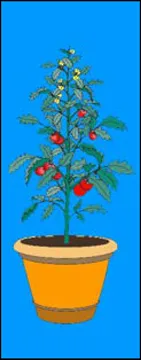
How much sun is available?
Choose plants according to how much sun or shade they’ll get each day. Most vegetables need at least 6 to 8 hours of direct sun every day. Leafy vegetables, such as lettuce, onions, carrots and beets will do okay in partial shade. But plants that bear fruit such as tomatoes, eggplant, squash, peppers need more than 8 hours of full sun.
What type of container?
Almost any container will do as long as it has good drainage. Smaller containers and unglazed clay pots dry out very quickly in summer. The smallest for outdoor use is probably 8 to 12 inches in diameter and depth. In part shade, you may have success with smaller containers. If you are using recycled containers, scrub them well and rinse in a solution of 9 parts water to one part bleach. If containers are porous (clay, wood, cement) soak them well in water before filling so they won’t act like sponges and pull all the water out of your soil.
A deeper container is always better than a wider container because it provides more space for the roots to grow down in search of moisture and cooler temperatures. This will enable plants to thrive during hot summers when more frequent irrigation is required. Containers should be at least 4” deeper than the the length the roots will reach at maturity.
Since plants in containers are above ground, the roots are more sensitive to temperature extremes. Midsummer heat can kill tiny hair-like feeder roots. Without these feeder roots, the plant will wilt even if the soil is wet. Then larger roots become very susceptible to root rot fungus that can destroy the rest of the plant. Overheating of the soil is a common cause of failure in container plantings. Thick wood insulates best, dark-colored containers will absorb more heat, and light-colored containers reflect heat.
What should you plant?
Shallow-rooted crops like herbs, lettuce, green onions, radishes and spinach are easy to grow. Carrots, potatoes, turnips and other roots crops need much deeper containers. Tall or sprawling vegetables (eggplant, peppers, squash and tomatoes) have extensive root systems. They will bear well if they have enough room for roots to develop. To get the most out of your limited space, choose high yielding and dwarf varieties with small-to-moderate sized fruit. These include beans, beets, carrots, lettuce, peppers, radishes and some varieties of summer squash and tomatoes. Stay ccmg.ucanr.edu UC Master Gardener Program of Contra Costa County 3 Planning your Garden Vegetable Gardening Handbook away from varieties labeled “whopper”. Look for short, bushy, rather than tall, vining plants. For the highest yield, provide support for vining or trailing crops and add the stakes or trellis when you first plant the seeds or transplants so that you won’t damage roots by adding them at a later date.
Seeds or transplants?
Plant beans, beets, carrots, cucumbers, lettuce, peas, radishes and squash from seed. Eggplant, peppers, and tomatoes are best purchased as transplants. Buy the smallest size available (6 packs or 4” pots), since they will develop better roots and grow to larger sizes more quickly than the gallon size plants can acclimate to the location.
Preparation of the soil
Do not use garden soil. It may contain diseases and fungi and is usually very heavy and slow to drain. Buy a high quality soil mix that is sterilized and able to absorb moisture and drain quickly.
Fertilizing
Plants “trapped” in containers cannot search for nutrients or water. Confined root systems demand frequent but light fertilizing during their growing period. Nutrients are leached from the soil with every watering and need to be replenished regularly. Two to four weeks after planting, begin applying a water soluble fertilizer (mixed one-quarter strength) with each watering. Organic gardeners can use liquid fish emulsion, liquid kelp or blood or bone meal. The three numbers on the fertilizer package - such as 10-10-10 - explain what the fertilizer is formulated to do. The numbers are always in the following order:
- Nitrogen - for green leaves
- Phosphorus – for flowers and fruit
- Potassium – for root growtrganic gardeners can use liquid fish
When one of the numbers is higher than the others, that means the fertilizer is designed to promote more growth in that specific part of the plant. Do not overfeed. A little is good, a lot is NOT better!
Watering requirements
All containers dry out quickly. Watering requirements will vary according to the season, type of container, soil mix and sun exposure. Check containers daily. Stick your finger into the top inch of soil. If it feels damp there is no immediate need for water. If it feels dry, water until some runs out the bottom of the container. In mid-summer and on windy days this may be needed daily. In summer, provide a saucer that can fill with the excess water and then be reabsorbed as needed. In winter, remove the saucer so the plants don’t sit in water and stagnate.
Water early in the morning to avoid wet leaves at night when temperatures drop and mildew and disease organisms flourish. Use a slow even spray to avoid washing out the soil.
Mulching
Mulch plants with straw or other non-woody material from June through the summer. It will reduce evaporation, save water, and plants grow better without struggling.
Plant Suggestions Depending on Container Depth
The tables below suggest plants that are good for different container depths
Plants good for shallow containers
| Plant Name | Plant Spacing | Soil Depth |
|---|---|---|
| Beets | 3" apart | 9" to 12" |
| Leaf Lettuce | 6" apart | 9" to 12" |
| Onions | 3" apart | 9" to 12" |
| Radishes | 1" to 2" apart | 9" to 12" |
| Spinach | 5" apart | 9" to 12" |
| Swiss Chard | 6" apart | 9" to 12" |
Plants good for moderate depth containers
| Plant Name | Plant Spacing | Soil Depth |
|---|---|---|
| Broccoli | 12" apart12" apart | 12" to 14" |
| Cabbage | 12" apart | 12" to 14" |
| Cauliflower | 12" apart | 12" to 14" |
| Cherry Tomatoes | 12" apart | 12" to 16" |
| Eggplant | 12" apart | 12" to 16" |
| Peas | 3" apart | 12" to 16" |
| Peppers | 12" apart | 12" to 16" |
| Carrots | 2" apart | 9" to 18" (depending on carrot length |
Plants good for deep containers
| Plant Name | Plant Spacing | Soil Depth |
|---|---|---|
| Beans | 5" apart | 16" to 18" |
| Cucumbers | 12" apart | 16" to 18" |
| Potatoes | 6" apart | 16" to 18" |
| Summer Squash | 18" apart | 16" to 18" |
| Tomatoes | 18" apart | 16" to 18" |
What to Grow in Containers
The table below lists plants that do well in containers, including what type of container, sun and water requirements, and other useful information about the plant.
| Plant | Container Type | Sun Requirement | Yield | Sow seed or Transplant |
|---|---|---|---|---|
| Beans (Bush or vine type) |
| Full Sun | High | Sow seed |
| Beets |
| Full Sun | High | Sow seed |
| Carrots |
| Full Sun | High | Sow seed |
| Cucumbers (Bush or vine type) |
| Full Sun | Normal | Sow seed |
| Eggplant |
| Full Sun | Normal | Transplant |
| Lettuce |
|
| High | Sow seed |
| Onions (especially bunching) |
| Full Sun | Normal | Sow seed |
| Peas (Vining) |
| Full Sun | Normal | Sow seed |
| Peppers |
| Full Sun | High | Transplant |
| Radishes |
| Full Sun | Normal | Sow seed |
| Spinach |
| Full Sun | Normal | Sow seed |
| Squash (summer and winter types) |
| Full Sun | Normal | Sow seed |
| Swiss chard |
| Full Sun | Normal | Sow seed |
| Tomato |
| Full Sun | High | Transplant |
| Tomato (Cherry) |
| Full Sun | High | Transplant |
| Turnips |
| Full Sun | Normal | Sow seed |
Previous ← Chapters → Next or Return to the Table of Contents of this Handbook.