
Vegetable Gardening - Handbook for Beginners
Chapter 1.4.
During fall and winter, plant double the amount you would during spring and summer, since plants will grow slowly and harvests will be less frequent. Plant what you and your family enjoy eating, and plant enough to meet your family’s needs. Choose disease-resistant varieties. Consider maturity dates (early or late season variety), and the size the plant gets relative to the available space. Be sure to select varieties that do well in your growing area. Also try a few new types of vegetables to perhaps discover new favorites. Some crops have short harvest periods, so you can make several successive plantings or choose several varieties to stagger harvests. Planting three weeks apart in spring results in about two weeks’ delay in harvest time.
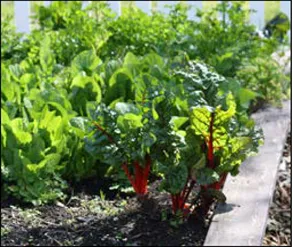
If some of your crops have short growing seasons, you may want to plant more of the same or different crops after harvesting the first.
Vegetables grown from seed will take 4 to 6 weeks longer to mature than those grown from transplants. If you grow your own transplants from seed, start them four to six weeks before the desired planting date.
To discourage soilborne pests, avoid planting the same crop, or crops from the same plant family, in the same place two years in a row. For example, a four-year rotation could include tomatoes, corn, legumes, and squash.
When planting perennials, locate them where they won’t be disturbed by the more frequent cultivation, harvesting, and replanting required by annual vegetables.
Plant vegetables to best utilize available space. If you have little space, use varieties that don’t become as large as others, or select varieties that can be grown vertically on trellises.
Vegetable Families
(Adapted from George Pessin -- 5/06)
| Botanical Family | Common Name | Edible Members |
|---|---|---|
| Alliaceae* | Allium or Onion Family | chives, garlic, leeks, onions, shallots |
| Amaranthaceae or Chenopodiaceae * | Amaranth or Beet family | amaranth, beet, chard, epazote, quinoa, spinach |
| Apiaceae or Umbelliferae* | Carrot or Dill family | angelica, anise, caraway, carrot, celery, chervil, cilantro, cumin, dill, fennel, lovage, parsley, parsnip |
| Asteraceae or Compositae* | Aster, Daisy, or Sunflower family | artichoke, chicory, cardoon, endive, escarole, jerusalem artichoke, lettuce, radicchio, shungiku, (sunflower) |
| Brassicaceae or Cruciferae* | Brassica, Cabbage, or Mustard family | arugula, bok choy, broccoli, brussels sprouts, cabbage, cauliflower, kale, kohlrabi, mizuna, mustard, radish, rapini, rutabaga, tat soi, turnip |
| Cucurbitaceae | Cucumber, Gourd, Melon, or Pumpkin family | Pumpkin family chayote, cucumber, melon, pumpkin, squash, watermelon |
| Fabaceae or Leguminosae* | Legume Family | (beans), fava beans, lentils, peas, peanuts, and soybeans |
| Lamiaceae* | Mint Family | (basil), marjoram, mint, oregano, rosemary, sage, thyme |
| Poaceae or Gramineae | Grass Family | bamboo, barley, corn, rice, rye, sugarcane, wheat |
| Solanaceae | Nightshade, Potato or Tomato Family | eggplant, pepper, (potato), tomato |
*Cool weather crop (can be grown through the winter in California) (Italics) are contrary to the rule
Recommended Vegetable Planting Dates for California
| Vegetable | North / North Coast | South Coast | Interior Valleys | Desert Valleys | Crop Type | Amount to plant for 4 people |
|---|---|---|---|---|---|---|
| Beans, snap1,2 | Jul; May-Jun | Mar-Aug | Apr-May; Jul Aug | Jan-Mar; Aug | Warm Season | 15-25 ft. row |
| Beets 1,2 | Feb-Aug | Jan-Sep | Feb-Apr, Aug | Sep-Jan | Cool Season | 10-15 ft. row |
| Broccoli 2,3 | Feb-Apr; Aug-Sep | Jun-Jul; Jan Feb | Dec-Feb; Jul | Sep | Cool Season | 6-100 ft. row |
| Cantaloupes, Other melons | May | Apr-May | Apr-Jun | Jan-Apr, Jul | Warm Season | 5-10 hills |
| Carrots 1,2 | Jan-May; Jul Aug | Jan-Sep | Aug-Sep; Feb-Apr | Sep-Dec | Cool Season | 10-25 ft. row |
| Chard 1 | Feb-May; Aug | Feb-May | Feb; Aug | Sep-Oct | Cool Season | 3-4 plants |
| Chives 1 | Apr | Feb-Apr | Feb-Mar | Sep-Feb | Cool Season | 1 clump |
| Corn, Sweet 2 | May-Jul | Mar-Jul | Mar-Jul | Feb-Mar | Warm Season | 20-30 ft. |
| Cucumbers | Apr-Jun | Apr-Jun | Apr-Jun | Feb-May | Warm Season | 6 plants |
| Eggplant 1,3 | May | Apr-May | Apr-May | Feb-Apr | Warm Season | 4-6 plants |
| Garlic 1 | Oct-Dec | Oct-Dec | Oct-Dec | Sep-Nov | Cool Season | 10-20 ft. row |
| Lettuce 1,2 | Feb-Aug | Aug-Apr | Aug; Nov-Mar | Sep-Dec | Cool Season | 10-15 ft row or 5 ft row each month |
| Okra | May | Apr-May | May | Mar | Warm Season | 10-20 ft. row |
| Onions 1,4 (bulb) | Jan-Mar | Feb-Mar | Nov-Mar | Oct-Nov | Cool Season | 30-40 ft. row |
| Onions 1,2,3 (green) | Apr-Jul | All year | Aug-Dec | Sep-Jan | Cool Season | N/A |
| Peas 1,2 | Jan-Apr; Sep Oct | Aug; Dec Mar | Sep-Jan | Sep-Oct | Cool Season | 30-40 ft row |
| Peppers 1,3 | May | Apr-May | May | Mar | Warm Season | 5-10 plants |
| Potatoes, sweet 3 | May | Apr-May | Apr-Jun | Feb-Jun | Warm Season | 50-100 ft. row |
| Potatoes, white | Early: Feb Late: Apr-May | Feb-May; Jun-Aug | Feb-Mar; Aug | Dec-Feb | Warm Season | 50-100 ft. row |
| Pumpkins | May | May-Jun | Apr-Jun | Mar-Jul | Warm Season | 1-3 plants |
| Radish 1,2 | All year | All year | Sep-Apr | Oct-Mar | Cool Season | 4 ft. row |
| Spinach 1 | Aug-Feb | Aug-Mar | Sep-Jan | Sep-Nov | Cool Season | 10-20 ft. row |
| Squash, Summer 1 | May-Jul | Apr-Jun | Apr-Jun | Feb-Mar | Warm Season | 2-4 plants |
| Squash, Winter 1 | May | Apr-Jun | Apr-Jun | Feb-Mar; Aug | Warm Season | 2-4 plants |
| Tomatoes 1,3 | May | Apr-Jul 15 | Apr-May | Dec-Mar | Warm Season | 6-10 plants (if processing) |
| Turnips 1 | Jan; Aug | Jan; Aug-Oct | Feb, Aug | Oct-Feb | Cool Season | 10-15 ft. row |
| Watermelons | May-Jun | Apr-Jun | Apr-Jun | Jan-Mar | Warm Season | 6 plants |
Adapted from: California Master Gardener Handbook, Home Vegetable Gardening; Dennis Pittenger, editor.
Region Definitions
- North and North Coast = Monterey County north
- South Coast = San Luis Obispo County south
- Interior Valleys = Sacramento, San Joaquin, and similar valleys
- Desert Valleys = Imperial, Coachella valleys
Planting dates are only approximate, as the climate may vary even in small regions of the state. Contact your local Master Gardeners and experiment on your own to find more precise dates.
Footnotes
1. This crop is suitable for a small garden if compact varieties are grown.
2. In a suitable climate, these crops can be planted more than once per year for a continuous harvest.
3. Transplants may be used for planting.
4. Onion varieties are daylight dependent. Short-day and intermediate-day varieties are autumn planted. Long-day varieties are planted in spring.
Previous ← Chapters → Next or Return to the Table of Contents of this Handbook.