
Looking beyond the Rain
In December of 2022, the heavens opened up and spilled forth their bounty of liquid gold (rainfall), ending the latest drought that spanned from 2020 to 2022 in California. Water restrictions were scaled back in March of 2023, and the drought was officially declared as being over in October of that year. Fortunately, we’ve received a respectable amount of rain in the three years since.
So, you might ask, why should we care about conserving water now? Why are the water districts still strongly encouraging us to cut back? Why are we seeing a robust slate of offerings in their landscape water efficiency rebate programs?
This article is part one of a two-part series that first talks about why we should care about water conservation. Then in the second part, we’ll offer simple and innovative strategies to not only conserve water, but also help your wallet stay nice and full.
Let’s look at two traditional (and convincing) reasons for caring very much about conserving water.
Reason #1: Drought
Each year, there is a finite amount of water available to us during the dry season. Local and mountain reservoirs fill with water during the rainy months of November through April. And the Sierra Nevada normally receives a snowpack that slowly melts and fills the reservoirs, acting as a delayed water-delivery system during the dry months of May through October.
But this pattern is often interrupted by too little rainfall or a snowpack that is meager or melts too early. This results in a reduced water supply for that year. And water restrictions that come with drought make it hard for the plants in our landscapes to survive, much less thrive. The customary drought restriction is to limit outdoor watering to two days per week. And unless you have either an established native-plant or low-water-plant landscape, two days per week is just not enough to keep the plants in a healthy state through the hottest parts of the dry season. If you’re growing crops and need to start with seeds or seedlings, this does not work at all.
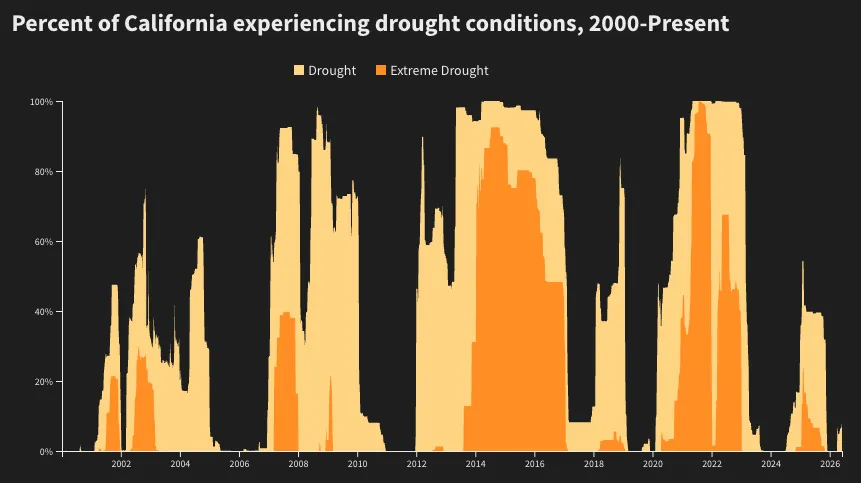
How often does drought happen in California? The graphic below shows how prevalent drought has been in this century. So, given that the state is experiencing drought more often than it’s not, it follows that we should prepare ourselves and our landscapes for the next drought, which might be closer than you think. The snowpack this year was disappointing. The traditional annual April 1 measurement at Phillips Station south of Lake Tahoe found no measurable snow. The California Department of Water Resources (DWR) reports that the state’s major reservoirs are “flirting with capacity,” but the required snowpack is non-existent. This alone should be a compelling enough reason to care about water conservation, and to actively engage in it.
Source: https://www.drought.gov/states/california
Reason #2: The rising cost of water
Like so many other commodities and services, the tide of water cost is rising. For East Bay Municipal Utility District (EBMUD), one of the two major water districts serving Contra Costa County, the average water rate increase has been 6.5% annually over the past five years. The other major water district serving the county is Contra Costa Water District (CCWD). This water district calculates its rate increases on a per-day basis, averaging $75 per year for the past five years. Both water providers are having to raise their rates to offset inflation, rising operational costs, and the need to upgrade aging infrastructure.
Please remember that we pay for the potable water supply entering our homes and the used water leaving, as well. It is assumed that all water consumed at a residential property is leaving the home via the sewer system. Thus, we are charged for the water that enters the wastewater system, which then undergoes treatment to disinfect it. The treated water is then released into various waterways, including the San Francisco Bay, Suisun Bay, San Pablo Bay, Peyton Slough, and the Carquinez Strait, depending on which sanitation district processes it. Some of this treated water is used as recycled water for landscaping and industrial processes.
If your water provider also provides wastewater services, the sewer charges will be on the water bill and be charged on a per-unit basis, like the incoming potable water. If your wastewater service is a company other than the water district, it will likely be billed as a fixed-fee line item on your property tax bill. It should be noted that costs for wastewater services are rising also. A sampling of rate increases over four of the wastewater providers in Contra Costa County showed that the cost of these services went up an average of 5.3% per year for the past five years.
In this article, you have been presented with two good reasons to care about conserving water. So, maybe you’ve always been intent on doing the right thing. Or perhaps you feel it’s smart to prepare for the next drought so that your outdoor environment handles the water restrictions smoothly. Or maybe you’re motivated by the prospect of lowering those water bills while at the same time enjoying a healthy and robust garden. Our hope is that you not only care but also feel inspired to take action with some simple (and hopefully fun) strategies to conserve water. Please move on to part two of this two-part series. We’ll “see” you there.