
By Jeanette Alosi.
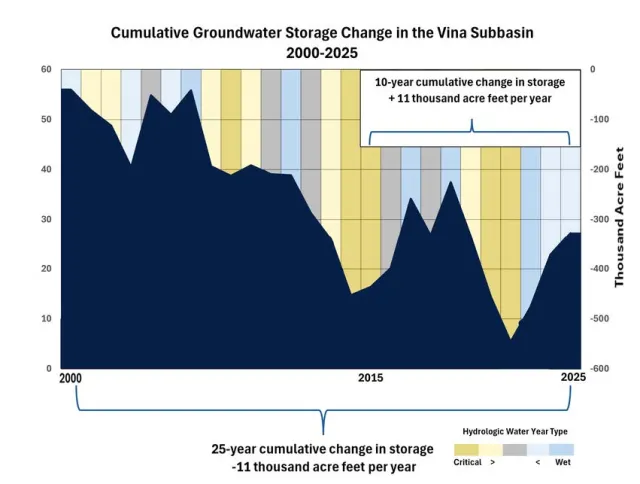
In 2014, the California legislature passed the Sustainability Groundwater Management Act (SGMA). The goal of SGMA is to ensure groundwater sustainability over the long term. Groundwater is crucial to California, comprising up to 60% of the total supply in drought years and about 40% in average years. Our local groundwater fluctuates annually, with groundwater levels declining during droughts and increasing during wet years. However, in the last 30 years we have had more dry years and fewer wet years; therefore the long-term trend is a steady decline.
Before getting into the intricacies and alphabet soup of SGMA, what exactly is groundwater and why should we care?
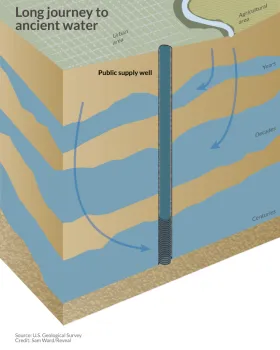
What is Groundwater? Groundwater is the water stored underground as opposed to surface water found in rivers, lakes, and streams. Groundwater fills the underground spaces between rocks, sand, and sediments. An extensive permeable layer of rock, sand, and sediment that stores and transmits groundwater is called an aquifer. Locally, the Tuscan Aquifer lies beneath us in the Northern Sacramento Valley; it took thousands of years to accumulate and is a valuable resource with greater utilization during drought periods. Currently, we are pumping out more groundwater than is being replenished. Groundwater is crucial for agriculture and our economy, and about 33 million Californians rely on it for a portion of their drinking water and household use. Six million Californians living in rural areas rely solely on groundwater including most residents in our local area.
SGMA’s primary goal is to achieve long-term groundwater sustainability. This could be accomplished by reducing pumping and groundwater demand, and/or increasing groundwater recharge.
SGMA Agencies and Plans. To achieve sustainability, SGMA required the creation of local Groundwater Sustainability Agencies (GSAs). These agencies were required to develop Groundwater Sustainability Plans (GSPs) to achieve groundwater basin sustainability. In addition, a Stakeholder Advisory Committee (SHAC) and the Butte County Department of Water & Resource Conservation provide technical assistance and make recommendations to the GSA boards. The California Department of Water Resources (DWR) oversees compliance and reviews all the groundwater sustainability plans. With review, DWR can direct “recommended corrective actions” to a GSP.
SGMA requires the interest of all stakeholders and beneficial users of groundwater to be considered in the plans. Stakeholders include agricultural, domestic well users, municipal uses, environmental uses such as groundwater dependent ecosystems (GDEs), users of interconnected surface water, federal and state agencies, California Native American tribes, and disadvantaged communities. (Wat. Code, § 10723.2).
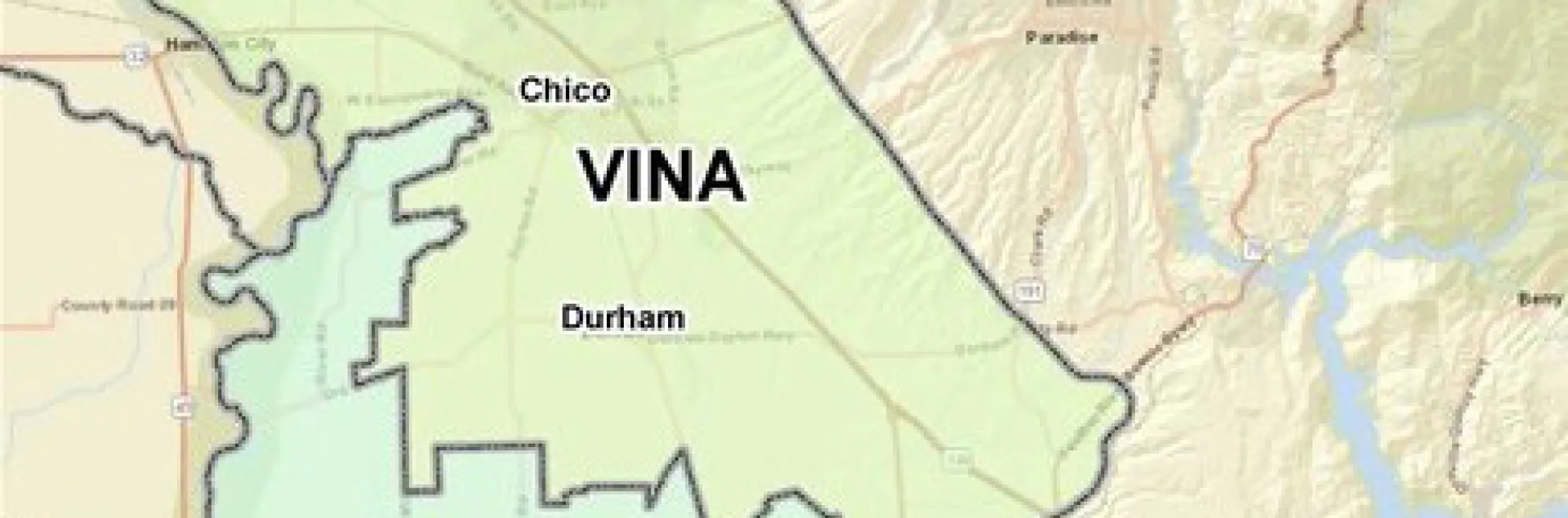
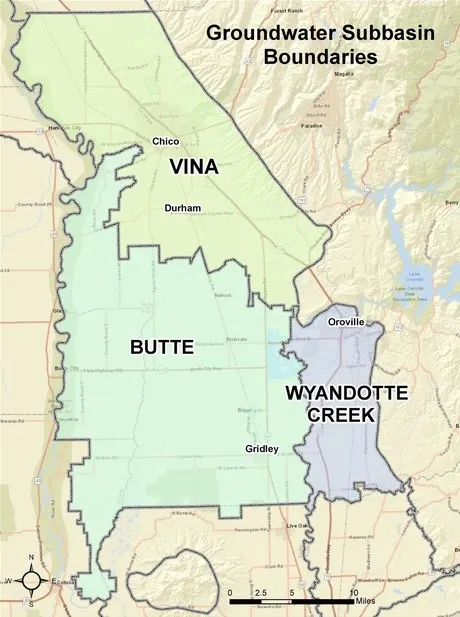
Subbasins. Locally, there are 3 subbasins: Vina, Butte and Wyandotte Creek. Each subbasin has its own GSA and plan to achieve sustainability. This article will mainly focus on the Vina subbasin which underlies Durham, Chico and Northern Butte County.
Vina Subbasin Facts
- 85-91% of the total water supply in the subbasin relies on groundwater. In 2025, that figure was 91%.
- 234,000 acre feet is the estimated annual sustainable yield of the subbasin (one acre foot is roughly the annual amount of water used by 2 families of 4 in Butte County).
- 90% is used by agriculture; 10% is used by municipal and domestic users.
- Over 4,200 domestic wells have been drilled in the subbasin, according to DWR records.
- Annually, there is an estimated deficit of 20,000 acre feet due to dry years and pumping beyond the sustainable yield (data from 2000-2018).
Undesirable Results Must be Avoided
Each GSP must address 6 "undesirable results" defined by SGMA:
- Chronic lowering of groundwater levels.
- Reduction of groundwater storage.
- Seawater intrusion (not a concern in our area).
- Degraded water quality.
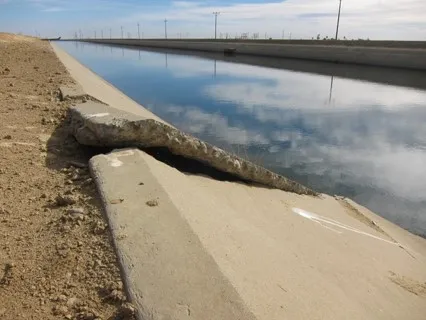
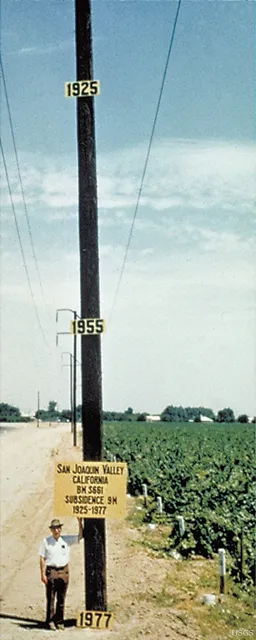
- Land subsidence (lowering groundwater levels can cause aquifers to compress, which can cause land surface sinking, potentially damaging infrastructure).
- Water quality degradation.
- Depletions of interconnected surface water (rivers and streams) potentially harming wildlife habitats or beneficial users.
Measurable Objectives and Minimum Thresholds. To prevent these undesirable results, subbasins have Measurable Objectives (MOs) or the sustainability goal for the subbasin. For example, the Vina subbasin’s MOs are primarily based on historical lows. During past historic lows (2021-2022), some domestic wells did fail in my own Chico neighborhood and in the Durham area. The Vina GSP also specifies Minimum Thresholds (MTs), the lowest groundwater level allowed before restrictions are triggered. The Vina subbasin’s MTs are on average 63 feet lower than the MO or sustainability goal, and lower than adjacent subbasins. If groundwater levels reach the MTs, the previous GSP estimated that 24% to 32% of domestic wells would be at risk of going dry.
To measure groundwater levels, there is a network of monitoring wells in the Vina subbasin. These wells have shown a “declining trend of the past 21 years” according to the 2025 “Annual Status of the Vina Subbasin” report.
Plan Update. The first Vina GSP was submitted in January 2022, and is currently being updated for a January 2027 submission.
Although the 2022 Vina GSP was approved by DWR, they included the following recommended corrective actions:
- Consider how dry year declines could be offset by managing reduced pumping and increased recharge in other years.
- Consider the impact of the low MT levels on domestic wells, water system, environmental and other beneficial users.
- Evaluate the effect of groundwater MT levels on sustainability indicators (groundwater storage and interconnected surface water).
DWR also conveyed that any risk assessment for domestic wells should consider all “working” wells and not apply an arbitrary cutoff date of 1980, as had been done in the 2022 plan.
For More Information. Upcoming Vina GSA meetings are on November 4 and December 2. Visit the Vina GSA website for information on upcoming meetings. We all have a stake in our local groundwater. Public comments are strongly encouraged by October 26, 2026 for consideration in the 2027 Vina plan update.
UC Master Gardeners of Butte County are part of the University of California Cooperative Extension (UCCE) system. To learn more about us and our upcoming events, and for help with gardening in our area visit the UC Master Gardener website. If you have a gardening question or problem, email the Hotline at mgbutte@ucanr.edu or leave a phone message on our Hotline at 530-552-5812. To speak to a Master Gardener about a gardening issue, or to drop by the MG office during Hotline hours, see the most current information on our Ask Us section of our website.