
UC Davis doctoral candidate and mosquito researcher Carla-Cristina “CC” de Melo Edwards, a first-generation graduate student, makes the Energizer Bunny look like a slow-poke. Or a lethargic turtle. Or that creature that doesn't stir on Christmas Eve.
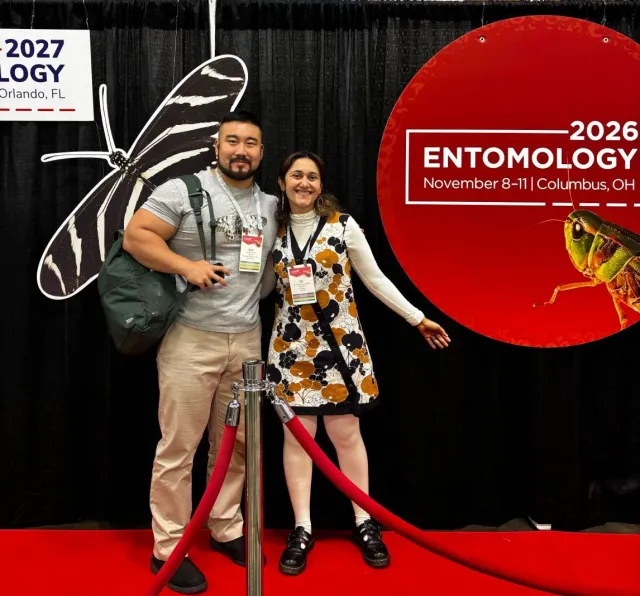
CC just returned from the 74th annual Entomological Society of America meeting, held Nov. 8-11 in Columbus, Ohio, with two major awards and scores of memories.
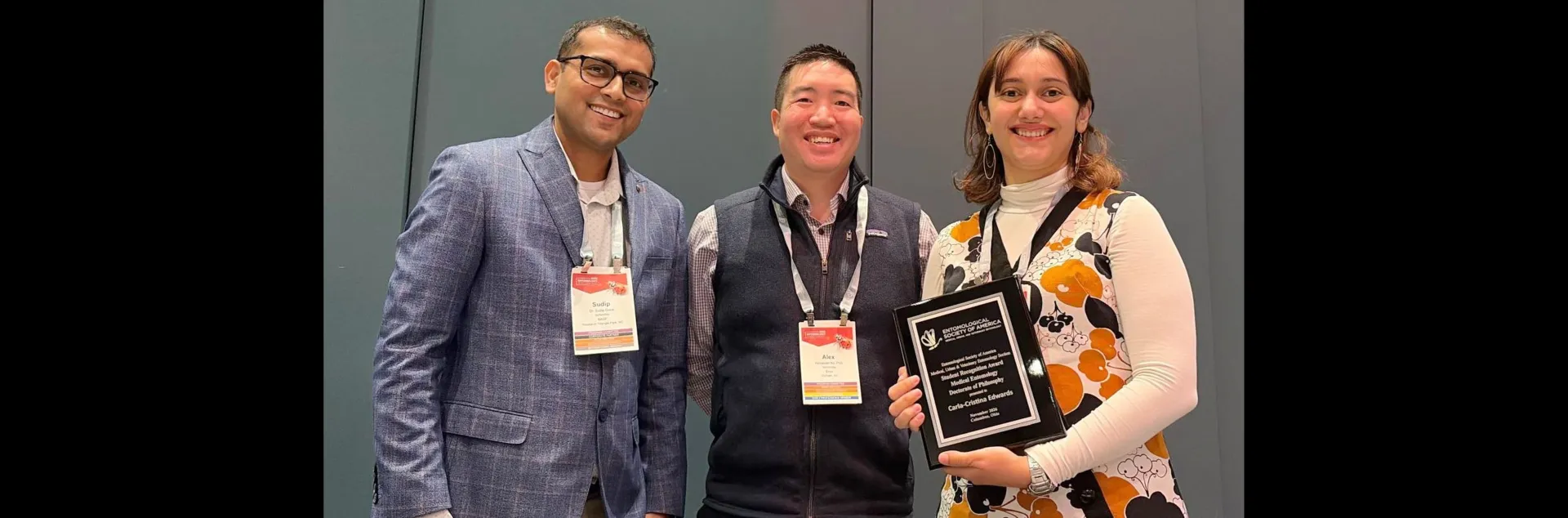
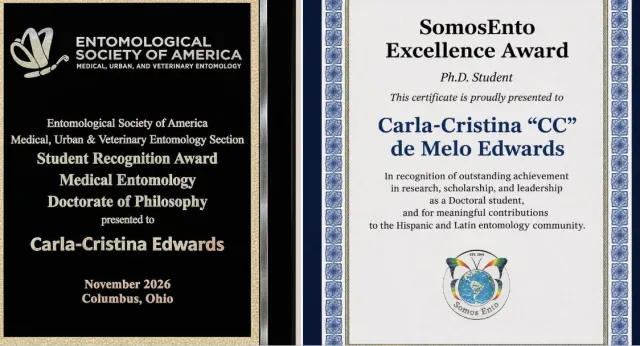
CC, who studies with medical entomologist-geneticist Geoffrey Attardo, UC Davis Department of Entomology and Nematology, received the 2026 Medical, Urban, and Veterinary Entomology (MUVE) Student Recognition Award in Medical Entomology for a PhD Student and the SomosEnto Latin/Hispanic Community at ESA Doctoral Student Excellence Award.
"I am incredibly honored and grateful," she said.
At the conference, themed "Connect Your Science, Expand Your Net," CC shared her research findings with a poster on "Seeing Resistance in a New Light: Using Raman Spectroscopy to Detect Insecticide resistance in Aedes aegypti" in the MUVE graduate poster competition.
She also co-organized a three-hour symposium on "From Vectors to Voices: Communicating Medical Entomology for Public Health Impact," with five friends and colleagues Jennifer Mora of Rutgers University/Central Life Sciences; Zackary Sieb, Monmouth County Office of Mosquito Control; Stephanie Zapata, Rutgers University; Dhivya Rajamanickam, PhD, Baylor University; and Drew Lysaker, The Pennsylvania State University.
"Vectors, vector-borne diseases, misinformation, and distrust of science are all on the rise across the country," the organizers pointed out. "With these combined factors, communication of medical entomology research is crucial." Speakers discussed their medical entomology research and related how they communicate their findings "to share the overall broader public health impact." Topics included integrated mosquito management plan at the Jacksonville Zoo, communicating the expansion of ticks and tick-borne diseases, prevention of lyme disease in rural communities, Cooperative Extension and vector-borne diseases, building trust through vector-borne disease, and using medical geography to strenghten public communication on vector-borne disease risks.
CC commented that another highlight was reconnecting with her undergraduate research advisor, Jason Pitts of Baylor University. "It was being a McNair Scholar in his lab as an undergrad that got me interested in entomology and going to grad school. Such a wonderful full-circle moment!"
She holds a bachelor's degree in biology, with a concentration in cell and molecular biology, from Baylor University in 2021. Her undergraduate research involved the sensory and oviposition responses of Aedes aegypti in relation to the compound geosmin. Then she pursued and received her master's degree in biology in 2023 from Texas Tech University, Lubbock, where she focused on medical entomology and vector biology. She investigated the effects of microplastics in relation to Aedes aegypti and Aedes albopictus (the Asian tiger mosquito.
CC is projected to receive her doctorate from UC Davis in 2027. She investigates the physiological mechanisms underlying pyrethroid resistance in Aedes aegypti (the yellow fever mosquito).
Highly recognized for her research, public service and creativity, CC was recently awarded a 2026–2027 Sagehen Research Grant for her project, “Evaluation of Raman Spectroscopy for Characterizing Insecticide-Associated Biochemical Variation in California Mosquito Populations Using UC Natural Reserve Sites.” The project uses Raman spectroscopy to investigate biochemical variation associated with insecticide exposure and resistance in California mosquito populations.
Earlier this year, CC won a $1000 prize from the UC Davis Institute for Innovation and Entrepreneurship’s “Little Bang! Pitch Plus Poster Competition" for her innovative business plan to produce and market a mosquito spray as a cosmetic product. (See news story)
CC' swork is widely recognized and supported with fellowships, awards, scholarships and grants. She received the 2023-25 UC Davis Eugene-Cota Robles Fellowship Award; the 2024-25 CDC-Pac Vec Graduate Fellowship Award from the Centers for Disease Control and Prevention/Pacific Southwest Center of Excellence in Vector-Borne Diseases; and she received the UC Davis William Hazeltine Research Award for three consecutive years (2024-2025, 2025-2026 and 2026-2027). Hazeltine (926-1994), an ardent supporter of the judicious use of public health pesticides to protect public health, managed the Butte County Mosquito Abatement District, Oroville, from 1966 to 1992, and the Lake County Mosquito Abatement District from 1961-1964.
Active in both the ESA and the American Mosquito Control Association (AMCA), CC chairs the AMCA’s Young Professionals, comprised of more than 500 young mosquito control professionals throughout the nation.
At UC Davis, she is the newly elected president of the Scholars of Color+ Alliance (SOCA) as of April. "We are having our graduate symposium coming up in September!" she commented.
CC earlier served as vice president of the Entomology Graduate Student Association and as High School Outreach Chair for the UC Davis Society for the Advancement of Chicanos (SACNAS) Graduate/Postdoctorate Chapter.
She continues to volunteer at the Bohart Museum of Entomology open houses, UC Davis Picnic Day and UC Davis Biodiversity Museum Day.
Those are just a few of her projects and accomplishments.
Bottom line: CC makes the Energizer Bunny look like a slow poke.
Cover image:
UC Davis doctoral candidate CC Edwards receives the 2026 Medical, Urban, and Veterinary Entomology (MUVE) Student Recognition Award in Medical Entomology for a PhD Student at the Entomological Society of America annual meeting, held Nov. 8-11 in Columbus, Ohio. With her are Sudip Gaire (far left) of BASF, incoming MUVE president, and Alex Ko of ENVU, outgoing MUVE president.