This planting guide covers the county coastal and inland regions.
By Vincent Lazaneo, Farm Advisor Emeritus, UC Cooperative Extension 2026
This guide is adapted from a publication by UC Farm Advisors Daniel Close and Bernard Hall. The planting dates reflect agricultural practices during the 1950's, 1960's and 1970's. Average temperatures are warmer now due to climate change but the guide is still a helpful tool for gardeners.
Most Vegetables Fall into Two Groups
Cool Season Crops
(Fall - Winter Planting)
They grow best when average temperatures are 55-75°F and usually tolerate slight frost when mature. Food value is generally higher per pound than in warm season crops.
We eat a vegetable part of a plant
- Root – carrot, parsnip, beet, radish, turnip
- Stem – Kohlrabi, white potato
- Leaf – spinach, lettuce, celery, asparagus, cabbage, onion
- Immature flower parts – cauliflower, sprouting broccoli, globe artichoke
Characteristics and Storage
- Planting time should allow the crop to mature during the cool season.
- Root depth is shallow to medium.
- Storage is at a cooler temperature and for a longer period than for warm season crops.
- Store at 32°-42° F, except white potatoes (50°-60°F).
Warm Season Crops
(Spring - Summer Planting)
They grow best when average temperatures are 65-95°F and they are intolerant to prolonged freezing temperatures. Food value is generally lower per pound than in cool season crops.
We eat the fruit of the plant
- Mature fruit – tomato, watermelon, cantaloupe, winter squash
- Immature fruit – summer squash, cucumber, snap and lima beans, sweet corn
Characteristics and Storage
- Planting and harvesting time should be in the warm season.
- Root depth is medium to deep.
- Storage is at a warmer temperature and shorter period than for cool season crops.
- Store tomatoes, garlic, onions, and unripe melons at room temperature away from direct sunlight.
- Store peppers, cucumbers, ripe melons, snap beans, summer squash at 45°-55°F
Plant vegetables in San Diego based on whether they are a warm or cool season crop.
Note: Two exceptions to the above classifications are peas (a fruit, yet a cool season crop) and sweet potatoes (a root and warm season crop).
Recommended Planting Dates
| Warm Season Crop | Coastal (Region 1 & 2) | Inland |
|---|---|---|
| Beans, Snap | Mid Mar - Aug | Apr - Mid Aug |
| Beans, Lima | Mid Apr - Jul | Mid Apr - Jul |
| Cantaloupe | Apr - Jun | Apr - Jun |
| Corn, Sweet | Mid Mar - Jul | Apr - Jul |
| Cucumbers | Mid Mar - Jul | Apr - Jul |
| Eggplant (plants) | Apr - Jun | Apr - Jun |
| Melons (Casaba, etc) | Apr - Jun | Apr - Jun |
| Okra | Apr - Jun | Apr - Jun |
| Pepper (plants) | Apr - Jul | Apr - Jun |
| Squash, summer | Mid Mar - Aug | Apr - Jul |
| Squash, winter | Apr - Jun | Apr - Jun |
| Sweet Potato (plants) | Apr - Jun | May - Jun |
| Tomato (plants) | Mar - Jul | Apr - Jun |
| Watermelons | Apr - Jun | Apr - Jun |
| Cool Season Crop | Coastal | Inland |
|---|---|---|
| Beets | Sept - May | Sept - Mid Apr |
| Broccoli (plants) | Sept - Feb | Sept - Feb |
| Broccoli (seeds) | Aug - Dec | Aug - Oct |
| Cabbage (plants) | Sept - Feb | Sept - Feb |
| Cabbage (seeds) | Aug - Dec | Aug - Oct |
| Carrots | Sept - Apr | Sept - Mar |
| Cauliflower (plants) | Sept - Feb | Sept - Feb |
| Cauliflower (seeds) | Aug - Dec | Aug - Oct |
| Chard | Sept - Jun | Sept - Apr |
| Endive | Sept - May | Sept - Apr |
| Kale | Sept - Apr | Sept - Apr |
| Kohlrabi | Sept - Mar | Sept - Mar |
| Head Lettuce | Sept - Mar | Sept - Feb |
| Leaf Lettuce | Sept - Apr | Sept - Mar |
| Onion (bulb) Short Day | Oct - Dec | Mid Oct - Dec |
| Onion (bulb) Medium Day | Jan - Feb | Jan - Feb |
| Onion (green) | Sept - May | Sept - Apr |
| Peas | Sept - Mar | Jan - Mar |
| Potatoes (Irish) | Feb - Mar, Mid Aug - Sept | Mid Feb - Apr, Mid Aug - Sept |
| Radish | Sept - May | Sept - Mar |
| Spinach | Sept - Apr | Sept - Mar |
| Turnips | Sept - May | Mid Sept - Apr |
Timing Your Vegetable Garden
Planting periods for some common cool and warm season vegetables are given for a year having average weather conditions. The beginning and end of a planting period can vary by several weeks from year to year. Gardeners need to exercise more judgment when planting early or late in the season. Suitable planting dates are dictated to a large extent by the amount of time a vegetable takes to grow from seed to a harvestable size and by the vegetable’s climatic requirements. Seed catalogs give the number of days required from seed to harvest under optimum growing conditions. The cold tolerance of some vegetables is listed below as a guide for early planting.
Hardy Vegetables: This group includes: cabbage plants (which have been well hardened), kale, kohlrabi, brussel sprouts, spinach, turnip, radish, asparagus, rhubarb and onion (from sets). These vegetables are not injured by light frosts and the seed will germinate at a rather low temperature.
Half-Hardy Vegetables: This group includes: lettuce, beet, carrot, chard, parsley, parsnip, heading broccoli, early potatoes, onion (from seed), garden peas, celery plants, and cauliflower plants. The seeds of these vegetables will germinate at rather low temperatures, but the young plants are injured by frost.
Tender Vegetables: This group includes: snap bean, tomato, sweet corn, and sweet potato. These vegetables are injured by the lightest frost and do not thrive at a low temperature even when frost does not occur. They should not be planted until all danger of frost is past.
Very Tender Vegetables: This group includes: eggplant, pepper, cucumber, watermelon, muskmelon, lima bean, squash, and pumpkin. These vegetables do not thrive until the soil has become warm. The seed will rot if the soil is not warm.
Bioclimate Region
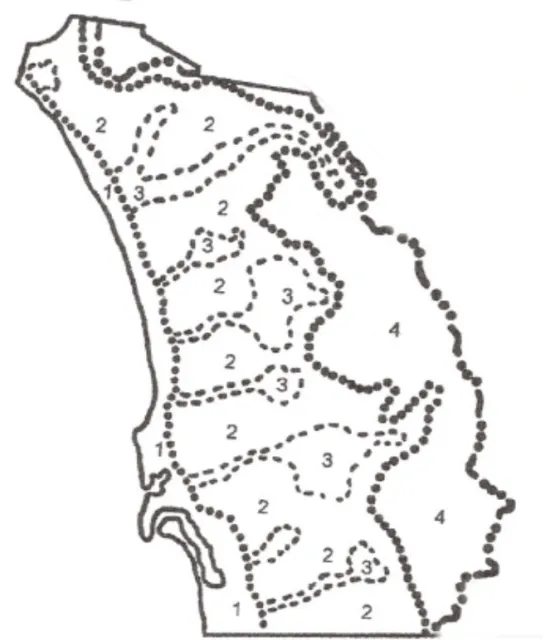
San Diego County
Bioclimates are complexities of weather that differ from each other in some characteristic of importance to plants and animals. Subdivisions of California’s bioclimates are named for the geographic areas with which they are most closely associated. These names are used to designate the agricultural areas of the state.
Approximate Area = Sea Level to 2000’ Elevation Contour
(Description of image: A black and white map of San Diego County. It shows a thin region 1 along the coast, running north to south, a wide region 2 in the center running north to south, some outlined pockets running west to east in the center labeled region 3, and a medium sized outlined area labeled region 4 on the east boundary of the map.)
| Region | Subdivision | |
|---|---|---|
| 1 | Coastal | Maritime |
| 2 | Inland | Hill and Mesa |
| 3 | Inland | Valley and Canyon |
| 4 | Inland | High Elevation |