
California's Path towards Sustainable Water Use
We all need water to survive. And we are so fortunate to be living in an urban setting where we have instant access to a clean supply of this precious resource. It always feels like a miracle to me that in Contra Costa County, the water that we consume during the dry season most likely traveled hundreds of miles from the Sierra Nevada to get to our tap.
In this state, there is a strong push for “Making Water Conservation a California Way of Life.” In fact, Governor Jerry Brown issued an executive order with that exact name in April of 2016. That proclamation spurred the creation of AB-1668 and SB-606, which were signed into law in 2018. These brought about a water conservation framework that will have us reducing our water use throughout the state until the final date of July 1, 2040. You can find more information about this regulation in the resources at the end of this article.
This article is Part Two of a two-part series in this newsletter. In the first article, named “Why We Should Care About Water Conservation,” two good reasons were provided for taking action to reduce our water use. The water conservation framework mentioned above didn’t appear as one of those reasons. This is because the framework does not directly affect you and me.
The primary entities that must comply with AB-1668 and SB-606 are urban water suppliers, agricultural water suppliers, and small water suppliers. Regional water budgets have been issued to all of these water suppliers. Even though we are not being regulated directly, we will experience adjustments in policy, tiered pricing, and enhanced rebate programs that will directly affect us, as our water providers navigate compliance with the laws.
The good news
You might ask how there can be good news. So far, in these two articles, we’re highlighting drought, rising prices for potable water and wastewater services, and two state laws that are mandating water districts to comply with community water budgets that will get increasingly tighter over time.
The reality of all of this is that there has never been a better time to get assistance from our water districts. They are literally paying us to take actions that will have an immediate and lasting positive effect on not only the quantity of water we consume but also the health and well-being of our gardens. They are bending over backwards to give us access to state-of-the-art technology for both indoor and outdoor water systems.
So, let’s jump into those simple strategies. We’ll start with the water districts.
EBMUD and CCWD
East Bay Municipal Utility District (EBMUD) and Contra Costa Water District (CCWD) are the two major water providers in Contra Costa County. In fact, together they serve 86% of the total population in Contra Costa County. Their offerings of information and assistance are so abundant that you’ll need to set aside a good block of time (at least an hour) to sift through the treasure troves they have waiting for you to peruse. If you do not have either of these water districts as your provider, please do go to the website of your water provider and look around at all the goodies they offer their customers. Most likely you won’t be disappointed.
Strategy #1: Sign up for “My Water Report”
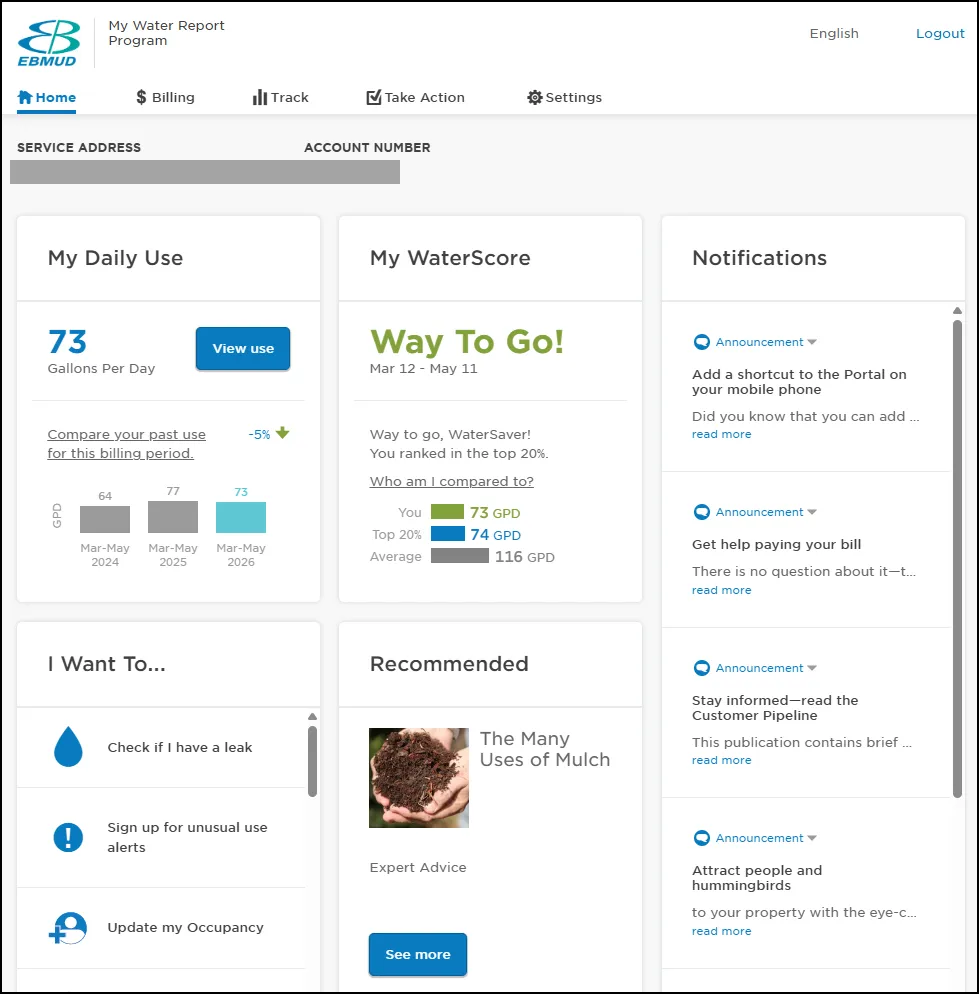
EBMUD and CCWD both contract with watersmart.com to bring you a portal that is literally an explosion of reporting tools and metrics that will blow your mind! It’s a free service that connects you to the absolute best and easiest way to practice water conservation like a pro. I couldn’t even begin to explain what goes on in there, but I can say for sure that it will enlighten you as to how you are doing with your water consumption and how you can improve it. And if you’re doing well, it acts as your own personal cheerleader! Below is a screenshot of a dashboard.
Strategy #2: Determine your indoor water use
This is a simple strategy for differentiating your indoor and outdoor water use. Your water meter measures all water use together. It doesn’t separate indoor use from outdoor use.
Knowing your average indoor water use is important because there are some targets for indoor consumption that you’ll want to try and achieve (or at least see where you stand). The “Making Water Conservation a California Way of Life” laws specify target numbers that kick in at different dates. The indoor water use standard is measured in gallons per capita (person) per day (GPCD). The standard was 55 GPCD until January 2025, when it changed to 47 GPCD. It will finally lower to 42 GPCD on January 1, 2030.
There is another important aspect to determining your indoor water use. Once you know what your customary indoor water use is, you can subtract that amount from any given month’s water use and know how much of that was used outdoors.
How to determine your indoor water use
- Gather your last 6 water bills if you’re billed every other month, and your last 12 bills if you’re billed monthly.
- Find the water bill with the lowest “gallons per day” reading. This will most likely be a winter month when it was raining, so your irrigation was likely turned off.
- Note the gallons per day number as your approximate indoor water use. Of course, if you were on vacation or out of town for any portion of that billing period, the reading will not be truly indicative of indoor water use. House guests will also throw this number off.
- To determine your GPCD, divide this gallons-per-day number by the number of people living in your house.
Strategy #3: Purchase a flowmeter
This strategy involves you putting out about $100. But one leak discovered by the flowmeter will make you celebrate your brilliant decision to buy this device. EBMUD and CCWD both have rebate programs for flowmeters. A flowmeter attaches to your water meter and, with a free mobile app, will keep you apprised of real-time water use. They’re great for detecting leaks both indoors and outdoors, and saving you loads of money when they find one and send you a notification. EBMUD currently has 13 brands to choose from, and CCWD offers only one brand (but it’s a good one). Highly recommended is a type of flowmeter that you can install yourself without cutting into house water pipes.
Strategy #4: Generate accurate irrigation schedules
Irrigation scheduling is a difficult skill to master. It requires knowledge that most people don’t have. One way to generate accurate irrigation schedules is to use a scheduling calculator with a user-friendly interface that can walk you through the scheduling process.
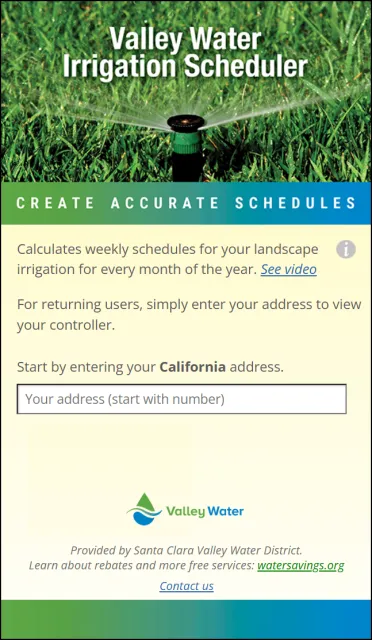
One such calculator is the free Valley Water Irrigation Scheduler. It is a web application that works well on any device. Developed by the Valley Water District in San Jose, it can be used by anybody living in California. It saves your watering schedule based on your property’s address without requiring a login or account.
https://www.valleywaterscheduler.com/
Strategy #5: Gamify your water use
This is a strategy that could be fun. The idea is to compete with yourself. And you can do it as a personal quest or a household one. Find a metric on either your water bill or your My Water Report pages that you would like to improve. It could be the number of gallons per day consumed, or the number of billed units for the whole billing period, or any other metric. Proclaim to yourself or others that you are challenging yourself to beat that number. It’s important to only compete in the same billing period. For example, my next water bill is in July. For July 2025, we averaged 72 gallons per day for our household. I proclaim that I will beat that number for the July 2026 water bill.
If you actually do achieve what you proclaimed, treat yourself to something nice. Go out to your favorite restaurant. Or buy new clothes. Do whatever you like to do when you want to acknowledge your awesomeness.
I hope I’ve provided at least one strategy in this article that pays off for you. I’d like to point out a general theme here that may not be obvious. Embedded in most of these strategies is a secret agenda. All of these strategies except for #4 were engineered to get you to engage with and get accustomed to numbers—amounts of water.
A huge failing of our modern American water delivery and billing systems is the fact that we don’t have the slightest idea HOW MUCH water we’re using when we turn on the tap to do anything. We only get billed for our water use every month or two. And when we get billed, the amount is in cryptic billing quantities called “units.” A unit represents either 748 cubic feet or 1,000 gallons, depending on what unit your water meter measures in.
Those massive amounts of water are of no use to me when I’m trying to decide how saving my shower warmup water and watering the rose bush behind the garage will benefit me. So, visiting my EBMUD “My Water Report” and cruising the statistics and the “Way to go!” pats on the back help me connect with and enjoy the little wins. I hope you start getting used to thinking in water-use numbers. And I hope you enjoy your little wins.
Resources
FAQs for Making Water Conservation a California Way of Life Regulation
https://www.waterboards.ca.gov/conservation/regs/docs/2025/conservation-reg-faq-08-25.pdf