
by Paige Weisskirch, UC Master Food Preserver Online Delivery Program Volunteer
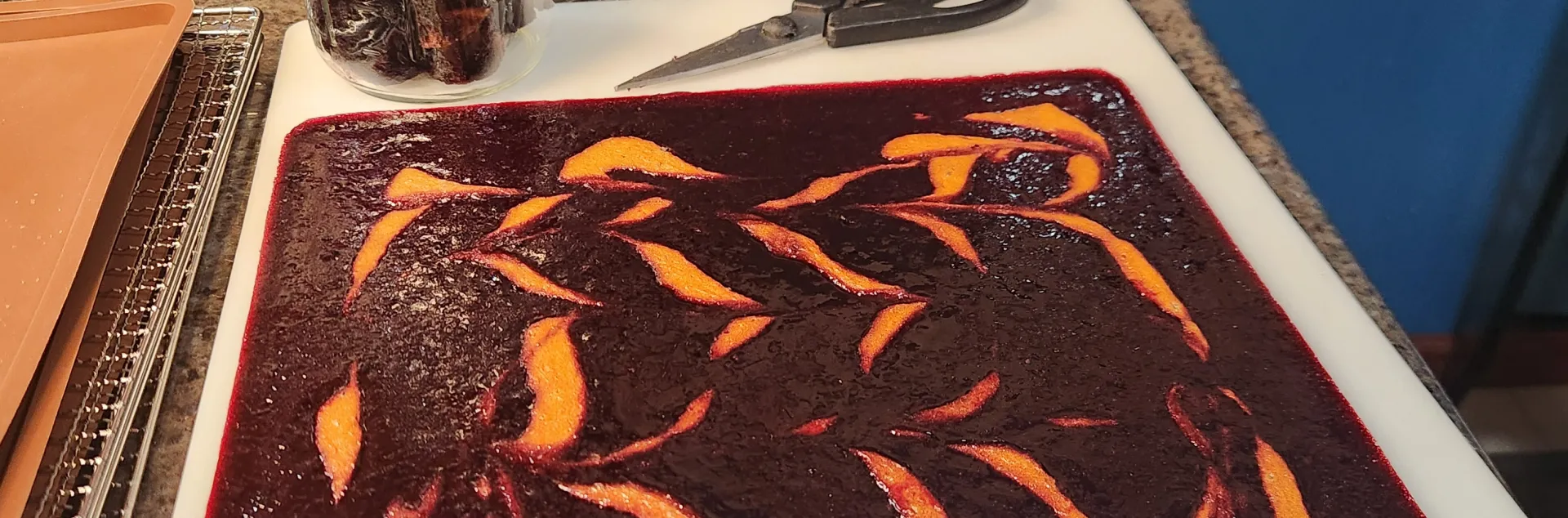
Fruit leather is one of my favorite ways to use up fruit that is just past its prime: soft pears, a handful of mushy berries, peaches that need to be used today, or the apples that have lost their crispness but still have plenty of flavor. I often throw the bits and bobs into a freezer bag, and when it looks like I have at least 2 cups' worth, into the blender it all goes. Recently, I found some frozen fruit from last summer that I needed to use up to make room for this season's haul. Making fruit leather means I make room in the freezer, and nothing goes to waste.
Homemade fruit leather also carries a bit of nostalgia for me. My grandmother lived in the San Fernando Valley and had several plum trees, and like many people of her generation, she could not stand to see food go to waste. Once, I watched her scoop a plum off the driveway after my grandfather had run it over with the car so she could feed it to her chickens. I'm pretty sure she would have tried to feed it to me if there had not been witnesses. Every summer, she took advantage of the hot California sun and made plum leather. She poured unsweetened fruit puree onto sheet pans, set them on her cinder block fence in the backyard, and covered them with old window screens. Sometimes the plum leather was perfect; just as often, it was too wet, too dry, or came with little bits of "nature" attached. I still ate it.
Fruit leather is still one of the most adaptable preservation methods, but today we have better tools and more reliable guidance. A dehydrator gives us more control than a backyard fence, and research-based recommendations from the National Center for Home Food Preservation (NCHFP) and University Extension programs like UCANR help us make fruit leather that is safe and reliable.
Texture starts with the fruit
The texture of fruit leather depends on the fruit itself, especially its natural pectin, sugar, and moisture content. Pectin is a naturally occurring carbohydrate found in plant cell walls that helps provide structure. Fruits such as apples, apricots, and pears tend to make smooth, flexible leathers. Lower-pectin fruits, such as strawberries, raspberries, cherries, and peaches, may make a thinner or more brittle leather when used on their own. One of the easiest ways to improve the texture of homemade fruit leather is to add applesauce. Apples are naturally rich in pectin, and applesauce adds body to the puree. A simple starting point is to combine 2 cups of unsweetened applesauce with 2 cups of fruit puree. This works especially well with berries and other softer or watery fruits. The applesauce helps the leather dry more evenly and makes the finished product easier to peel, roll, and store.
Sugar also affects texture, not just sweetness. Whether the sugar is naturally present in the fruit or added as sugar, honey, corn syrup, agave syrup, or maple syrup, it helps shape the final texture. Sugar binds some of the water in the puree, slowing moisture loss and helping keep the finished leather flexible rather than hard and brittle. It also contributes body, enhances flavor, helps balance tartness, and can support better color and texture during storage.
This is one reason overripe fruit often makes excellent fruit leather. As fruit ripens, some starches convert to sugars, acidity may mellow, and the fruit becomes softer and easier to puree. Those naturally occurring sugars become concentrated as the water is removed, giving fruit leather its intense fruit flavor and chewy texture. In other words, that slightly tired peach on the counter may be past its prime for slicing, but it may be just right for fruit leather.
Sweeteners and substitutes
Unlike jam and jelly, fruit leather does not rely on sugar for safety or preservation. The preservation step is drying. Removing enough moisture prevents the growth of microorganisms that cause spoilage. That means fruit leather can be made with little or no added sugar, though the final texture may differ from a higher-sugar version. A no-added-sugar leather may be firmer, less glossy, or more likely to crack, especially if the fruit itself is low in natural sugar or pectin.
One question I've been asked several times is whether fruit leather can be made with sugar substitutes. The answer is usually yes, but the details are a bit more complicated. There is surprisingly little research-based guidance from Extension programs on newer sugar substitutes. Most Extension recommendations were developed when saccharin and aspartame were the most common alternatives to sugar. The NCHFP notes that saccharin-based sweeteners can be used to reduce tartness without adding calories, while aspartame-based sweeteners may lose some of their sweetness during drying.
Today's home preservers have more options. Sucralose (sold as “Original Splenda®”), monk fruit, stevia, erythritol, and allulose are all widely available. They can be used to sweeten fruit leather, but results may vary, because none of them behaves quite like sugar. They sweeten without adding the bulk or moisture retention that keeps leather pliable, so a substitute can taste right and still dry harder or stiffen in storage. Allulose comes closest to behaving like sugar, making it the most interesting one to try, though there is currently little Extension guidance on using it in homemade fruit leather. Splenda® sweetens well but lacks the body that sugar provides. If you enjoy experimenting, fruit leather is a good place to do it. Start with small batches and keep notes: the fruit combination, whether you added applesauce, the sweetener you used, the thickness of the puree, the drying time, and how the leather felt after a week in storage.
Natural liquid sweeteners such as honey, agave syrup, maple syrup, and corn syrup are also options. Because they contain sugars and moisture, they often help produce a softer, more pliable fruit leather than many non-nutritive sweeteners. The NCHFP notes that corn syrup or honey works very well when you plan to store the leather for a while, as they help prevent sugar crystals from forming. They also add their own flavors. Honey pairs nicely with apples, pears, berries, and stone fruit. Maple syrup can add depth to apple-, pear-, or pumpkin-based leathers. Agave has a milder flavor and blends easily into many fruit purees. Keep in mind that honey should never be used in foods served to children under 12 months old due to the risk of infant botulism.
That said, some of my favorite fruit leathers have no added sweetener at all. As with that overripe peach, very ripe fruit (peaches, pears, apples, apricots, bananas, and mangoes) often provides all the sweetness needed. If your goal is to reduce added sugar, starting with naturally sweet fruit is the simplest and most reliable approach.
Drying and storage
Drying is the step that matters. Fruit leather is usually dried at about 140°F until it is flexible, leathery, and no longer sticky. The puree should be spread evenly, about one-eighth to one-quarter inch thick. If it is too thin, it may become brittle. If it is too thick, the edges may dry before the center is ready.
A dehydrator is the easiest tool for making fruit leather because it provides steady, low heat and good air circulation. Many newer ovens now include a dehydrator setting, and those can work well too. If your oven has that feature, follow the manufacturer's directions and aim for a drying temperature around 140°F.
If your oven does not have a dehydrator setting, use the lowest available oven temperature. The extension guidance for oven-drying fruit leather recommends an oven temperature of about 140°F to 145°F. If your oven does not go that low, it may not be well-suited for drying foods. An oven thermometer is useful because many ovens run hotter or cooler than the dial suggests. Leaving the oven door open a few inches can help moisture escape and hold the temperature down. Most oven doors will not stay open that far on their own, so you can wedge a heatproof utensil, like a wooden spoon, in the door to prop it open and keep the temperature as close to 140°F as possible. Use caution around children and pets and follow your oven manufacturer's safety guidance.
For oven drying, line a rimmed baking sheet with parchment paper or a suitable nonstick liner and spread the puree evenly. Avoid spreading the puree to the edge of the pan. It's easier to peel off parchment if there is a bit of an "edge" to hold onto. Rotate trays occasionally if your oven has hot spots (and most of them do). If your oven has a convection option, use it. Oven drying often takes longer than dehydrator drying and may be less even, so begin checking for doneness toward the end of the drying time and watch the edges carefully. If the edges dry much faster than the center, you can trim them off and allow the thicker center portion to continue drying. All that said, you can make excellent fruit leather in an oven.
Properly dried fruit leather should peel cleanly from the tray liner and bend without cracking. It should not feel wet, and it should not stick to itself when folded. Slight tackiness can be normal, especially with naturally sweet fruits, but it should not feel moist or wet.
After drying, let the fruit leather cool completely before storing. Conditioning is a step borrowed from dried-fruit guidance rather than a standard requirement for fruit leather, but it serves as a useful optional check for quality and moisture. To condition, place the cooled pieces loosely in a clean, airtight container for a few days, checking it daily. Any remaining moisture redistributes throughout the batch, and if condensation appears inside the container, the leather needs more drying before you package it for long-term storage.
Once fully dried, fruit leather should be stored in airtight containers, vacuum-sealed bags, or freezer bags. It keeps best in a cool, dark place. For longer storage, refrigeration or freezing can help preserve color, flavor, and texture.
Beyond snacking
Fruit leather can also be a fun place to add vegetables. I think of this as "fruit leather with a bonus," not as a replacement for serving vegetables at meals. Cooked vegetables such as carrots, pumpkin, winter squash, sweet potato, or beets can be blended with fruit puree. I've even thrown in a bit of leftover spinach or other mild greens. Think of it like a dehydrated smoothie. Apple, pear, peach, mango, and berry purees are good partners for veggies because they bring sweetness and flavor. Start with a small amount of vegetable puree and increase it once you know your family likes the combination. You can add spices too! A bit of pumpkin pie spice or cardamom can be delicious. The National Center for Home Food Preservation also has guidance for vegetable leathers, including pumpkin, tomato, and mixed vegetable leathers, so this is not as strange as it may sound.
Leathers also travel well. Because they are lightweight, compact, and do not require refrigeration when properly dried, they are handy for lunchboxes, road trips, camping, backpacking, and airplane travel. A strip of fruit leather can be eaten as is, chopped into oatmeal, or rehydrated with a little hot water to make a quick fruit sauce or puree.
For families with babies or toddlers, unsweetened fruit leather can be rehydrated with hot water and mashed into a simple fruit puree when traveling. Use only fruits the child has already tolerated, avoid added sugar, and never use honey for children under 12 months old. Once fruit leather has been rehydrated, treat it like freshly made baby food: serve it promptly, keep it clean, and refrigerate or discard leftovers according to food safety guidance.
Grandma may have had the right idea with her sheet pans, plum trees, and sunny backyard fence. These days, I prefer a dehydrator, a clean liner, and a little less "nature" in the final product.
A Simple Fruit Leather Recipe
Combine 2 cups unsweetened applesauce with 2 cups fruit puree. Add 1 tablespoon of lemon juice, if desired, for flavor and color retention. Sweeten to taste with sugar, honey, agave syrup, maple syrup, corn syrup, or your preferred sweetener. For a no-added-sugar version, choose very ripe fruit and skip the added sweetener.
Spread the mixture evenly on dehydrator trays lined with silicon trays or parchment paper, creating a layer approximately one-eighth to one-quarter inch thick. Dry at 140°F until the leather is pliable and no longer sticky. Cool completely before cutting into strips. Condition if desired, then store in airtight packaging.
For oven drying, use an oven or dehydrator setting that can maintain about 140°F to 145°F. Line a rimmed baking sheet, spread the puree evenly, and allow moisture to escape during drying. Begin checking for doneness after several hours but expect drying time to vary depending on the oven, humidity, fruit, and thickness of the puree.